



All Rare & Genetic Disorders articles – Page 3
-
 News
NewsNew nanostructure makes CRISPR edits safer and three times faster
Northwestern University researchers have created DNA-coated nanoparticles that deliver CRISPR into cells three times more effectively while reducing toxicity. The advance could overcome one of the biggest barriers to gene-editing therapies.
-
 News
NewsThree powerful antibodies discovered with potential to treat mpox
Researchers at Mount Sinai have identified three antibodies that target mpox and prevent severe disease in vivo. The work positions A35-specific antibodies as candidates for therapeutic development.
-
 Article
Beyond the hype: a veteran's honest assessment of AI in drug discovery - Part 2
Thibault Géoui explains why AI could finally help pharma overcome its productivity crisis and why the payoff won’t come as quickly as the optimists claim.
-
 News
NewsKidney organoids reveal hidden toxicities in AAV gene therapy
Stem cell-derived kidney organoids have revealed hidden toxicities in adeno-associated virus (AAV) gene therapy delivery – offering a powerful new way to improve the safety of future treatments.
-
 News
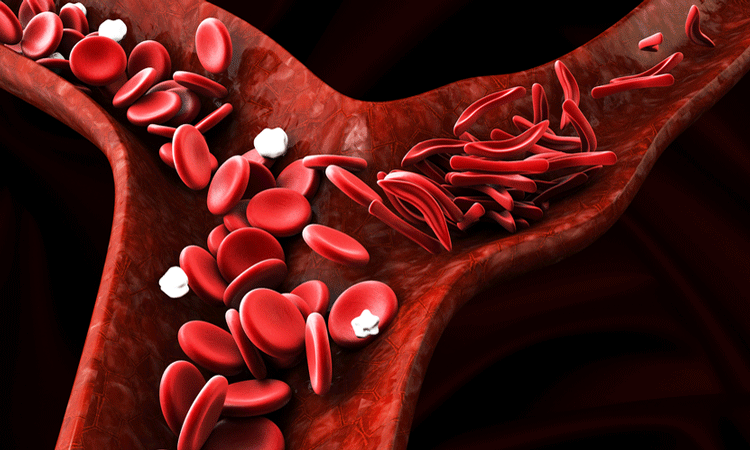
NewsNew CRISPR breakthrough could transform sickle cell treatment
Researchers at UNSW Sydney have unveiled a next-generation CRISPR tool that could lead to safer treatments for genetic disorders, including Sickle Cell.
-
 News
NewsFDA-approved asthma drug may protect against food allergy reactions
An existing asthma drug has been shown to almost completely prevent life-threatening allergic reactions to food in mice, after researchers found a previously unknown genetic pathway linked to anaphylaxis.
-
 News
NewsMast cells: new target for preventing meningitis and brain disease
Scientists at Washington University School of Medicine have discovered that mast cells – immune cells best known for triggering allergic reactions – also help protect the brain from bacterial and viral infections. This could have important implications for treating brain infections in the future.
-
 News
NewsNew 3D bioprinted lung tissue could transform respiratory research
UBC Okanagan researchers have developed a new 3D bio-printed lung model that closely mimics the complexity of human tissue – providing scientists with a powerful new tool for studying respiratory diseases.
-
 Article
NGS is evolving: collaboration and tech lead the way
Next-generation sequencing (NGS) is advancing fast – and it’s not happening in isolation. Strategic partnerships and automation are streamlining workflows and reshaping what's possible in genomics research.
-
 News
NewsMeet the hemifusome: a new organelle with big impact
Scientists have discovered a previously unknown organelle inside human cells - the hemifusome - that could change our understanding of rare genetic disorders.
-
News
New discovery shows how viral vectors release genes in therapy
Researchers at The University of Osaka have found how structural changes in the VP1 protein of AAV vectors trigger genome release - offering insights for improving the safety, efficiency and stability of gene therapy delivery systems.
-
 Article
How GPCR-targeting therapies are advancing the fight against inflammatory disease
Discover how Domain Therapeutics is using its deep knowledge of GPCR biology to create novel therapeutics with the potential to combat inflammatory diseases such as atopic dermatitis, IBD and arthritis.
-
 News
NewsSB000: a safer path to anti-aging therapies
Shift Bioscience has announced new aging research, highlighting the discovery of SB000. This novel single-gene target reverses cellular aging without activating dangerous pluripotency pathways.
-
 Article
Automated red blood cell exchange: bridging treatment gaps in sickle cell disease care
Despite the promise of gene therapies, automated red blood cell exchange (aRBCX) remains an underutilised therapy in the management of sickle cell disease (SCD). In this article, Dr Aaron Haubner and Carly Newton of Terumo Blood and Cell Technologies, highlight the urgent need for partnerships and equitable access to this ...
-
 News
NewsNew UCD centre targets the biggest bottleneck in rare research
The world’s first translational research center dedicated to urea cycle disorders (UCDs) has been launched in Zürich, marking a significant moment in rare disease innovation.
-
 News
NewsNasal spray gene therapy shows potential to treat lung diseases
Researchers at Mass General Brigham have developed a new gene therapy delivery system, AAV.CPP.16, that targets the lungs via nasal spray, which could offer a potential breakthrough in respiratory gene therapy.
-
 Article
AI at the forefront of age-related disease treatment
The body undergoes changes with age that can lead to conditions like sarcopenia and osteoarthritis, burdening individuals and healthcare systems. Find out how Rejuvenate Biomed uses AI to decode ageing biology and develop combination therapies targeting the root causes of age-related diseases, offering hope for better treatments and quality of ...
-
 Article
Cracking the code to scalable cell and gene therapy
Cell and gene therapy is rapidly transforming the treatment of complex diseases, yet scaling production efficiently remains a challenge. Dr Tia Harmon from PHC Corporation of North America explores the innovations that are optimising cell expansion to enhance the discovery of advanced therapies.
-
 News
NewsRepurposed anti-inflammatory drug may help treat alcohol use disorders
A new study by Scripps Research reveals that apremilast, an FDA-approved anti-inflammatory drug, may help reduce both alcohol consumption and pain sensitivity, offering a potential dual therapy for alcohol use disorder.
-
 News
NewsTargeting zombie cells: a new treatment for chronic back pain
McGill University researchers have found that two drugs can eliminate senescent “zombie cells” in spinal discs, offering a potential new treatment for chronic low back pain.