




Carterra’s new 48-channel SPR platform reimagines throughput, automation and data quality for modern discovery workflows.
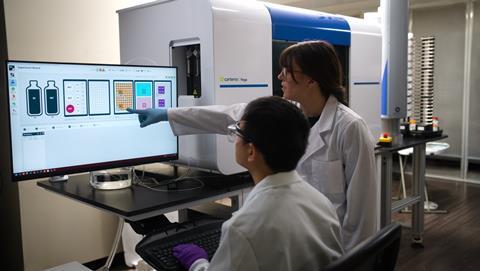
Surface plasmon resonance (SPR) has long been one of the most trusted techniques in drug discovery. For decades, it has given scientists direct, label-free insight into how molecules interact, supporting fragment-based screening, small molecule characterisation and antibody research with a level of kinetic detail unmatched by many other methods. Yet as essential as SPR has been, one limitation has remained stubbornly in place: throughput.
Today’s discovery environment looks very different from the one in which SPR first rose to prominence. AI-driven modelling, large-scale screening strategies and increasingly complex biological questions now dominate early research. These approaches depend on vast quantities of high-quality interaction data generated in real time. While the science has accelerated, traditional SPR platforms, largely capped at eight channels, have struggled to keep pace.
That gap narrowed significantly in February 2026, when Carterra introduced Vega, a next-generation SPR system built as a step change in the scale and speed of early discovery. Vega brings 48 parallel channels into a single instrument and, when paired with an optional robotic handler, can screen more than 20,000 compounds in just 24 hours. Automated operation allows experiments to run unattended, enabling researchers to execute multiple assay formats and workflows without constant manual intervention.
But Vega’s importance extends well beyond raw throughput. By changing how SPR fits into early discovery with its ‘many-on-few’ configuration, the platform reshapes timelines, expands experimental ambition and helps ensure that researchers have the data to make better decisions on drug candidates earlier in the process.
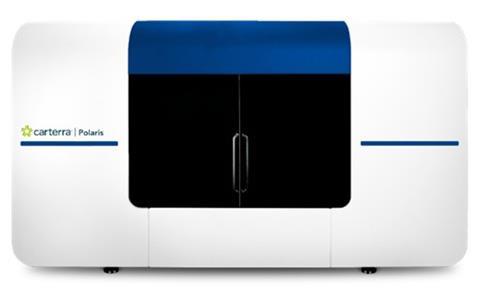
Carterra Vega™ delivers 48-channel parallel SPR, enabling high-resolution screening of more than 20,000 analytes per day.
Moving beyond the throughput trade-off
Until now, using SPR meant accepting a familiar compromise. Scientists could obtain highly detailed kinetic data, but only by working through limited compound sets and tightly focused targets. Large libraries were often impractical, forcing teams to choose between breadth and depth.
With Vega’s dramatically expanded parallelisation, researchers can now explore fragment and small molecule libraries at a much larger scale. This shift allows earlier, more comprehensive exploration of chemical space without sacrificing the kinetic detail that makes SPR so valuable.
At the same time, Vega builds on Carterra’s established one-on-many array architecture while adding many-on-few assay capabilities. This opens the door to label-free workflows commonly associated with previous eight-channel platforms, while preserving true real-time kinetic resolution. The result is a more flexible SPR system that supports a wider range of experimental designs within a single platform.
The result is a more flexible SPR system that supports a wider range of experimental designs within a single platform.
Higher 48-channel throughput makes it possible to screen entire libraries, uncover rare chemotypes, detect weak or fleeting interactions and map off-target binding profiles early, information that can shape lead optimisation and de-risk programmes long before candidates reach the clinic.
Aligning SPR with AI-driven discovery
Vega arrives as AI and machine learning take on a central role in drug discovery workflows. These models thrive on clean, consistent, high-resolution data, yet generating such datasets experimentally has become increasingly challenging amid tighter budgets, limited sample availability and pressure to deliver results faster.
By producing large volumes of high-fidelity binding data, Vega directly supports this new paradigm. The system can detect interactions involving analytes as small as 100 Da and operate at temperatures down to 10°C, allowing researchers to capture subtle molecular behaviours that are often invisible in higher temperature or lower sensitivity assays. Weak fragment interactions, in particular, can reveal previously unrecognised binding pockets that inspire entirely new design strategies.
The system can detect interactions involving analytes as small as 100 Da and operate at temperatures down to 10°C, allowing researchers to capture subtle molecular behaviours that are often invisible in higher temperature or lower sensitivity assays.
Because Vega’s data are generated in real time and at scale, they integrate naturally into computational pipelines. This strengthens the feedback loop between in silico modelling and experimental validation, improving predictive accuracy and accelerating iteration. For machine learning frameworks, the platform provides a higher quantity and quality of data, enabling teams to reduce uncertainty earlier and advance higher-quality molecules.
Accelerating the path to patients
While Vega represents a major advancement in SPR technology, its ultimate value lies in its downstream impact. By expanding what is possible in early discovery, the platform increases the likelihood that promising therapeutic candidates are identified sooner, optimised more intelligently and progressed with stronger supporting evidence.
This acceleration matters most to patients. For those facing rare diseases with few treatment options, aggressive cancers that demand precise targeting or chronic conditions that remain inadequately addressed, shortening the journey from scientific insight to effective therapy can be transformative.
By equipping researchers with deeper molecular understanding and feeding AI models with the data they require to perform at their best, Vega enables a more ambitious, more informed approach to drug discovery, one that aligns technological innovation with the urgent need for better medicines.
About Carterra
Carterra® is a leading provider of innovative technologies designed to accelerate drug discovery and development, enabling faster medicines to reach patients. Carterra’s high throughput LSA®, LSA-XT, Carterra Ultra® and Carterra Vega™ instrument platforms are integral in monoclonal antibody (mAb) screening and characterisation, and small molecule screening and lead discovery. They combine patented microfluidics technology with real-time high throughput surface plasmon resonance (HT-SPR) and industry-leading kinetic and epitope analysis and visualisation software. The technology can deliver up to 100 times the data in 10 percent of the time while using only 1 percent of the sample compared with existing platforms.
Carterra’s technology provides customers with screening and characterisation throughput and functionality that matches the output from state-of-the-art antibody expression platforms and AI-based drug development workflows. This enables all candidates in a library to be rapidly and comprehensively screened early in the discovery process so that unique epitopes and potential novel therapeutic candidates can be identified, while expanding and enhancing intellectual property coverage. Carterra’s technology condenses months of work into a few days.















No comments yet