




A protein can look very different in disease without a single change to its sequence. Measuring these structural changes could reveal drug targets invisible to genomic and expression data alone.
Artificial intelligence (AI) has changed what researchers can learn about protein structure. Advances in structure prediction mean three-dimensional models can now be generated from amino acid sequences at a scale that would have been difficult to imagine using experimental structural biology.
A predicted structure, however, does not necessarily show how a protein behaves in disease.
Proteins are dynamic. Their shape can change in response to signalling, binding partners, cellular stress, post-translational modifications and the surrounding biological environment. The same protein sequence could therefore adopt different conformations in healthy and diseased tissue.
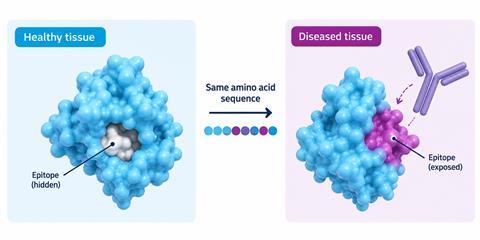
Changes in protein conformation can expose binding sites or epitopes that are inaccessible in healthy tissue, creating potential therapeutic targets without any change in the underlying genetic sequence or protein abundance.
Dan Benjamin, Co-Founder and Chief Technology Officer at Immuto Scientific, is investigating these disease-associated protein conformations using structural proteomics, mass spectrometry and AI. Benjamin explains why experimental structural data could help researchers find targets that sequence and expression studies alone may not reveal.
What protein prediction cannot see
AI structure models are also shaped by the structural data available to train them.
“The advances in protein structure prediction have been remarkable,” he said. “The limitation is not that these models are poor at what they were built to do. It is that they can only learn from the structural information available to them.”
Much of the experimental structural data used to train these models comes from purified proteins studied outside their native biological environment. These experiments provide valuable structural information, but they may not capture the different conformations a protein adopts inside a living cell.
The advances in protein structure prediction have been remarkable.
A tumour, for example, can have altered signalling, metabolic stress and protein interactions. These conditions may change the conformation of a protein even when its amino acid sequence remains the same.
“A protein in a tumour can therefore adopt a different conformation from the same protein in healthy tissue, even though the sequence is identical,” Benjamin explained.
If these disease-associated states are absent from the underlying structural data, computational models may struggle to predict them reliably.
For Benjamin, this changes the question researchers need to ask of AI.
“Not just how sophisticated is the model, but what biological information are we giving it?”
Finding targets without a sequence change
Drug target discovery has traditionally drawn heavily on genomic and expression data. Researchers might look for a mutation associated with disease or a protein that is expressed at higher levels in diseased tissue.
Disease-associated protein conformations create another possibility.
In disease, altered signalling, protein-protein interactions, post-translational modifications, abnormal multimerisation or receptor activation can shift these states.
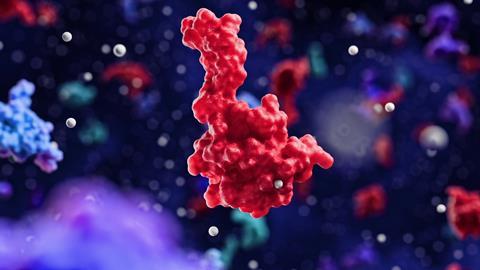
The resulting structural change may alter which parts of the protein are accessible at its surface.
“What is interesting from a drug discovery perspective is that the sequence of the protein may not change at all,” Benjamin said. “What changes is its shape and that can expose an epitope that is inaccessible in the healthy state.”
An epitope is a region of a protein that can be recognised by an antibody. If an epitope is preferentially exposed in diseased cells but inaccessible in healthy cells, it could provide a way to target the disease-associated form of the protein more selectively.
What is interesting from a drug discovery perspective is that the sequence of the protein may not change at all.
This creates a different route to target identification. Rather than asking only whether a protein is mutated or differentially expressed, researchers can investigate whether disease changes its structure in a therapeutically useful way.
“That opens a target space that conventional genomic and proteomic approaches largely cannot see,” Benjamin explained.
Adding structure to proteomics
Immuto describes its approach as structural surfaceomics, which Benjamin characterises as bringing structural biology to the scale of proteomics.
Conventional proteomics can identify which proteins are present in a sample and measure differences in their abundance. What it generally cannot determine is the structural state those proteins occupy.
Immuto uses chemical labelling in living cells and disease-relevant models to measure which regions of surface proteins are exposed or protected. Mass spectrometry is then used to detect these modifications and compare structural patterns between biological conditions.
These comparisons could include healthy and diseased cells or treatment-sensitive and treatment-resistant states.
The measurements do not provide a complete atomic structure of every protein. Instead, they generate experimental constraints that provide information about which regions of a protein are accessible in a particular biological context.
“The mass spectrometry data do not simply give us a complete atomic structure,” Benjamin explained. “They give us empirical structural constraints at high throughput.”
Those constraints can then be integrated with computational models to build a representation of how the protein may exist under the biological condition being studied.
Importantly, this could reveal differences between disease states even when conventional measurements show little change in sequence or protein abundance.
KEY TAKEAWAY
The same protein, at the same abundance, can create a different therapeutic opportunity depending on its structural state.
Giving AI experimental constraints
This is also where Benjamin sees a useful role for AI.
Rather than asking computational models to infer disease-associated protein structures without experimental evidence, structural measurements can constrain the range of possible solutions.
“I think the most useful role for AI here is to work with the experiment, rather than trying to replace it,” he said.
On the target discovery side, computational methods can help analyse structural measurements across many proteins, identify patterns and prioritise structural changes associated with disease.
I think the most useful role for AI here is to work with the experiment, rather than trying to replace it.
Once researchers identify a disease-associated epitope, the problem of designing a therapeutic becomes more specific.
“Instead of asking an AI system to design an antibody against an entire protein, we can give it empirical information about the specific residues and structural region we want the antibody to recognise,” Benjamin explained.
Experimental constraints could also help with antibody-antigen modelling. Computational co-folding models can generate several plausible structures for an interaction, but determining which prediction represents the biologically relevant state can remain difficult.
Even a relatively small amount of experimental information about the interaction could help narrow those possibilities.
“The experiment grounds the model in reality and the model allows us to make much more use of the experimental data,” Benjamin said.
Finding new targets in drug-resistant cancer
Treatment resistance provides one example of where structural changes could reveal therapeutic opportunities.
Immuto has studied patient-derived models of EGFR-mutant non-small cell lung cancer, including cancer that had developed resistance to the EGFR inhibitor osimertinib. Comparing treatment-sensitive and resistant models revealed structural changes across the cell surface.
Some of those differences were not defined simply by proteins appearing, disappearing or changing in abundance. Instead, proteins had adopted different conformations in the treatment-resistant state.
“That matters because if you were looking only at sequence or expression, those proteins might not stand out as targets,” Benjamin explained. “Structurally, however, the resistant cells can expose features that are different from the treatment-sensitive state.”
Such differences could create epitopes that allow therapeutics to distinguish between biological states.
Structurally, however, the resistant cells can expose features that are different from the treatment-sensitive state.
Benjamin sees potential applications for antibodies, antibody-drug conjugates (ADCs), multispecifics and other targeted biologics designed to recognise disease-associated conformations.
The example also illustrates how structural analysis can add another layer to the study of treatment resistance. Structural changes associated with altered cellular biology may provide another source of potential targets.
KEY TAKEAWAY
Drug resistance may change more than which proteins are present – it can change the structural features available for therapeutic targeting.
Moving from one structure to many states
Benjamin expects experimental and computational structural biology to become more closely integrated over the next five years.
Traditional structural methods can provide highly detailed information, but applying them across large numbers of proteins, interactions and biological conditions is difficult. Higher-throughput experimental approaches could generate structural measurements across a much wider range of biological states.
AI could then use those data to improve modelling, while computational predictions could help determine which additional experiments would provide the most useful information.
“I think the more powerful model is a continuous loop between the two,” Benjamin said.
Rather than trying to determine a single canonical structure, the aim could be to understand how the same protein changes between healthy and diseased tissue, treatment-sensitive and resistant states or activated and resting cells.
“The biggest opportunity is moving from predicting a canonical protein structure to understanding how that protein changes across biological states,” Benjamin explained.
Achieving that will require structural datasets that capture more of the biological contexts in which proteins actually function.
For AI-enabled drug discovery, better algorithms may therefore be only part of the answer. Experimental data showing how targets change in disease could help computational models move from predicting what a protein could look like to identifying the structural states that matter for drug discovery.










No comments yet