


The strongest disease signal may not point to the best drug target. AI could help researchers identify what matters within complex biological networks.
Complex diseases such as cancer and neurodegenerative disorders can involve multiple interacting genes, pathways and biological processes. For early drug discovery, this makes identifying which parts of the underlying biology represent useful therapeutic targets particularly challenging.
Artificial intelligence (AI) could help researchers navigate this complexity by identifying combinations of biological factors that may be difficult to detect when genes, biomarkers or other variables are considered individually.
Dr Joseph Geraci, Co-Founder and Chief Scientific and Technical Officer at NetraMark, has a background spanning mathematical physics, AI and medicine. His work has included research in oncology and more than a decade developing AI tools to understand heterogeneous patient populations. He is also an Associate Professor of Molecular Medicine at Queen’s University.
Geraci argues that understanding complex disease requires looking not only at individual biological factors, but at how they interact.
“Complex diseases emerge from interacting systems,” he says. “A gene may matter enormously in one biological context and very little in another.”
What this means for target discovery
- Disease association is only the start – A gene associated with disease may not be the most suitable target for therapeutic intervention.
- Context can change a target’s importance – A gene may be important in one biological network or patient group, but less relevant in another.
- Networks can inform prioritisation – Understanding how genes and pathways interact could help researchers identify which parts of disease biology warrant further target validation.
Understanding interacting biology
One reason this is difficult is disease heterogeneity. Patients who share the same diagnosis can differ in the biology underlying their disease, potentially obscuring mechanisms that are important in particular groups.
Geraci argues that this becomes particularly problematic when biological diversity is reduced to an ‘average patient’.
Signals associated with particular groups can become lost when heterogeneous populations are analysed together, while individual biomarkers may fail to capture combinations of factors that contribute to disease or treatment response.
AI provides one way of examining these relationships across multiple types of data.
NetraMark’s NetraAI platform analyses genomic, imaging and clinical information to identify combinations of variables. According to Geraci, the approach does not require researchers to define a biological subgroup in advance, allowing the model to identify relationships within the data that may differ from existing diagnostic categories.
“Instead of asking, ‘Which gene causes this disease?’ we can begin asking, ‘What system of interacting factors produces this particular form of the disease in this particular group of patients?’” Geraci says.
In an open-science study of amyotrophic lateral sclerosis (ALS), a progressive neurodegenerative disease affecting nerve cells that control voluntary movement, the platform identified interacting biological systems associated with disease, including processes related to neuronal health and inflammation. These systems-level relationships can be difficult to detect when variables are examined independently.
For drug discovery, however, uncovering a network of disease-associated biology raises another question – which parts of that network should researchers actually target?
Prioritising targets within biological networks
As the number of genes and biological variables under investigation increases, the number of possible interactions between them grows rapidly. Identifying a network is therefore only the beginning. Researchers still need to distinguish relationships that could be therapeutically relevant from those that are less important to disease.
“The real challenge is not simply collecting more data, but identifying which combinations actually matter,” Geraci explains.
Geraci says NetraAI is designed to identify compact combinations of variables that work together and help define differences between patient populations. Potential targets can then be assessed according to their influence within these networks.
This also means considering how widely connected a potential target is to other biological processes.
“If a gene is connected to everything in the body, hitting it with a drug could disrupt multiple healthy pathways and cause severe, toxic side effects,” Geraci says.
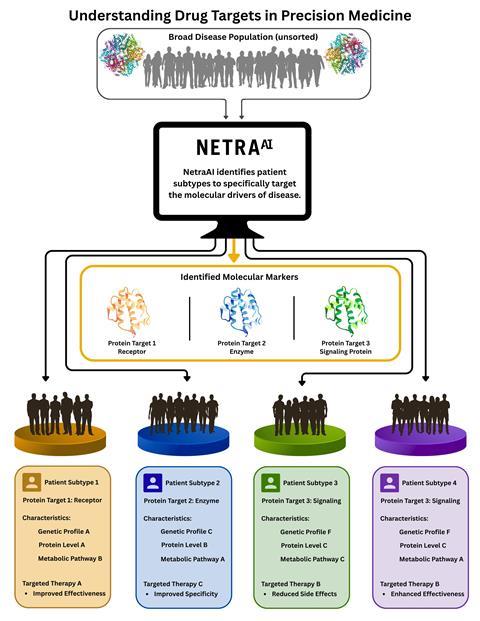
A highly connected gene may influence multiple biological systems, meaning that targeting it could have widespread effects. A more specific target may interact with fewer systems, potentially reducing off-target effects.
If a gene is connected to everything in the body, hitting it with a drug could disrupt multiple healthy pathways and cause severe, toxic side effects.
Looking at a potential target within its wider biological network could therefore provide information beyond whether it is simply associated with disease. It could help researchers assess its role within the system and generate more focused hypotheses about which biology should progress into experimental target validation.
But the usefulness of these findings depends on whether the relationships identified by AI represent genuine biological signals rather than patterns generated by noisy data.
Finding signals in small, noisy datasets
This presents a particular challenge in biomedical research, where datasets can contain hundreds of clinical, genomic and imaging variables but relatively few patients.
Geraci describes this as the classic small n, large p problem – a small number of observations compared with a large number of variables.
Under these conditions, AI models can overfit, learning patterns specific to the data on which they were trained rather than relationships that generalise to new data.
“The AI ends up memorising the scratches on the paint instead of understanding the motor,” Geraci says.
Geraci says standard machine-learning on unprocessed Phase II trial datasets, benchmarked by NetraMark, produced predictive accuracies ranging from 0.27 to 0.62. He states that with small medical datasets, models can learn from noise such as administration errors, symptom fluctuations and placebo responses rather than identifying the underlying biological signal.
The AI ends up memorising the scratches on the paint instead of understanding the motor.
For discovery researchers, finding a pattern is only useful if it holds up when tested.
Separating biological signal from noise
One way of addressing this problem is to avoid requiring a model to classify every observation.
NetraAI uses an approach Geraci calls algorithmic abstention, or a ‘no call’ option. Rather than forcing ambiguous or highly heterogeneous observations into a category, the system can classify them as unknown. The aim is to reduce the influence of uncertain data when identifying more stable relationships.
Even then, a computationally identified relationship needs to hold up when tested against unseen data.
Geraci says a portion of the data is withheld during model development, allowing identified relationships to be tested against observations the model has not previously encountered.
“If a discovered subgroup persona cannot survive this rigorous stress-testing and replicate its effect size on the unseen data, we throw it out,” he says.
As larger human datasets become available, Geraci expects them to become increasingly valuable for identifying biological networks and potential targets. However, he states that these resources will still need methods capable of identifying interactions between variables and distinguishing meaningful relationships from noise. A reproducible computational signal, however, is still not the same as a validated drug target.
If a discovered subgroup persona cannot survive this rigorous stress-testing and replicate its effect size on the unseen data, we throw it out.
From AI output to discovery decisions
AI can help researchers generate hypotheses about interacting genes, pathways and potential targets, but the resulting relationships still need to make biological sense and withstand further investigation.
For Geraci, this makes explainability important. If researchers are going to use computational findings to inform discovery decisions, they need to understand which variables contributed to them and be able to assess whether the underlying biology is plausible.
“A black-box model that predicts an outcome without showing the biology behind it has limited usefulness when scientists need to make decisions about the next clinical trial,” he says.
AI therefore does not remove the need for target validation or scientific judgement. Instead, its role could be to narrow complex biological information into relationships and hypotheses that researchers can interrogate and test experimentally.
“AI should remain augmented intelligence rather than an autonomous oracle,” Geraci concludes. “The computer should expose relationships that are difficult for humans to discover on their own, but the output needs to be transparent enough that biologists, clinicians and statisticians can interrogate it, challenge it and decide what is worth pursuing.”








No comments yet