



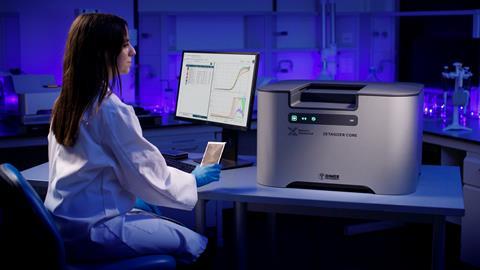

Stability problems can derail promising biologics late in development. Bringing high-throughput testing earlier into discovery could help researchers identify risks before they become costly failures.
Streamlining the development of biologics depends on access to reliable stability information early in the discovery process – and that means using equipment that can handle large numbers of samples easily. Dr John Stenson from Malvern Panalytical examines the limitations of existing equipment for stability testing using differential scanning fluorimetry (DSF), dynamic light scattering (DLS) and static light scattering (SLS), describing how new instrument advances promise to accelerate sample throughput, reduce costs and minimise the risk of failures due to poor data quality.
Stability testing remains a big risk factor in the development of biologics. But why is this?
First of all, there’s no doubt that monoclonal antibodies and other proteins are challenging molecules to deal with. As well as being structurally complex, they are highly sensitive to factors including pH, concentration, temperature, viscosity, buffer chemistry, excipients, conditions at phase boundaries and more. And what’s worse, all of these can interact in ways that are difficult to predict, increasing the need to reliably assess both conformational and colloidal stability through a suite of real-world tests.
Clearly, the earlier this information is available, the better. But the trouble is that most of these interactions aren’t caught by the binding and activity assays that have historically dominated early screening. That creates a real risk that time and money are expended on a promising candidate, only for it to fail later in lead optimisation or preclinical development when more rigorous stability tests are carried out.
So, how are companies attempting to reduce the risks associated with stability testing?
Increasingly, to close this ‘information gap’, stability testing is now being introduced at an earlier stage, in the window between hit confirmation and lead nomination. At this stage, the candidate pool is still broad enough to make meaningful selections, and the cost of eliminating a problematic molecule is a fraction of what it will be later down the line.
But for this approach to be effective, a large number of molecules at low concentrations must be studied in numerous buffers and under a wide range of environmental conditions – which translates to a need for high-throughput analysis. This is a major challenge in itself, but just as important is the need for the data to be trustworthy, to reduce the risk of a fluke result or human error leading to a good candidate being discarded. Achieving all this stretches existing analytical technologies to the limit, but new solutions are now coming forward.
How can we improve sample throughput while also maintaining data quality?
The answer to the throughput challenge lies in moving away from single-measurement formats. Let’s consider DLS, which is popular for stability testing for biologics because it’s a quick, non-destructive way of determining the diffusion interaction parameter kD. It can also measure the particle size distribution and the aggregation temperature Tagg, so it’s a versatile technique.
Historically, DLS measurements were performed on individual samples, which was fine for late-stage biologics testing, but of limited use for early-stage testing. However, the introduction of standard plate-based formats for DLS has transformed DLS into a highly scalable technique, and indeed to align with customer demand we’ve just released our new Zetasizer Core, which accepts standard 96-, 384- and 1536-well plates.
Having plate-compatible instruments enables you to not only boost your sample capacity, but also integrate acquisition with existing robotics used for automated plate preparation. In a stroke, that allows you to move up a couple of gears in terms of throughput and boosts the confidence in your DLS data by dispensing with manual handling.
Can these throughput enhancements also be applied to SLS?
It’s a good question to ask, because using SLS to determine the second virial coefficient B22 has a reputation as being difficult and slow, which leads many to instead use kD data obtained on their DLS instruments as a proxy. The main issue with doing this is that the influence of hydrodynamic friction upon kD means that it isn’t always a reliable proxy for intermolecular interactions. Worse still, the single-photon sensors used in many DLS systems become saturated at higher photon fluxes, meaning that the detector response stops being linear as you move up the concentration series.
Either way, the data has to be manipulated back into linearity, meaning that the results generated are low-quality – to the point where manufacturers of some DLS instruments don’t even promote the option to generate data on intermolecular interactions, because they know the results can’t be relied upon.
So here we have big challenges both in workflow and data quality, but the good news is that both can be tackled in one go. The crucial change is to use a dedicated SLS photodiode detector that has a linear response across the full range of interest. This way, we’re obtaining B22 data directly, meaning that data distortion is avoided and the results are inherently more trustworthy. It also means that you dramatically reduce the need for calibration, making the whole process much faster, more easily automated – again in a plate format – and allowing measurements to be acquired by staff without years of experience.
The role of DSF in stability workflows is also changing. But where is it going?
Over recent years, the speed, ease of use and data quality of DSF has meant that it’s become an appealing alternative to differential scanning calorimetry for determining protein unfolding. But rollout of DSF earlier in stability workflows has been hampered by the inability to run samples at speed in bulk – an issue compounded by the use of custom sample holders, which can be expensive, running into hundreds of dollars. So to overcome both these limitations, on the Zetasizer Core it’s possible to use industry-standard microwell plates, in exactly the same way as for DLS and SLS.
Another advantage of the Zetasizer Core is that it uses intrinsic DSF, which allows signals to be generated from proteins themselves without the complication of needing to add fluorescent dyes, as is needed for extrinsic analysis. So I see intrinsic DSF as having an increasing role early on in stability workflows as an initial screen to flag potential issues, with the gold-standard DSC being used as a follow-up.
I should add that the resolution of DSF data is also improving, and that’s important because it opens the possibility of seeing minor unfolding events. Such events – for example, at near-ambient temperatures – could be an early signal of a more critical instability under therapeutic conditions, once again reducing the risk of a failure being uncovered further down the road.
Taking the broader view for a moment, doesn’t bringing more analytical methods on board mean greater workflow complexity?
No, not necessarily, because instrument manufacturers are stepping up to the challenge of biologics and developing systems tailored to the needs of early-stage stability testing. So the Zetasizer Core uses integrated optics within the scanning head to make DLS, SLS and DSF measurements simultaneously in a single run. This is not only super-quick, but it allows protein aggregation and conformational stability to be interpreted together rather than having to be correlated across separate experiments.
To be clear, the need for multiple instruments in stability workflows isn’t going away any time soon. But by integrating the most informative analytical techniques into a single platform, it becomes possible to quickly screen larger numbers of samples early on during discovery, with more in-depth analysis of the most promising samples positioned later in the workflow.
This all sounds like a promising approach to de-risking stability measurements, so what does the future hold?
The need for high-throughput and better data quality is a trend that’s only going to accelerate, as pharma moves towards more advanced biologics such as fusion proteins and antibody–drug conjugates, which are likely to have even more tightly-defined stability windows. Separately, automation through robotics and AI has already made a massive difference to discovery workflows in small-molecule pharma, and it’s now starting to have an impact on biologics too.
From my perspective, we can’t allow those advances to be held up by limitations in assessing stability. That’s where manufacturers like Malvern Panalytical are at the forefront of a new trend, by providing instruments that maximise scalability, minimise time-to-results, and importantly keep data quality high and risk levels low. All this without requiring years of expertise to run the equipment. In my view, this is where we have a major role to play in helping pharma companies get ahead in the race to develop effective biologic drugs.
Find out more about the Zetasizer Core on the Malvern Panalytical website: https://bit.ly/4xBvlMg










No comments yet