



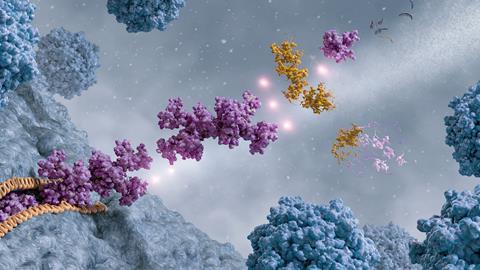

Traditional screening methods have delivered countless medicines, yet many intracellular targets remain stubbornly out of reach. We spoke with Dr Rab Prinjha, Chief R&D Officer at Curve Therapeutics, about the limitations of conventional approaches and the growing promise of intracellular screening.
The pharmaceutical industry is well versed in identifying disease-associated proteins and generating molecules capable of binding to them. Advances in genomics, functional biology, structural biology and high-throughput screening have enabled the identification of new therapeutic targets and a deeper understanding of disease mechanisms.
Yet despite these advances, many biologically important intracellular targets remain difficult to drug. Some estimates suggest that as many as 80 percent of biologically relevant intracellular targets may still be beyond the reach of conventional drug discovery approaches, leaving significant therapeutic opportunities unexplored.
What is preventing researchers from accessing these targets? To find out, Drug Target Review asked Dr Prinjha about the limitations of conventional discovery approaches and how screening directly within mammalian cells might offer a superior way forward.
The limitations of conventional screening
For more than three decades, high-throughput screening has played a central role in small-molecule drug discovery. These technologies have enabled researchers to evaluate hundreds of thousands, and in some cases millions, of compounds against disease-associated targets.
More recently, technologies such as affinity selection mass spectrometry (AS-MS) have expanded researchers’ ability to identify molecules that bind to challenging targets. However, these methods typically rely on isolated proteins that have been removed from their native biological environment.
“Since these isolated proteins have been removed from their natural function-assisting partners and lack relevant activity-activating modifications, it is perhaps not wholly surprising that many important targets will long remain difficult to drug conventionally,” explained Prinjha.
Since these isolated proteins have been removed from their natural function-assisting partners and lack relevant activity-activating modifications, it is perhaps not wholly surprising that many important targets will long remain difficult to drug conventionally.
This can create a significant challenge. While isolated proteins may be suitable for biochemical screening, they often fail to capture the complexity of how proteins behave within living cells.
Throughout his successful career in pharmaceutical research, including leadership roles at GSK, Prinjha experienced this problem repeatedly.
“Even though we successfully advanced more than 30 small molecules, antibodies and bispecifics into late-stage clinical studies, I was often frustrated by the many occasions when we identified a promising new disease target,” he said.
“We successfully identified potent and selective inhibitors through conventional HTS campaigns, but after significant optimisation work, we found that the molecules failed to deliver the biology required of functional drugs.”

Why cellular context matters
As scientific understanding of disease biology continues to deepen, researchers are now recognising the importance of studying proteins within their natural environment.
“Proteins do not function in isolation. The more we learn about biology, the clearer it has become that proteins depend on context, location and partnerships to function appropriately in normal cells and even more so in disease cells,” he said.
These factors can directly affect druggability. The presence of interacting proteins, nucleic acids or disease-specific modifications may expose binding pockets that are absent in isolated proteins. Conversely, pockets identified in biochemical assays may not exist in the same form within living cells.
Proteins do not function in isolation. The more we learn about biology, the clearer it has become that proteins depend on context, location and partnerships to function appropriately in normal cells and even more so in disease cells.
“In particular, the presence of partner proteins or target nucleic acid sequences can fundamentally alter the formation and exposure of cryptic druggable pockets and hence the druggability of the protein,” said Prinjha.
This growing appreciation of protein context is helping to drive interest in discovery approaches capable of evaluating targets within living cells rather than relying exclusively on purified proteins and simplified assay systems.
Moving discovery into mammalian cells
One emerging strategy involves screening directly inside mammalian cells.
Rather than testing compounds against isolated proteins, researchers can evaluate their effects while targets remain embedded within their natural biological networks. This allows proteins to be studied in the presence of relevant binding partners, signalling pathways and disease-associated modifications.
Instead of simply identifying molecules that bind a target, researchers can focus on finding compounds that generate a desired biological response.
“We consider the ultimate aim of drug discovery to be identifying and progressing functional modulators of disease proteins, and not just potent but potentially inactive binders,” Prinjha explained.
The growing interest in cyclic peptides
Alongside advances in cellular screening, interest in cyclic peptides, particularly macrocycles, has increased significantly across the industry.
Traditional small molecules remain highly effective for many targets, particularly those with well-defined binding pockets. However, many intracellular proteins function through large protein-protein interactions or dynamic structural interfaces that can be difficult for conventional small molecules to engage.
Cyclic peptides are ring-shaped molecules that sit between traditional small molecules and larger biologic therapies in terms of size and complexity. They occupy a broader and more diverse chemical space than conventional small molecules, allowing them to engage intracellular targets that can be difficult to access using either small molecules or biologics.
From within the cyclic peptide class, macrocycles have emerged as perhaps the most intriguing, and have attracted substantial interest from investors and pharma alike. The hope is that these molecules can combine the cell permeability and oral bioavailability of small molecules with the high specificity and target affinity often associated with biologic therapies.
“The ability of cyclic peptides to make multiple contacts with target proteins, specifically inhibit protein-protein interactions and allosterically alter biological function through cryptic or induced pockets is far greater than that of small molecules,” said Prinjha.
Curve is a unique player in the macrocycle space. It has developed Microcycles®; compact, rigid macrocycles typically comprising five to 11 amino acids and designed to behave like a small molecule, thus enabling the discovery of novel therapeutic candidates against challenging intracellular targets.
Curve’s proprietary Microcycle discovery platform presents a differentiated approach to unlocking intracellular targets. It allows for functional pooled screening inside of a mammalian cell, where targets are presented in all of their dynamic and disease-relevant forms, and libraries can be screened and enriched on the basis of their biological function.
Choosing the right intracellular targets
Although new technologies are expanding the range of druggable proteins, target selection remains critical.
For Curve, prioritisation begins with strong human genetics, functional genomics and translational evidence linking a target to disease biology.
“We look for those with a viable clinical progression path that aligns with our ability to pursue them competitively, either alone or in partnership,” Prinjha explained.
The company also evaluates whether suitable cellular readouts can be developed for its screening platform before advancing a programme.
What comes next?
Researchers are continuing to develop new technologies for tackling previously inaccessible intracellular targets.
Efforts are underway to improve the cellular permeability, oral bioavailability and pharmacokinetic properties of cyclic peptides and macrocycles, while advances in protein engineering are creating new opportunities to engage challenging disease targets.
AI and ML are undoubtedly becoming indispensable tools in the drug discovery and development arsenal.
Artificial intelligence and machine learning are also playing an increasingly important role across drug discovery, influencing activities ranging from target identification and data analysis to compound design and optimisation.
“AI and ML are undoubtedly becoming indispensable tools in the drug discovery and development arsenal,” said Prinjha.
More fundamentally, researchers are recognising that proteins cannot be fully understood in isolation. As interest in intracellular targets continues to grow, the ability to study proteins within their native cellular environment could help researchers access new areas of the druggable proteome and uncover therapeutic opportunities that have previously remained out of reach.











No comments yet