


Scientists at Memorial Sloan Kettering Cancer Center have identified DHRS7 as the gene encoding a long-elusive enzyme in the 5-oxoETE inflammatory signalling pathway, uncovering an unexpected protective function.
Researchers have identified a human gene responsible for producing an enzyme involved in a critical inflammatory signalling pathway, solving a scientific puzzle that has persisted for more than 30 years.
The discovery, published in Nature, reveals that the pathway does more than recruit immune cells to sites of infection or injury. It also protects healthy cells from damage caused by the inflammatory response itself.
The findings from Memorial Sloan Kettering Cancer Center (MSK) could help researchers better understand conditions involving uncontrolled inflammation, including cancer, inflammatory bowel disease (IBD) and asthma.
The study also highlights the importance of choosing the right experimental model, with zebrafish enabling researchers to investigate a pathway that cannot be studied in the same way in mice.
A missing enzyme and an unexpected model
Researchers at McGill University first investigated 5-oxoETE, a fatty signalling molecule that attracts immune cells to sites of infection, in 1992. Although scientists could observe an enzyme producing and breaking down the molecule, they could not identify the human gene responsible for making it.
Without knowing the gene, researchers were limited in their ability to manipulate the enzyme and investigate its role in disease.
The mystery was finally resolved by Yanan Ma, a postdoctoral researcher at MSK’s Sloan Kettering Institute, building on earlier work by former colleague King Lam Hui. By screening candidate genes in human cells and silencing them individually, the researchers found that disabling DHRS7 eliminated the enzyme’s activity, identifying it as the gene responsible.
The team also discovered why previous attempts to investigate the pathway in mice had been unsuccessful. Mice lack a known receptor on their immune cells that can bind to 5-oxoETE, meaning the pathway cannot be studied in the same way as in humans.
Instead, the researchers turned to zebrafish, where the pathway remains intact.
“Mice and rats are the primary model used in biomedical research,” says Dr Ma. “It makes sense – they’re mammals, and there’s about an 80 percent overlap between their genes and ours. But in mice, there’s no known receptor on their immune cells that the alarm signal – 5-oxoETE – can bind to. This means that you can’t study the pathway in mice, but the pathway is intact in fish. So picking the right alternative model was critical to advancing our understanding of how the human body responds.”
From inflammatory alarm to cellular protection
The breakthrough took an unexpected turn when another MSK postdoctoral researcher, Miklos Lengyel, was studying colitis in zebrafish.
When he disabled hcar1-4, the fish version of the human OXER1 gene, he expected inflammation to decrease because the receptor that detects 5-oxoETE had been removed.
Instead, the fish developed spontaneous intestinal inflammation, even without an infection. Removing neutrophils, immune cells that typically respond to inflammatory signals, did not resolve the problem.
The researchers then found that silencing DHRS7, which prevents the production of 5-oxoETE, also increased inflammation.
“It made absolutely no sense,” said Dr Lengyel. “I had to prove using several different methods before the rest of the lab was convinced.”
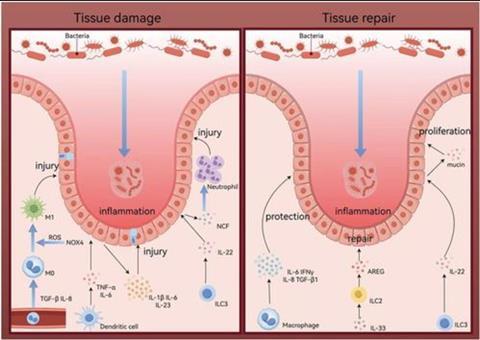
The findings revealed a second function for the pathway: protecting healthy cells from the damaging effects of inflammation.
When the pathway was disrupted, intestinal cells became vulnerable to low-level chemical stress caused by normal gut bacteria. The team traced this protective effect to NUDIX hydrolases, a family of enzymes that remove damaged DNA building blocks before they can cause further problems.
Without this protective mechanism, cellular damage triggered cell death and inflammation, even when no external infection was present.
“As it turns out, this signal isn’t just an alarm, it’s also a shield,” said Dr Niethammer.

Implications for cancer and inflammatory disease
The findings could have implications for diseases in which inflammatory signalling becomes disrupted. According to the researchers, mutations in DHRS7 and OXER1 have been identified in gastrointestinal and uterine tumours. Non-functional versions of OXER1 have also been associated with poorer outcomes in colorectal, pancreatic and kidney cancers.
The pathway may also be relevant to IBD and asthma, which involve inflammation affecting protective mucosal linings. Lower levels of 5-oxoETE in intestinal tissue have been linked to worse outcomes in IBD, while an independent study of asthma in primates found that blocking OXER1 reduced immune cell responses but also led to the loss of protective mucus-producing airway cells.
“More research is needed, but there’s a possibility that activating the pathway could increase the resilience of the gut to oxidative stress — which might help counteract damage caused by radiation therapy or chemotherapy,” Dr Lengyel says.
The team is also investigating how physical injury activates the same pathway. Mechanical stress on cell membranes releases arachidonic acid, which provides the raw material for producing 5-oxoETE. Oxidative stress then drives its conversion, with DHRS7 amplifying the signal.
Further research will now be needed to establish whether manipulating this pathway could lead to treatments that protect healthy tissue without compromising the immune system’s ability to fight infection or cancer.










No comments yet