

By organising recent evidence around a ‘peribiliary immune niche’, a new review identifies three overlapping processes – immune initiation, effector amplification and regulatory failure – that may explain chronic inflammation in primary biliary cholangitis.
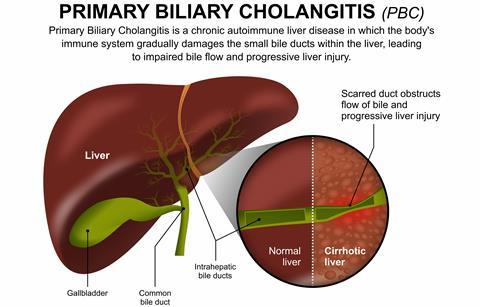
A new review of primary biliary cholangitis (PBC) has highlighted how interactions between immune cells and bile duct cells drive chronic inflammation, potentially leading to more personalised treatments.
PBC is a chronic autoimmune disease that destroys small bile ducts inside the liver, causing cholestasis and potentially leading to fibrosis, cirrhosis and liver failure. It predominantly affects middle-aged women, with an estimated global annual incidence of 1.8 cases per 100,000 people and a prevalence of 18.1 per 100,000.
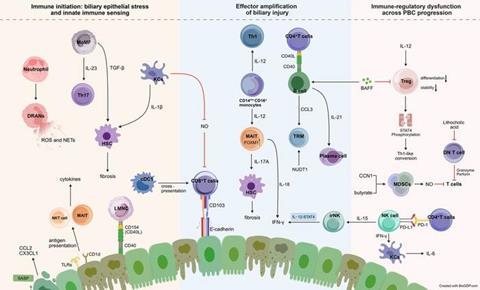
The review organises recent evidence around a ’peribiliary immune niche’, an interacting community of epithelial and immune cells surrounding damaged bile ducts. The authors identify three overlapping processes – immune initiation, effector amplification and regulatory failure – that may explain why inflammation becomes chronic.
Epithelial stress may initiate disease
Biliary epithelial cells play an active role in the development of PBC by initiating and sustaining inflammation when they become damaged or senescent. They release signals that attract immune cells and promote further tissue injury, while also displaying molecules involved in antigen presentation and innate immune sensing.
One of PBC’s key features is the retention of the mitochondrial autoantigen PDC-E2 within apoptotic bodies during cell death. This may help explain why antimitochondrial antibodies target bile ducts, despite mitochondrial antigens being present throughout the body.
Senescent cells also release signalling molecules that recruit macrophages and may spread cellular senescence, while CD40 signalling and neutrophil-derived reactive oxygen species and extracellular traps cause further injury. This inflammatory environment can then activate wider immune responses, with dendritic cells presenting autoantigens to T cells and recruited monocytes developing into macrophages that release inflammatory and profibrotic mediators. Liver-resident Kupffer cells may also activate hepatic stellate cells, contributing to fibrosis.
Immune cells amplify damage
Several immune cell populations contribute to ongoing bile duct damage in PBC. CD8 tissue-resident memory T cells accumulate within the biliary epithelium, where they sustain local cytotoxic activity. Th1 cells, follicular helper T cells and natural killer cells further amplify inflammation, while B cells contribute to both antibody production and immune signalling.
Beyond producing antimitochondrial antibodies, B cells within the liver can release inflammatory cytokines. One subset also recruits cytotoxic CD4 tissue-resident memory T cells to the bile ducts, potentially intensifying tissue injury.
These inflammatory responses may be compounded by a breakdown in immune regulation. Regulatory T cells can become depleted or unstable, while other immune populations lose their suppressive activity. This weakening of the body’s natural immune restraints may allow inflammation to persist and further damage the biliary epithelium.
Existing treatments have limitations
Ursodeoxycholic acid (UDCA) is currently the leading treatment, but approximately 25-50 percent of patients have an inadequate biochemical response.
The review outlines the PPAR agonists elafibranor and seladelpar for the patients showing this response. Both improve biochemical markers, while seladelpar can also reduce itching. However, benefits for survival, transplantation and liver decompensation are still unconfirmed.
The authors cite obeticholic acid as a cautionary example, following the withdrawal of its US approval and revocation of its European authorisation amid safety concerns and insufficient confirmatory evidence of clinical benefit.
Treatments that directly target immune pathways are still at an early stage of development. In a Phase II trial, ustekinumab failed to significantly reduce alkaline phosphatase levels, while rituximab lowered both antimitochondrial antibodies and alkaline phosphatase but did not improve fatigue. Other strategies, including engineered regulatory T cells and CAR-T cell therapies, remain largely experimental.
Personalised treatment remains a research goal
The authors of the review suggest combining liver biochemistry and histology with advanced techniques, including single-cell sequencing and spatial transcriptomics, to identify the dominant disease mechanisms in individual patients.
However, the findings are based on existing research rather than a new clinical trial, with much of the evidence drawn from animal models and peripheral blood samples rather than liver tissue. Further research will now be needed to determine whether identifying the dominant immune pathways in individual patients can reliably guide treatment decisions and improve outcomes. For now, immune-guided therapy remains a potential target for personalised care rather than an established clinical approach.






No comments yet