


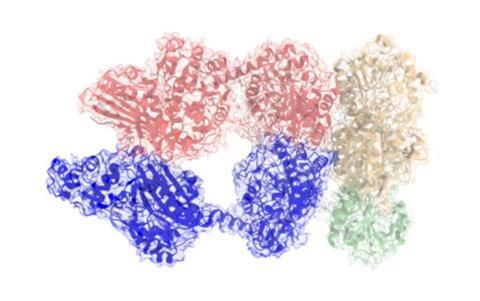
The first high-resolution structural map of the complete human alpha-aminoadipic semialdehyde synthase enzyme has been published, identifying a flexible regulatory region that could guide the design of novel inhibitors for glutaric aciduria type 1.

Researchers have mapped the structure of an enzyme that could offer a new drug target for treating glutaric aciduria type 1 (GA1), a rare inherited metabolic disorder that can cause irreversible brain damage.
The study, led by scientists at the Icahn School of Medicine at Mount Sinai, provides new insights into how the enzyme, known as alpha-aminoadipic semialdehyde synthase (AASS), functions and how its activity is regulated. The findings could help guide the development of drugs designed to inhibit the enzyme and reduce the accumulation of harmful metabolites associated with GA1.
This is the first detailed picture of the complete AASS enzyme, giving us a much clearer understanding of how its different parts work together. We also found that relatively small changes in a flexible region of the protein can have a substantial effect on its activity. That gives us an important new avenue to explore as we work toward potential treatments for GA1.”
Michael Lazarus, Associate Professor of Pharmacological Sciences, the Icahn School of Medicine.
Understanding the enzyme’s activity
GA1 is an inherited disorder that affects the body’s ability to break down certain amino acids. It can cause toxic metabolites to accumulate, potentially resulting in brain damage and serious neurological complications.
AASS plays a role in lysine degradation, making it a potential target for researchers investigating ways to influence the metabolic processes involved in the condition.
“Our investigation of AASS as a potential drug target has revealed multiple ways to alter the enzyme’s activity,” says senior and co-corresponding author Sander Houten, Professor of Genetics and Genomic Sciences at the Icahn School of Medicine. ”A better understanding of how nature uses these mechanisms to control lysine degradation will help with the development of treatments for the disease.”
To investigate the enzyme, the researchers first developed a method to isolate the complete human AASS protein, and then used cryo-electron microscopy to determine its structure at high resolution.
The team combined this structural analysis with biochemical experiments to examine how AASS behaves under different conditions, including when exposed to substances that activate or inhibit its activity. Computer simulations were also used to investigate how changes in the enzyme’s structure influence its function.
The results highlighted a flexible, hinge-like region that plays an important role in regulating AASS. The researchers found that relatively small structural changes at this point could have substantial effects on the activity of the wider protein.
“Our findings show how a relatively small change at a flexible connection point can influence the behavior of a much larger protein,” says Dr Lazarus.
Towards potential GA1 treatments
The structural findings could provide a starting point for designing molecules that inhibit AASS, although the research remains at an early stage. The experiments were conducted in laboratory settings and further studies, including research in animals and potentially humans, will be needed to establish whether targeting the enzyme is safe and effective.
“With this new enzyme structural knowledge, we can begin to explore how to design molecules that inhibit AASS and assess whether they could eventually lead to a treatment for GA1,” adds senior and co-corresponding author Robert J. DeVita, Professor of Pharmacological Sciences and Director of Medicinal Chemistry at the Icahn School of Medicine.
The team’s next step is to use the structural map to identify and develop potential AASS inhibitors. Beyond GA1, the findings could also provide broader insights into how subtle structural changes regulate enzyme activity.








No comments yet