



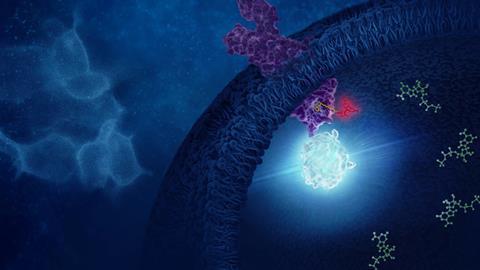

A drug can form exactly the complex it was designed to make and still fail to work. Two recently approved induced proximity drugs show why what happens after complex formation – not formation alone – can decide the outcome.
Two drugs, approved four months apart in 2026, work by holding two proteins together instead of acting on one alone. Forming that pairing is necessary, but it doesn’t guarantee the outcome. What decides whether it’s enough is how long the pairing lasts, and that changes by target – sometimes by the exact mutation. The underlying mechanism isn’t new. Molecular glue mechanisms like this were discovered by accident in other drugs, long before vepdegestrant or daraxonrasib existed. What is new in 2026 is applying that principle deliberately to targets it had never reached before.
For decades, a compound’s only job was to bind its target directly. Occupancy-based drug discovery asks a simple question: does the compound engage its target and how tightly? Binding affinity answers that question well enough to build an entire toolkit around it; because for occupancy-based drugs, tighter binding usually means more activity. Hold the target, block it, and the effect lasts as long as the hold does.
Induced proximity breaks that equivalence. The question occupancy-based assays are built to answer doesn’t determine whether these drugs work. These mechanisms can take several steps to produce an effect , and no single measurement can tell you which step succeeded and which one didn’t. That’s not a coincidence unique to vepdegestrant and daraxonrasib. A ligase-recruiting drug and a chaperone-recruiting drug work through completely different chemistry, but they hit the same measurement wall anyway.
The complex with no fixed answer
Vepdegestrant, a ligase-recruiting drug, is a milestone decades in the making. Its complex must do more than just form. A proteolysis targeting chimera (PROTAC) holds a target next to an E3 ligase long enough for the cell to tag it for destruction, then releases and does it again. Approved in May 2026 for patients whose tumours carry an ESR1 mutation,¹² vepdegestrant is the first PROTAC to reach the market – proof that programmes can now design towards this kind of catalytic behaviour deliberately rather than find it by accident, as early cereblon-based drugs did.
Forming the complex isn’t the whole story. “One of the challenges with degraders is that every step of the mechanism can fail independently, and failure at any step can look identical if the only readout is target level at a fixed timepoint. The field needed tools to interrogate each mechanistic event in living cells, and to observe those processes kinetically,” says Dr Kristin Riching, a Promega scientist whose own peer-reviewed work explores just how many of those steps can independently shape the outcome.³⁴ Forming the ternary complex is only the first of several, and no single measurement covers them all.
One of the challenges with degraders is that every step of the mechanism can fail independently, and failure at any step can look identical if the only readout is target level at a fixed timepoint.
The evidence backs her up, and it cuts in two different directions depending on the target. For SMARCA2, degradation rate barely tracked with how long the ternary complex lasted once it crossed a certain stability; for BRD4, using the identical ligase, degradation rate tracked closely with how long the complex held together.⁵ A separate study pushed the question further. Researchers created several versions of one pan-kinase degrader, varying how long each held its target once bound, and tested them against 25 kinase targets.⁶ Some kinases degraded well only with the shortest-lived version, because a lingering complex just occupied the ligase without producing anything. Others degraded well only with the longest-lived version, because tagging the target for destruction was the slow step, which took time to achieve⁶.
In each of these cases, the complex formed without any trouble. What happened after formation is what a binding assay cannot see – and that’s exactly where the results diverged.
Two mutations, two different outcomes
The same principle shows up somewhere far less expected. RAS has resisted drug discovery efforts for four decades, earning a reputation as undruggable. Direct binding can work on RAS, but only against one specific mutation, G12C, which creates a reactive pocket that has already been successfully drugged. Most other RAS mutants don’t share that same opening.
Daraxonrasib works around that limitation rather than solving it directly. It isn’t built around binding RAS directly at all. Instead, it recruits cyclophilin A, a chaperone already abundant in the cell, and together they form a composite surface that binds active GTP-bound RAS far more tightly than either partner could manage alone.⁷ That composite surface blocks RAS from reaching RAF and PI3K downstream.⁷
A weak signal against RAS alone would look like failure under most screening frameworks. “A compound that shows modest activity against an isolated protein but potently stabilises an intracellular complex in cells isn’t a false positive, it’s telling you the complex is the real drug target,” says Matt Robers, Associate Director of R&D at Promega.⁸ Daraxonrasib takes that modest-activity scenario to its extreme: tested against RAS alone, it shows next to no activity at all,⁷ which would disqualify it outright under a screening approach built around isolated-target binding. That kind of framework has no way to register a compound whose real activity shows up only in a complex. That in-complex activity held up in a Phase III trial in previously treated metastatic pancreatic cancer, producing a median overall survival of 13.2 months against 6.7 months on chemotherapy.⁹ The US Food and Drug Administration (FDA) approved it in August 2026 as Rasonque.¹⁰
A compound that shows modest activity against an isolated protein but potently stabilises an intracellular complex in cells isn’t a false positive, it’s telling you the complex is the real drug target.
Given daraxonrasib’s mechanism, more persistent complex formation might be expected to produce stronger inhibition of RAS signalling. A separate 2025 study tracked the complex in live cells over time and found instead that a second step follows complex formation – one that diverges by mutation.¹¹ In G12 mutants, that second step succeeds: the complex appears to help restore RAS’s own ability to switch itself off – an ability lost to these mutations. Once that happens, RAS flips to its inactive form, the chaperone’s affinity for that state collapses, and the complex dissociates. In Q61 mutants, that second step barely succeeds and the complex holds on.¹¹
The complex that lasted longest was not the one with the strongest effect. The G12 mutants, where RAS’s own off-switching was most restored, showed the deeper pathway shutdown and stronger antitumour effect in preclinical models.¹¹ The mechanism turns out to be more complex than a simple steric block, and that complexity only became visible by tracking the complex over time.
What it takes to see the difference
A single measurement would have missed both findings entirely. Watching the process itself, rather than relying on its result, is what made the difference visible.
The kinase rate-limiting-step work got there by comparing readouts from different points along the same pathway. Ternary complex formation, ubiquitination and degradation itself were each measured in parallel across each target and each version of the chemistry, instead of trusting one equilibrium measurement. Only by seeing where those readouts diverged could researchers tell which step was actually holding a given target back.⁶ The RAS divergence was caught differently: by tracking the complex over time in live cells – long enough to watch it either dissociate or persist, depending on the mutation.¹¹ A one-time binding snapshot would have shown the same tri-complex forming in G12 and Q61 mutants alike, without saying anything about what came next.
That’s the actual gap. A single endpoint, be it a biochemical affinity number or a target-level readout at a fixed timepoint, can’t distinguish a complex that is doing its job from one that formed and stalled. Binary target engagement in live cells shows whether the drug is on the target at all. Ternary complex formation shows whether the three pieces came together. Degradation or pathway kinetics over time show whether that formation actually produced the intended effect – and how fast. Each of those assays answers a question the others can’t, and none of them replaces the one before it because none of them was ever measuring the same thing.
Past the point of formation
Vepdegestrant and daraxonrasib illustrate the same principle from opposite directions. One holds a target next to a ligase long enough to tag it for destruction. The other recruits a chaperone to form a complex with a binding-resistant target. In both cases, persistence turned out to be unpredictable: depending on the target it could either help the drug work, work against it, or barely matter at all. The outcome wasn’t obvious until researchers watched it happen.
For these two drugs, the appropriate tools to see what actually happens already exist. For some targets, they don’t yet: no established complex to track, no known sequence of steps – only a hypothesis about how a compound might work.
Forming the complex was never the finish line. What happens after that is what actually determines the outcome, and it’s different for every target – sometimes for every mutation within one. Established target classes are where our experience runs deep. This frontier is where we’re helping to build the playbook.
See how far we can help you reach: Small Molecule Drug Discovery Solutions
References
1. Hamilton E, et al. (2025) Vepdegestrant, a PROTAC estrogen receptor (ER) degrader, vs fulvestrant in ER-positive/HER2-negative advanced breast cancer: results of the global, randomized, phase 3 VERITAC-2 study. J. Clin. Oncol. 43(suppl 17), LBA1000. DOI: 10.1200/JCO.2025.43.17_suppl.LBA1000
2. U.S. Food and Drug Administration. (2026) FDA approves vepdegestrant for ER-positive, HER2-negative, ESR1-mutated advanced or metastatic breast cancer. FDA News Release, May 1, 2026.
3. Riching KM, Caine EA, Urh M, Daniels DL. (2022) The importance of cellular degradation kinetics for understanding mechanisms in targeted protein degradation. Chem. Soc. Rev. 51, 6210–6221. DOI: 10.1039/D2CS00339B
4. Riching KM. Personal interview with Elise Johnson, June 1, 2026.
5. Wurz RP, et al. (2023) Affinity and cooperativity modulate ternary complex formation to drive targeted protein degradation. Nat. Commun. 14, 4177. DOI: 10.1038/s41467-023-39904-5
6. Fan AT, et al. (2025) A kinetic scout approach accelerates targeted protein degrader development. Angew. Chem. Int. Ed. 64, e202417272. DOI: 10.1002/anie.202417272
7. Cregg J, et al. (2025) Discovery of daraxonrasib (RMC-6236), a potent and orally bioavailable RAS(ON) multi-selective, noncovalent tri-complex inhibitor for the treatment of patients with multiple RAS-addicted cancers. J. Med. Chem. 68, 6064–6083. DOI: 10.1021/acs.jmedchem.4c02314
8. Robers M. Personal interview with Elise Johnson, June 17, 2026.
9. O’Reilly EM, et al. (2026) Daraxonrasib or chemotherapy in previously treated metastatic pancreatic cancer. N. Engl. J. Med. 395, 325–337. DOI: 10.1056/NEJMoa2605555
10. U.S. Food and Drug Administration. (2026) FDA approves first-in-class targeted therapy for metastatic pancreatic cancer. FDA News Release, August 26, 2026.
11. Cuevas-Navarro A, et al. (2025) Pharmacological restoration of GTP hydrolysis by mutant RAS. Nature 637, 224–229. DOI: 10.1038/s41586-024-08283-2














No comments yet