




A new detailed review of in vivo CAR T technology has assessed the key hurdles to overcome in order to transition cellular immunotherapy from bespoke manufacturing to a reliable off-the-shelf therapeutic platform.
A new review of in vivo chimeric antigen receptor T cell (CAR T) therapy highlights a potential shift in how cell therapies are developed and manufactured: instead of engineering immune cells outside the body and returning them to the patient, researchers are working towards programming T cells directly inside the patient.
The approach could eventually move CAR T therapy closer to an off-the-shelf genetic medicine, reducing the need for individualised cell manufacturing. But the technology remains at an early stage and researchers still face major challenges around delivery, safety, persistence and the biological condition of patients’ T cells.
The latest review, led by Professor Huji Xu of Naval Medical University with Professors Xuanming Yang and Yujia Cai of Shanghai Jiao Tong University, examines the development of the field and its progress towards clinical translation.
Why does this matter for early drug discovery?
Traditional CAR T manufacturing is a complex process. A patient’s T cells must be collected, activated, genetically modified, expanded and tested before being returned to the patient. This can take weeks and requires specialised manufacturing capacity.
For drug developers, that creates a fundamentally different development model from conventional medicines, where a treatment can be manufactured at scale before it reaches the patient. In vivo CAR T aims to move the genetic engineering step into the patient.
If successful, a single delivery system could potentially turn a patient’s own T cells into therapeutic cells without the need for extensive ex vivo manufacturing.
That could have implications well beyond manufacturing. The approach gives researchers another way to think about cell therapy as a programmable drug delivery platform. Instead of manufacturing the final therapeutic cell in a facility, developers could deliver the instructions and molecular machinery needed to create it inside the body.
What is in vivo CAR T?
Conventional CAR T
T cells are removed from the patient, genetically modified and expanded in a laboratory before being tested and infused back into the body. The process can take weeks and requires specialist manufacturing facilities and resources.
In vivo CAR T
Instead of removing and engineering T cells outside the body, genetic instructions are delivered directly to T cells inside the patient. This could reduce manufacturing time and costs while potentially making CAR-T therapy more scalable, but researchers must solve challenges around targeting, safety and how long the engineered cells remain active.
How does this fit with what is already happening?
Researchers are investigating both viral and non-viral delivery systems.
Targeted lentiviral vectors can carry relatively large genetic cargos and integrate genetic material into cells, supporting persistent expression. Engineered adeno-associated viruses (AAV) offer another viral approach while generally remaining as episomes.
Non-viral technologies include lipid nanoparticles (LNPs), polymeric nanoparticles and virus-like particles. LNPs are particularly significant because their composition and surface properties can be engineered to influence which cells they reach.
mRNA-based systems offer another potential advantage. Because mRNA expression is temporary, researchers can avoid some of the concerns associated with permanent genetic modification. The review highlights activity in non-tumour models including cardiac fibrosis and systemic lupus erythematosus.
The field is therefore developing at the intersection of cell therapy, gene therapy, RNA medicines and drug delivery.
Four challenges to watch
1. Persistence
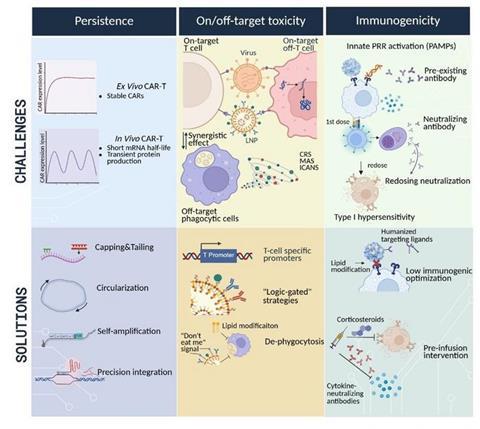
mRNA expression is temporary. That can be useful for controlling exposure but may not provide sufficient duration for complete tumour eradication. Circular RNA and self-amplifying RNA are being explored as ways of extending expression.
2. Targeting
A delivery system must reach the intended T cells without modifying unwanted cell populations. More sophisticated targeting strategies, including dual-recognition logic gates and T cell-specific promoters, could improve precision.
3. Immunogenicity
The immune system may recognise components of the delivery system or the therapeutic machinery itself. This could limit repeat dosing and is driving interest in stealth vectors and transient immunomodulation.
4. T cell fitness
A major biological problem is the starting material. T cells in patients with advanced cancer can already be exhausted or dysfunctional. Researchers may therefore need to combine in vivo CAR-T delivery with approaches that improve T cell function, such as cytokine pre-treatment or co-delivery of anti-exhaustion genes.
What happens next?
The next phase of the field is likely to depend on whether researchers can solve the delivery problem without creating a new safety problem.
The review outlines several areas to watch: more precise T cell subset targeting, multi-target CAR designs, improved vector engineering and the use of artificial intelligence to design delivery systems and therapeutic molecules.
For early drug discovery, the significance is therefore broader than a potentially simpler CAR T manufacturing process. In vivo CAR T could change what the therapeutic product actually is: from a batch of individually manufactured engineered cells to a medicine capable of creating therapeutic cells inside the patient.
Key takeaways
- In vivo CAR T moves cell engineering inside the patient, potentially reducing the need for individualised manufacturing.
- Delivery technology is central because therapeutic molecules must reach the right T cells with sufficient precision.
- LNPs, viral vectors and RNA technologies are among the leading approaches being explored.
- Safety, persistence, targeting and T cell fitness remain major hurdles.
- Clinical translation is beginning, but the technology is still developing and early findings will need to be validated in larger and longer studies.
- The wider opportunity extends beyond CAR T, potentially bringing together concepts from gene therapy, RNA medicines, targeted delivery and cell therapy.









No comments yet