



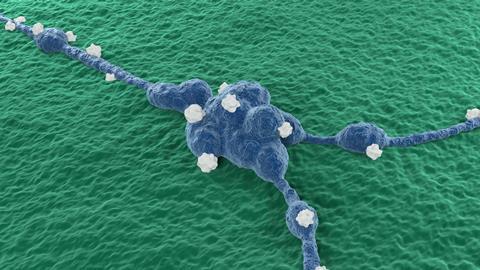
New preclinical findings identify VPS34 as a potential combination target in high-risk neuroblastoma, with inhibition of the protein shown to increase surface GD2 expression and enhance the efficacy of anti-GD2 immunotherapy in laboratory and mouse models.
Researchers have identified a potential way to make neuroblastoma cells easier for cancer-fighting antibodies to recognise, raising the possibility that an existing immunotherapy could eventually be made more effective.
High-risk neuroblastoma is one of the most aggressive solid tumours affecting children. Although anti-GD2 immunotherapies have improved outcomes for some patients, tumours can still evade the immune system, relapse or become resistant to treatment.
Now, researchers at Penn State College of Medicine have found that blocking a protein called PIK3C3/VPS34 can increase the amount of GD2 displayed on the surface of neuroblastoma cells. In laboratory experiments and mouse models, the approach enhanced the effects of anti-GD2 immunotherapy.
The study, published in Autophagy, points to VPS34 as a potential target for combination treatment.
Turning up the cancer ‘signal’
GD2 is a molecule found on the surface of neuroblastoma cells. It is the target recognised by monoclonal antibodies such as dinutuximab and naxitamab.
Once an anti-GD2 antibody attaches to a tumour cell, it can recruit immune cells, including natural killer (NK) cells, to destroy it. The researchers’ finding suggests that increasing the amount of GD2 on the cancer cell surface could effectively make that target easier to see.
The most exciting finding for us in this study was that VPS34 inhibition increased GD2 presentation, which would make the tumour more visible to the antibody.”
Hong-Gang Wang, Lois High Berstler Professor of Pediatrics and Professor of Cell and Biological Systems, Penn State College of Medicine
In the experiments, blocking VPS34 increased the total amount of GD2 inside tumour cells but increased surface GD2 disproportionately. This is important because antibodies need to encounter GD2 on the outside of the cell.
Why does more GD2 matter?
The concept can be thought of as turning up a molecular flag.
More surface GD2 → more opportunities for antibody binding → greater immune-cell recognition → increased tumour-cell killing.
When the antibody binds to GD2, NK cells can attach to the antibody and release proteins including perforin and granzymes. Perforin creates openings in the cancer cell membrane while granzymes enter the cell and trigger cell death.
In the Penn State experiments, combining VPS34 inhibition with anti-GD2 antibodies suppressed tumour growth more effectively than either approach alone. Mice receiving the combination also showed improved survival.
“Combining the two therapies gave us better results,” Zhang said.
Why does this matter for drug discovery?
The findings add VPS34 to a growing range of potential combination targets for neuroblastoma immunotherapy. The protein is involved in both autophagy, which helps cells recycle materials under stress, and endolysosomal trafficking, which controls how material is sorted and transported within cells.
The researchers found that blocking VPS34 increased GD2 on the tumour-cell surface, while targeting ATG14, a protein that works with VPS34 in autophagy, had a much smaller effect. This suggests that VPS34’s role in endolysosomal trafficking may be important for controlling how much GD2 reaches the cell surface.
The distinction could be significant for drug discovery because researchers will need to determine which aspects of VPS34 biology need to be blocked to achieve the desired anti-tumour effect while limiting unwanted effects.
“We had previously found that when we block autophagy, no matter the stage, it inhibited tumour growth, regardless if there was an immune response or not,” said Jiawen Zhang, a biomedical sciences doctoral student at Penn State College of Medicine. “But it had better efficacy in the models with working immune systems, which suggested it is probably also triggering the immune system to attack the tumours.”
The approach also fits into a wider effort to improve anti-GD2 therapy rather than simply replacing it. Anti-GD2 antibodies are already an established treatment for high-risk neuroblastoma, but relapse and treatment resistance remain challenges. Researchers are investigating combinations that can strengthen immune recognition or make tumours more vulnerable to attack.
“The reality is we’re trying to understand how to target neuroblastoma cells through multiple pathways to get more therapeutic benefit,” Wang said. “VPS34 inhibition can enhance anti-GD2 immunotherapy and it also independently makes the neuroblastoma tumour cells more detectable and vulnerable.”
For researchers, the next challenge is translating the finding into a drug-development strategy. The current evidence comes from cell experiments and mouse models, so it remains unclear whether VPS34 inhibition can safely increase GD2 and improve anti-GD2 treatment in patients. VPS34 inhibitors are still largely at the preclinical stage and can have off-target effects.
The potential may also extend beyond neuroblastoma. GD2 is found at high levels in cancers including melanoma and osteosarcoma, although anti-GD2 immunotherapy is currently clinically approved as standard patient care for neuroblastoma.
What happens next?
For the field, the immediate priority is turning the biological finding into a drug-development programme.
A successful VPS34 inhibitor would need to produce the desired changes in tumour cells while being sufficiently selective and safe for use in patients. Researchers would then need to establish the appropriate dose, treatment schedule and patient population before clinical trials could begin.
“Right now, what’s missing is a clinical-grade VPS34 drug,” Wang said. “We’re providing the preclinical evidence and rationale that, once better VPS34 inhibitors are developed, combining them with anti-GD2 could be an important neuroblastoma treatment strategy.”
For now, the study offers a proof of concept rather than a new treatment. Its importance lies in the possibility of changing the biology of the tumour so that an existing immune attack has a clearer target.
The question for drug developers is now whether that ‘brighter’ target can be created safely in patients – and whether making neuroblastoma easier to see can ultimately make it harder for the cancer to survive.
Key takeaways
VPS34 inhibition increased surface GD2 on neuroblastoma cells.
More GD2 could make tumour cells easier for anti-GD2 antibodies to recognise.
Combining VPS34 inhibition with anti-GD2 therapy produced stronger results than either approach alone in the reported models.
The findings are preclinical and do not yet demonstrate that the strategy is safe or effective in children.
The next major hurdle is developing a sufficiently selective, clinically suitable VPS34 inhibitors.



No comments yet