



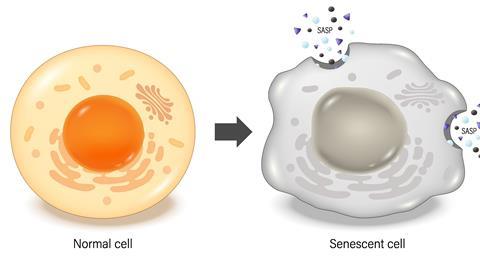
A new study has demonstrated how declining chaperone-mediated autophagy impairs both senescent cell self-regulation and macrophage-mediated clearance, creating a compounding cycle of tissue dysfunction in ageing.
A new study by scientists at the Albert Einstein College of Medicine have identified a potential new way to help the body clear so-called ‘zombie cells’ that accumulate with age and contribute to chronic inflammation and age-related diseases.
The research found that an age-related decline in a cellular recycling process makes it harder for both senescent cells and the immune cells responsible for removing them to function properly.
The findings suggest that restoring this recycling process could help reduce the accumulation of senescent cells and ease disease linked to ageing.
In older animals, age-related changes in both senescent cells and the immune cells responsible for removing them allow these zombie cells to accumulate and play a role in disease. By restoring cellular recycling, we may be able to help the body’s own defenses clear these cells more effectively.”
Dr Ana Maria Cuervo, Distinguished Professor of Developmental & Molecular Biology and of Medicine, the Albert Einstein College of Medicine
What are zombie cells?
Cellular senescence is a state in which cells stop dividing but remain metabolically active. Senescent cells can have beneficial roles, including supporting wound healing and tissue repair. However, when they accumulate with age, they can release inflammatory molecules that damage surrounding tissues and contribute to chronic disease.
Macrophages, a type of immune cell, normally help remove senescent cells while regulating inflammation and tissue repair. If this clearance process becomes less effective, senescent cells can persist and encourage neighbouring healthy cells to become senescent, creating a cycle of inflammation and tissue dysfunction.
The researchers focused on chaperone-mediated autophagy (CMA), a cellular recycling mechanism that identifies and breaks down selected proteins. Previous research established that CMA activity declines with age. The new study investigated how this decline affects both senescent cells and the immune system’s ability to remove them.
When cellular recycling declines
The research focused on chaperone-mediated autophagy (CMA), a process that helps cells identify and recycle damaged or unwanted proteins.
Previous research by Dr Cuervo found that CMA activity declines with age. The new study investigated whether this decline could also contribute to the accumulation of senescent cells.
Most experiments were carried out in mice, while analysis of human lung tissue provided evidence that the findings could also be relevant to people.
Senescent cells can play a useful role during processes such as wound healing. However, they normally need to be removed once their role is complete. Macrophages, a type of immune cell, are responsible for clearing them while also regulating inflammation and tissue repair.
Researchers found that mice whose macrophages lacked CMA accumulated more senescent cells at wound sites and healed more slowly.
Ageing creates a vicious cycle
The researchers also found important differences between senescent cells from young and old mice.
Cells from young animals increased their CMA activity when they became senescent. Cells from older animals failed to make this adjustment because their CMA activity was already low.
As a result, certain proteins were not properly broken down. The senescent cells released substances that encouraged nearby healthy cells to become senescent and made it harder for macrophages to recognise and remove them.
CMA activity was also lower in macrophages from older animals, further reducing their ability to engulf and eliminate senescent cells.
Why this matters for drug discovery
The research highlights CMA as a potential drug target for conditions associated with cellular senescence, chronic inflammation and tissue fibrosis.
Rather than eliminating senescent cells directly, this strategy aims to restore protein recycling in both senescent cells and macrophages, potentially allowing the immune system to clear these cells more effectively.
This distinction could open a complementary avenue for senescence-targeting therapies. Drug developers could investigate whether CMA activation offers advantages over senolytic approaches, which aim to selectively kill senescent cells, or senomorphic treatments, which seek to suppress their harmful characteristics.
However, CMA performs important functions throughout the body, meaning that candidate therapies will need to demonstrate appropriate selectivity, tolerability and long-term safety. Researchers must also establish whether benefits observed in mice translate into clinically meaningful improvements in humans.
Potential treatment
The researchers tested a small-molecule CMA activator called CA77.1 in aged mice. Five months of daily oral treatment reduced the accumulation of senescent cells in several organs and lowered signs of inflammation and fibrosis.
In a mouse model of idiopathic pulmonary fibrosis, an age-related disease in which scar tissue builds up in the lungs, early treatment with CA77.1 also reduced fibrosis, cellular senescence and inflammation.
“Our research connects two major drivers of ageing – declining CMA and cellular senescence – and shows for the first time how their interaction allows senescent cells to evade clearance by the immune system in old organisms,” said Dr Cuervo. “We’ve also found that instead of trying to kill zombie cells, we may be able to restore their interaction with the immune system so that the body can clear them naturally. The next challenge is determining whether this approach can eventually be developed into a safe treatment for age-related diseases in people.”






No comments yet