



A new preclinical study reveals that KRAS-mutant gastric adenocarcinoma fosters a TGF-beta-dependent immunosuppressive tumour microenvironment dominated by regulatory T cells, and demonstrates that dual KRAS and CTLA-4 inhibition can restore antitumour immunity.
A new study has identified a potential strategy for overcoming resistance to immunotherapy in patients with KRAS-mutant gastric adenocarcinoma, a molecular subgroup accounting for approximately 10 percent of cases.
Researchers found that oncogenic KRAS is associated with a strongly immunosuppressive tumour microenvironment, characterised by reduced infiltration of cancer-fighting T cells and an accumulation of regulatory T cells (Tregs). Their findings present strong evidence that combining KRAS inhibition with CTLA-4 blockade could improve treatment responses in this difficult-to-treat group.
The study involved looking at why patients with KRAS-mutant gastric adenocarcinoma often respond poorly to immune checkpoint inhibitors. The researchers initially performed whole-exome sequencing on tumour samples from patients who had received neoadjuvant chemotherapy alongside PD-1 blockade.
Among recurrently mutated genes associated with poor treatment outcomes, KRAS emerged as a key factor. Patients with KRAS-mutant tumours derived limited benefit even when their cancers had deficient mismatch repair (dMMR) and a combined positive score (CPS) above 10, both established biomarkers associated with responses to immune checkpoint inhibitors.
The research was conducted by researchers from Peking University Cancer Hospital & Institute and collaborating institutions, with support from the National Science and Technology Major Project of China, the Beijing Natural Science Foundation and the National Natural Science Foundation of China.
Tumours show a highly suppressive immune environment
Multiplex immunohistochemistry revealed that KRAS-mutant tumours contained relatively few lymphocytes, particularly CD8+ T cells, which are critical for attacking cancer cells. At the same time, the tumours showed increased infiltration by CD68+ myeloid cells.
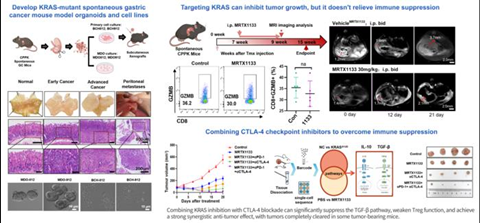
To investigate the mechanisms involved, the researchers developed a stomach-specific, genetically faithful and immunocompetent mouse model of KRASG12D-driven gastric adenocarcinoma. The CPPK model reproduced key stages of human poorly differentiated gastric cancer, including tumour development and subsequent liver and peritoneal metastases.
The model also mirrored the clinical findings, with tumours showing intrinsic resistance to PD-1 blockade.
Single-cell RNA sequencing revealed an extensively immunosuppressive tumour microenvironment. Regulatory T cells accounted for 41.7 percent of tumour T cells, while 55.3 percent of the NKT compartment consisted of exhausted T cells. TGF-beta signalling was strongly activated in tumour Tregs and showed spatial co-localisation with CTLA-4, highlighting TGF-beta-positive Tregs as a potential hub for maintaining immune suppression.
Combining targeted treatment with immunotherapy
The researchers next tested MRTX1133, a small-molecule inhibitor targeting KRASG12D. The treatment suppressed tumour growth, extended survival in mice and inhibited KRASG12D gastric cancer cell lines and organoids.
However, KRAS inhibition alone did not restore effective antitumour immunity. The immune cells that expanded following treatment were predominantly immunosuppressive Tregs, while cytotoxic T-cell function remained unchanged. Further experiments indicated that TGF-beta signalling was necessary for maintaining Treg dominance and suppressing effector T cells.
The team therefore combined KRAS inhibition with CTLA-4 blockade, which directly targets regulatory T cells. This approach reduced TGF-beta activity, impaired Treg function and enhanced antitumour immune responses.
Adding PD-1 blockade to the combination resulted in complete eradication of three subcutaneous tumours and significantly extended survival in the spontaneous CPPK model.
The findings suggest that targeting the KRAS–TGF-beta pathway could help overcome immune suppression in KRAS-mutant gastric adenocarcinoma, supporting further investigation of CTLA-4-based combination therapies in this patient group.







No comments yet