



Developed by researchers in Hungary, MALVINA combines fluorescence microscopy and machine learning to characterise bacterial virulence at the level of individual host cells, revealing how pathogens, microbes and drugs interact to shape infection outcomes in ways that population-level measurements routinely obscure.
Scientists have developed a new method that could transform how researchers assess bacterial infections by showing not only whether bacteria survive treatment, but how they behave inside human cells.
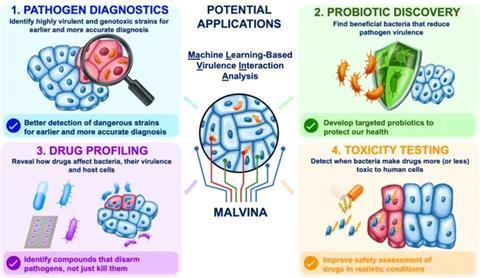
Researchers at the HUN-REN Biological Research Centre in Szeged and the Hungarian Centre of Excellence for Molecular Medicine (HCEMM) developed MALVINA, short for Machine Learning-Based Virulence Interaction Analysis. The technique combines fluorescently labelled bacteria, microscopy and machine learning to measure bacterial invasion, accumulation inside human cells and DNA damage in the same experimental system.
“One of the strengths of the method is that we can see the details of infection cell by cell. We can distinguish whether a few bacteria enter many cells, or whether large numbers accumulate in only a few cells, while also measuring the damage they cause,” said Bence Bognár, co-first author of the study.
Revealing hidden differences
Traditional methods can make very different infection patterns appear similar because they rely on average measurements. MALVINA instead examines individual cells, showing whether bacteria spread widely or accumulate heavily in a smaller number of host cells.
“What was particularly exciting in the experiments was that even with the same bacterial strain, individual host cells could behave very differently. Our method allowed us not only to observe these cell-to-cell differences, but also to quantify them,” said Terézia Kovács, co-first author of the study.
The researchers initially tested the system on four strains of Escherichia coli, including a harmless laboratory strain, disease-associated strains and strains capable of producing a DNA-damaging toxin.
MALVINA identified distinct patterns of virulence, with some strains invading many cells while others accumulated in fewer cells or caused greater DNA damage. An E. coli strain isolated from a colorectal tumour sample showed particularly strong invasive activity, entering human cells, accumulating inside them and inducing DNA damage.
The special feature of this method is that we can see, within the same individual host cell, how many bacteria have entered and what damage the cell has suffered. This gives a much more precise picture of the consequences of infection.”
Szilvia Juhász, Head of the Cancer Microbiome Group, HCEMM
Bacteria influence each other
The researchers also found that bacterial behaviour can be shaped by interactions with other microbes.
An invasive E. coli strain associated with inflammatory bowel disease encouraged an otherwise harmless laboratory strain to enter human cells. In other combinations, a genotoxic strain reduced the ability of invasive rivals to enter cells.
The team also investigated colibactin, a bacterial toxin known to damage DNA. Disabling colibactin production reduced DNA damage and weakened the bacterium’s ability to suppress rival strains, suggesting that bacterial virulence can depend on interactions within microbial communities.
Drugs can alter virulence
Experiments with antibiotics and other compounds showed that treatments can affect bacterial behaviour as well as survival. Some treatments reduced viable bacteria while increasing bacterial invasion of human cells.
This suggests future therapies may need to consider whether drugs make surviving bacteria less harmful rather than simply measuring how many bacteria they kill.
“MALVINA is powerful because it does not look at bacteria in isolation,” said Viktória Lázár, an EMBO Young Investigator, Group Leader at the HUN-REN Biological Research Centre in Szeged, and corresponding author of the study. ”It shows how they behave inside human cells and in the presence of other microbes. Infection is therefore not just a matter of bacterial numbers, but a process shaped by host cells, neighbouring microbes and drugs together.”
The researchers say MALVINA could help identify invasive or DNA-damaging strains, support microbiome-based strategies and aid the development of treatments designed to disarm pathogens. A patent application has been filed for the approach.





No comments yet