





Most common traits are influenced by many genetic variants with small effects. A new study suggests that unusually high or low levels of traits such as cholesterol or blood pressure may instead be driven by rare genetic variants with much larger effects.
Human genetics has become an important tool in early drug discovery. By linking genetic variants to disease, researchers can identify biological pathways involved in disease development and prioritise potential therapeutic targets for further investigation. Used alongside laboratory studies, human genetic evidence can strengthen confidence that a potential therapeutic target has a genuine role in disease.
Many common human traits, including cholesterol levels, blood pressure, body mass index (BMI) and blood glucose, are influenced by numerous genetic variants rather than a single gene. This is known as a polygenic liability, with each variant contributing only a small effect. This understanding has also led to the development of polygenic risk scores, which estimate an individual’s inherited genetic predisposition to a trait or disease from hundreds or even thousands of variants.
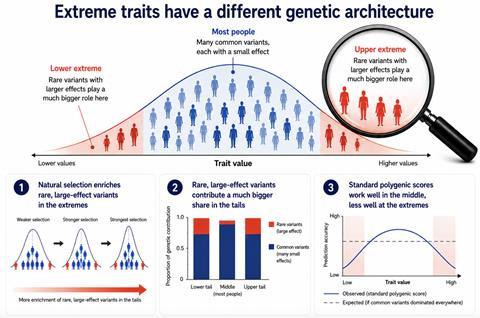
However, researchers have now found that this polygenic liability may not apply equally to everyone. A study published in Nature found evidence that people at the extreme high or low ends of many common traits may have a distinctly different genetic architecture from the wider population. Rather than their extreme traits being caused by the total burden of carrying hundreds of common genetic variants with small effects, some individuals appear to have extreme trait values due to carrying one or a few rare genetic variants that exert a much larger biological influence.
To explore the implications of these findings, Drug Target Review spoke with Professor Paul O’Reilly, Professor of Statistical Genetics at the Icahn School of Medicine at Mount Sinai and senior author of the study. O’Reilly explains how rare genetic variants could help researchers better understand disease biology, identify therapeutic targets and support more personalised approaches to prevention and treatment.
Understanding genetic architecture
Although researchers often describe diseases and traits as either monogenic or polygenic, the reality is usually more complex. Genetic architecture refers to the combination of genetic factors that contribute to a particular trait, including how many variants are involved, how common they are within the population and the size of their individual effects.
Monogenic diseases, such as cystic fibrosis or Huntington’s disease, are primarily caused by mutations in a single gene. By contrast, many common conditions and disease-associated traits result from the combined influence of numerous genetic variants, together with environmental and lifestyle factors. This complexity has made it challenging to determine which genes play a causal role in disease. O’Reilly’s research focuses on understanding this complexity.
“A major theme of my lab’s work has been the development of polygenic risk scores, which are an estimate of a person’s genetic liability to a trait or disease based on aggregating their genetic risk factors across the genome,” he says.
His research also explores how common variants, rare variants, environmental influences and evolutionary forces combine to produce human variation.
“Ultimately, our goal is to better understand and predict disease before it arises in people so that it can be prevented or else treated using medications that match the patient’s genetic profile.”
Investigating the genetics of extreme traits
The idea for the study emerged from scientific debate about whether people with particularly severe manifestations of disease might have a different genetic basis from those with milder presentations.
“I realised that the distribution of polygenic risk scores in the population could give us a clue about whether individuals at the extreme ends of certain traits were there due to a few rare variants of large effect or else because of many hundreds of common variants of tiny effect,” O’Reilly explains.
To investigate this question, the researchers developed two complementary statistical methods. The first analysed genetic patterns across large population datasets, while the second compared trait patterns between siblings. Finding consistent results using two independent methods increased confidence that the observations reflected genuine biological differences rather than statistical chance.
I realised that the distribution of polygenic risk scores in the population could give us a clue about whether individuals at the extreme ends of certain traits were there due to a few rare variants of large effect or else because of many hundreds of common variants of tiny effect.
The approaches were then applied to 74 quantitative traits using data from the UK Biobank and the All of Us Research Programme. These large population cohorts contain genetic and health information from hundreds of thousands of volunteers, providing sufficient statistical power to detect genetic patterns in the tail-ends of traits that would be difficult to identify in smaller studies.
The researchers examined traits including cholesterol, blood glucose, haemoglobin, heart rate, body weight and age at menopause, asking whether individuals at the extreme ends of these measurements displayed evidence of a different genetic architecture.
A mixed genetic architecture
Many common traits remain strongly polygenic across the population. However, the researchers found that this picture changes for some individuals at the extremes of those traits.
“Common traits do tend to be polygenic,” O’Reilly explains, “but what our research shows is that a seemingly high fraction of common traits have a distinctly less polygenic signal at their extremes, meaning that more people than previously thought may have extreme trait values due to just one or a few rare genetic variants of large effect.”
Rather than representing a single genetic model, O’Reilly describes the extremes of many traits as a mixture of different genetic mechanisms.
“The trait is still polygenic, but we could think of the tails of those traits as being a mixed bag,” he says. “Some individuals have extreme trait values due to many hundreds of common alleles of tiny effect, while some have extreme trait values due to just one or a few rare alleles of large effect.”
More people than previously thought may have extreme trait values due to just one or a few rare genetic variants of large effect.
The findings also showed that this pattern was not universal. “Our findings also show that some trait extremes do not have this signal, suggesting that individuals with those extreme trait values probably have a genetic liability composed of many hundreds of small-effect common alleles.”
These observations suggest that researchers should not assume all individuals with extreme trait values share the same underlying biology. Instead, different genetic mechanisms may produce similar clinical or biochemical outcomes.
One explanation comes from evolutionary biology. Genetic variants with large biological effects are often less common within populations because natural selection may reduce their frequency when they negatively influence survival or reproduction. As a result, individuals carrying these rare variants may stand out more clearly at the extreme ends of certain traits.
Why rare variants matter for drug discovery
Understanding which genes directly influence disease remains a central goal of early drug discovery. Genetic evidence can help researchers identify biological pathways that contribute to disease development and provide confidence that a potential therapeutic target is biologically relevant.
According to O’Reilly, rare variants may be particularly informative.
“Rare variants of large effect are thought to affect genes that are more likely to impact the core biology of a disease,” he explains.
Although rare variants account for less of the overall variation within a population than common variants, they may provide clearer evidence about which biological pathways initiate disease.
Rare variants of large effect are thought to affect genes that are more likely to impact the core biology of a disease.
For drug discovery, this means that studying rare variants could help researchers identify genes that play a direct role in disease biology. These genes can then be investigated using experimental models to understand how disrupting or modifying their function influences disease processes and whether they represent suitable therapeutic targets.
The findings may also help researchers prioritise genes for functional validation. Rather than investigating hundreds or thousands of genes associated with polygenic risk, rare variants may narrow the search to a much smaller number of genes with larger biological effects.
A biomarker-first strategy
The study also highlights the value of investigating measurable biological traits before focusing directly on disease outcomes.
Many common diseases, including cardiovascular disease, diabetes and stroke, develop gradually through changes in biomarkers such as blood pressure, cholesterol and blood glucose. Since these traits are measured on a continuous scale rather than as a simple yes-or-no disease outcome, they often provide greater statistical power for genetic studies.
O’Reilly believes this could help researchers identify disease genes more efficiently.
“Many traits, such as blood pressure, cholesterol levels and BMI, are on the causal path towards these diseases,” he says. “Because we typically have greater statistical power when searching for the genetic causes of continuous traits rather than binary outcomes, then taking a biomarker-first approach may be more powerful for discovering the genetic causes of the disease endpoints.”
Implications for precision medicine
The findings could also influence how patients are assessed in the future.
Current genetic testing often distinguishes between rare inherited disorders caused by a single mutation and common diseases influenced by many genes. O’Reilly believes his team’s work could help determine where individual patients fall between these two extremes.
“Our work may enable us to say how likely it is that a patient has just a single mutation responsible for their condition or that instead it’s due to many hundreds of genes, which could influence their follow-up testing and treatment plan.”
Next steps for drug discovery
The researchers are now extending their work to investigate specific diseases, including cardiovascular disease and Alzheimer’s disease.
“We think our findings can be helpful for drug discovery and development not only because rare variants may be closer to the disease biology than common variants,” O’Reilly says. “They’re also easier to investigate because researchers can focus on just a handful of high-impact genes, rather than the challenge of developing treatments to mitigate the effects of hundreds or even thousands of genetic variants.”
Although further studies will be needed to understand how broadly these findings apply across different diseases and populations, the work suggests that rare variants may provide an important route towards understanding disease biology.
For early drug discovery, investigating individuals at the extremes of common traits could help researchers identify the genes and pathways that matter most, supporting the development of more targeted therapies.













No comments yet