



A three-signal culture protocol developed at the University of Osaka successfully converts human peripheral B cells into germinal centre-like B cells capable of somatic hypermutation.
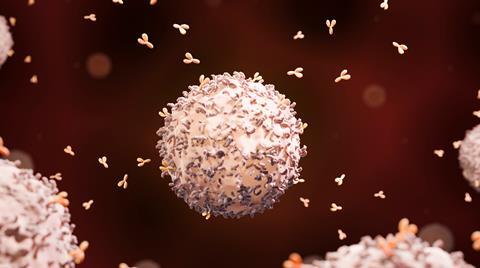
Scientists at the University of Osaka have developed a new laboratory technique that can turn B cells taken from human blood into cells that closely resemble those found in germinal centres, where the immune system refines antibodies following infection or vaccination.
The researchers say the relatively simple method could provide a new tool for studying how human antibody responses develop and for investigating potential approaches to improving vaccines and understanding autoimmune disease.
Their findings show that the process requires just three signals normally delivered to B cells by helper T cells. Crucially, the signals must be provided in a specific order.
The resulting cells, called in vitro germinal centre-like B cells or iGCB cells, displayed many of the molecular characteristics seen in germinal centre B cells taken from human tonsils. They also underwent somatic hypermutation, a process in which mutations are introduced into antibody genes to help generate antibodies with different properties.
Recreating the germinal centre environment
Germinal centres develop in lymph nodes and tonsils following exposure to an infection or vaccination. They provide an environment where B cells rapidly multiply and modify their antibody genes before competing for survival.
Through this process, B cells capable of producing more effective antibodies are selected. However, obtaining human germinal centre B cells for laboratory research is difficult and existing culture techniques have not fully replicated their molecular characteristics.
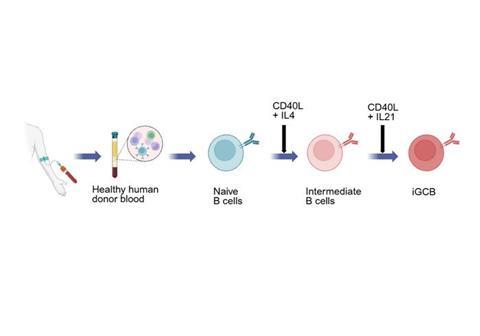
To overcome this, the Osaka researchers developed a two-stage culture system.
They initially exposed naive B cells to soluble CD40L and IL-4. After four days, they replaced the IL-4 with IL-21. This sequence activated BCL6, a protein that plays a central role in establishing the germinal centre programme.
Changing the order of the signals produced a different outcome. The researchers also found that maintaining IL-4 rather than switching to IL-21 did not generate the same germinal centre-like cells.
The iGCB cells produced by the new method showed similarities to human tonsil germinal centre B cells across several measures, including their surface markers, transcription factors and DNA repair machinery.
They also demonstrated somatic hypermutation. However, the researchers did not observe affinity maturation, the subsequent process through which B cells producing antibodies with increasingly strong binding to a target are selected.
A new tool for immune research
The researchers believe the defined nature of the system could make it particularly useful for investigating the signals involved in human germinal centre formation.
Individual factors can be added or removed from the culture, allowing researchers to examine their effects directly. This could help identify which signals encourage germinal centre development and which may prevent it.
Such a system could ultimately contribute to research aimed at producing stronger or more effective vaccine-induced antibody responses. It may also help scientists investigate the mechanisms involved in autoimmune diseases in which abnormal antibody responses occur.
“The germinal centre is where the immune system fine-tunes its antibodies. What surprised us most was how little it took: three signals, given in the right order, and human B cells will build the germinal center program themselves. I hope this gives the field a straightforward way to investigate the signals that drive human germinal center B cells and helps support research on better vaccines and autoimmune disease,” said Dr James B Wing, corresponding author of the study.



No comments yet