



Sample collection strategy can have a significant impact on the success of genomic studies. As studies become larger, more geographically distributed and technically demanding, stabilised saliva collection offers a practical way to support recruitment and logistics while maintaining sample quality for downstream genomic analysis.
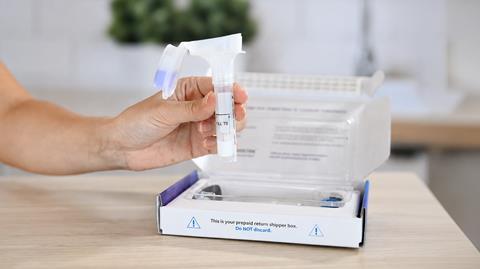
Genomic research is scaling faster than traditional collection models can support
Genomic research is increasingly extending beyond single-site, clinic-based models and into larger, more geographically distributed cohorts. In just a few short years, the questions researchers can ask – and the scale at which they can ask them – have expanded dramatically.
Population genomics now span continents. Polygenic risk score (PRS) research is highlighting longstanding ancestry gaps. Rare disease studies, biomarker discovery and multi-analyte programmes are converging on ever-larger, more diverse participant pools. Long-read sequencing is improving access to genomic regions that are difficult to resolve with short-read technologies.
Each of these avenues raises the ceiling on what genomics can deliver. But they also raise the floor on what a study must accomplish operationally before a single base is sequenced. More participants, more geographies and more sophisticated downstream workflows all place new demands on the least glamorous – and most consequential – step in the pipeline: getting a high-quality sample from a person into a lab.
Sample collection – where scale, access and diversity often collide
Ask most researchers where a large genomic study is likely to stall and few will point to sample collection first. Yet it is frequently where scale and diversity ambitions collide with logistical reality.
Consider the challenges which compound as studies grow:
- Participant recruitment and retention become harder when enrolment requires a clinic visit;
- Geographic dispersion makes every phlebotomy appointment a potential scheduling and travel time headache;
- Paediatric and difficult-to-access populations are often underrepresented precisely because venepuncture is invasive, distressing or impractical;
- Elderly participants face mobility or access barriers that make in-clinic collection a genuine deterrent; and
- Population diversity gaps persist when collection methods implicitly favour those who live near research centres.
Layered on top are complex study logistics: cold-chain shipping and the coordination of multi-site studies. Each adds cost, delay and a point of potential failure.
Consider real-world examples that make such stakes concrete. The VIKING II cohort – studying volunteers with Northern Isles ancestry – replaced the in-clinic saliva collection of its predecessor studies with an online portal and mail-return kits, gathering 3,594 saliva samples returned by mail as of January 2023.1
In South Asian polygenic risk score (PRS) research, genomic data from Genes & Health – including 44,396 British-Bangladeshi and British-Pakistani participants, with DNA obtained from saliva collected using Oragene™ kits – were analysed alongside UK Biobank data from a cohort of approximately 500,000 predominantly White British participants. The study found that PRS for multiple sclerosis derived from European-ancestry genome-wide association studies (GWAS) were less accurate in the South Asian cohort, highlighting the need for genetic studies involving more ancestrally diverse populations.2
In African cleft genetics, Oragene™ saliva kits enabled DNA collection from 814 cleft-lip/±palate cases, 205 cleft-palate-only cases and 2,159 controls across Ethiopia, Ghana and Nigeria – a large-scale effort that helped address the paucity of genetic studies in African populations.3
The pattern is consistent: when collection is decentralised and participant-friendly, previously hard-to-reach populations become reachable, and scale becomes affordable. Several published examples suggest that decentralised, participant-friendly collection can help broaden reach and reduce the logistical burden associated with research programmes.

What researchers need from an alternative sample type
When venipuncture and phlebotomy impose recruitment or logistics bottlenecks, researchers need to evaluate alternative sample types against clear scientific and operational criteria. A credible alternative sample type must satisfy five requirements simultaneously, without trading one for another:
- Sample quality – high enough for demanding downstream assays;
- Sample quantity – sufficient to run multiple analyses from a single collection;
- Stability during transport – ambient temperature – to eliminate cold-chain dependence;
- Operational scalability – capable of expanding to thousands of participants without a proportional expansion of staff and infrastructure; and
- Downstream genomic workflow compatibility – from microarrays to whole-genome and long-read sequencing.
These criteria are not independent. A method that is easy for participants but yields degraded or insufficient DNA simply moves the bottleneck downstream. The goal is a sample collection approach that relaxes the recruitment and logistics constraints and meets analytical standards.
Published studies show saliva supporting diverse genomic applications
Saliva has quietly accumulated a substantial body of supporting evidence meeting these demands. Far from a convenience-only compromise, DNA originating from saliva samples now appears across a broad range of research applications, including population genetics, disease-risk studies, PRS research, epigenetics, psychiatric genetics and large cohort studies.
The breadth of published studies is instructive:
- Population genetics. In a Jewish population-based BRCA screening programme using saliva-based Oragene™ kits 6,179 women were tested and 93 carriers were identified. In the clinical referral stream, 242 were tested and 38 carriers were identified. The population-based programme used 244 genetic-counselling hours, compared with 484 hours in the clinical stream.4
- Epigenetics. A study of 431 children aged 10–15 used saliva collected in Oragene™ devices for DNA methylation analysis, with the authors noting saliva’s particular value in children and adolescents “for whom venepuncture is an obstacle to study participation.”5
- Psychiatric genetics. Saliva supported oxytocin receptor gene (OXTR) genotyping in a community sample examining PTSD and dissociation – an application area where community-based, non-clinical recruitment is often essential.6
What unites these examples is that saliva did not merely make the study easier; in several cases it appears to have made the study possible at the required scale and diversity.
Emerging sequencing technologies: raising the bar for sample quality
For years, the strongest objection to saliva was analytical: could it truly stand in for blood in the most demanding workflows? The head-to-head, donor-matched compatibility data are where the future-focused case becomes compelling.
Across established methods, concordance with blood is high. Whole-genome sequencing of saliva collected in Oragene™ devices produced “high-quality genomic sequencing data comparable to blood samples,” with low error rates.7 Exome sequencing yielded a similar mean variant count from saliva (28,738) versus blood (28,067), with both achieving 98.5 percent exon coverage.8 SNP genotyping variants were “highly concordant” between saliva and blood from the same donor,9 and HLA typing reached 100 percent concordance.10
The more forward-looking story is long-read sequencing (LRS), where the bar is higher still. Long-read platforms depend on high molecular weight (HMW) DNA, and there is growing interest in resolving the difficult-to-map genomic regions that short reads handle poorly. Reported results show that:
- PacBio™ HiFi sequencing of saliva-derived DNA (Oragene™ collection devices, Nanobind™ extraction) established saliva as “a viable alternative to blood for obtaining high-quality, long-read sequencing data.”11
- Oxford Nanopore Technologies LRS of saliva-derived DNA collected with Oragene™ devices demonstrated that salivary DNA is well suited for WGS. Using as little as 2.5 μg of salivary HMW DNA, researchers achieved read N50 values up to 65 kb and generated high-quality sequencing data suitable for detecting structural variants, CNVs, SNPs and STRs.12
High molecular weight DNA matters because sequencing technology is a moving target. Published examples show saliva-derived DNA collected in Oragene™ devices supporting both established genomic assays and emerging long-read sequencing workflows.
Designing future studies: adapting to participants
Put these threads together and a clear design principle emerges for a new wave of genomic research: adapting the study to the participant – not the reverse.
Minimally invasive, self-collected saliva connects naturally to the study designs the field is moving toward:
- Remote recruitment, where mailed kits and online consent replace clinic visits.1
- Large-scale cohorts, where collection must scale to thousands without unnecessary operational complexity.
- Global studies, where ambient-temperature stability removes the cold-chain barrier to worldwide sample transport.13
- Longitudinal research, where participant-friendly saliva collection facilitates repeated sampling and ongoing study participation over time.1
- Inclusion of underrepresented populations – paediatric, elderly, community-recruited and ancestrally diverse groups, whose limited representation has skewed GWAS and PRS accuracy.3
The evidence suggests these are not competing priorities. A single, well-chosen collection strategy can relax recruitment, logistics and scalability constraints while preserving – and, in the case of HMW DNA, enabling – compatibility with increasingly sophisticated genomic workflows.
Sample collection, in other words, may shape study success more than its modest reputation implies. Choosing the right approach is not a downstream convenience. It is an upstream strategic decision that determines who can participate, how far a study can scale and which questions can be answered at all.
Learn more about Oragene™ and ORAcollect™ saliva collection devices.
References:
- Kerr SM, Edwards R, Buchanan D, Dean J, Miedzybrodzka Z, Wilson JF. VIKING II, a worldwide observational cohort of volunteers with northern isles ancestry. Int J Popul Data Sci. 2023 May 15;8(1):2121. doi:10.23889/ijpds.v8i1.2121. PMID: 37670955; PMCID: PMC10476511.
- Breedon J, Marshall CR, Giovannoni G, et al. Polygenic risk score prediction of multiple sclerosis in individuals of South Asian ancestry. Brain Commun. 2023;5(2):fcad041. doi:10.1093/braincomms/fcad041.
- Alade A, Awotoye W, Butali A, et al. Shared genetic risk between major orofacial cleft phenotypes in an African population. Genet Epidemiol. 2024;48(6). doi:10.1002/gepi.22564.
- Metcalfe KA, Poll A, Royer R, et al. A comparison of the detection of BRCA mutation carriers through the provision of Jewish population-based genetic testing compared with clinic-based genetic testing. Br J Cancer. 2013;109(3):777-779. doi:10.1038/bjc.2013.309.
- Dunstan J, Bressler JP, Moran TH, et al. Associations of LEP, CRH, ICAM-1, and LINE-1 methylation, measured in saliva, with waist circumference, body mass index, and percent body fat in mid-childhood. Clin Epigenetics. 2017;9:29. doi:10.1186/s13148-017-0327-5.
- Lee H, King AP, Li Y, Seng JS. Oxytocin receptor gene, post-traumatic stress disorder and dissociation in a community sample of European American women. BJPsych Open. 2022 Jun 3;8(4):e104. doi:10.1192/bjo.2022.74. PMID: 35656579; PMCID: PMC9230437.
- Tayeb M, Lazic AM, Kovacevic M, et al. Blood vs. Saliva: Analysis of the Effect of Sample Type on Variant Calling Confidence for Human Whole Genome Sequencing. Seven Bridges Genomics/DNA Genotek; MK-00426.
- Iwasiow RM. Saliva Samples Collected and Stabilized With Oragene•DNA Are a Reliable Source of DNA for Next Generation Sequencing. DNA Genotek; MK-00014.
- Tayeb M, Iwasiow RM, Hu P, et al. Evaluation of Performance of Genomic DNA From Saliva Collected With Oragene•DNA for the Purpose of SNP Discovery and CNV Analysis on Illumina BeadChip Technology. DNA Genotek; MK-008.
- Tayeb M, Iwasiow RM. Saliva Collected Using the Oragene Family of Products Is a Reliable Source of DNA for HLA Typing Using Next Generation Sequencing. DNA Genotek; MK-00111.
- Pacific Biosciences, DNA Genotek. HiFi Sequencing Performance of Saliva DNA Samples Collected With DNA Genotek Oragene Devices and Extracted Using Nanobind Kits. DNA Genotek.
- Dillane C, Tayeb M, Søndergaard MT, Wollenberg R. Optimizing Oxford Nanopore long-read whole genome sequencing of salivary DNA. Scientific poster. DNA Genotek Inc and DNASense/cmbio; MK-3154.
- DNA Genotek Inc. Growing Applications of Nucleic Acids in Genomics and Multi-omics Research: An Overview of Collection Advantages, Use Cases and the Scientific Evidence Behind Saliva as a Sample Type. DNA Genotek, a subsidiary of OraSure Technologies; 2025. MK-3112 v1.











No comments yet