

Danaher Corporation and Microsoft are combining scientific instrumentation expertise with Azure-powered AI to build an interoperable, agentic laboratory platform.

Danaher has announced a strategic partnership with Microsoft to develop AI-powered scientific instruments and connected laboratory technologies, with the first commercial applications expected to reach customers this year.
The collaboration aims to accelerate the development of an interoperable, agentic AI platform that connects instruments and technologies across Danaher’s businesses while remaining compatible with the wider laboratory ecosystem.
By combining Danaher’s expertise in scientific workflows and instrumentation with Microsoft’s artificial intelligence (AI) technologies, the companies hope to help scientists move more quickly from research questions to experimental evidence.
Developing an agentic AI platform for laboratories
The partnership will focus on building a shared platform for instrument control and scientific insight generation, using Microsoft Azure to provide secure cloud infrastructure and Microsoft Foundry to power AI agents.
These agents will be designed to interpret experimental results, guide instrument operation and support scientists throughout research workflows. The shared platform will also enable technologies from different manufacturers to work together, supporting interoperability in multi-vendor laboratories.
”Danaher’s businesses bring deep scientific and instrument expertise to customers every day,” said Julie Sawyer Montgomery, President and CEO of Danaher. ”With Microsoft, we are building a common foundation, so our instruments and laboratories work together consistently, as one connected Danaher. Through context and learning, that foundation can continuously inform the next experiment and the best analysis. This partnership is an important step toward making laboratories not just connected, but intelligent.”
The companies are already working towards the first commercial applications, which are expected to become available to Danaher customers in 2026.
These include MetaXpress Acquire AI Assistant, software developed by Molecular Devices for its high-content cellular imaging systems. The application is designed to provide product support, with additional next-generation, agent-enabled instruments from Danaher businesses planned for 2027.
AI assistants could reduce experimental time
The proposed platform will support scientists across several stages of experimental research, including translating scientific questions into experimental plans, configuring instruments and guiding experimental execution.
AI agents will also be designed to monitor experiments, identify data quality issues in real time and recommend corrective actions or subsequent experiments for scientists to review.
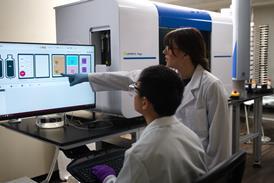
Early internal testing has indicated potential efficiency improvements. In preliminary testing involving a Leica microscope, novice scientists using an AI-assisted experimental workflow took up to 83 percent less time and completed up to 68 percent fewer steps than novice users working without an AI assistant.
According to Danaher, participants using the AI assistant produced high-quality data and completed the experiment in a time comparable to an expert.
The findings suggest that AI-assisted instrumentation could help reduce the complexity of laboratory procedures, potentially making sophisticated experimental techniques more accessible to less experienced researchers.
“Danaher’s scientific expertise, combined with Microsoft’s AI platform, aims to give scientists more choice and control, and more time for discovery,” said Deb Cupp, Executive Vice President and Chief Revenue Officer, Microsoft Global Enterprise. ”This partnership aligns with our goal to help translate AI into real-world impact.”
Towards increasingly autonomous science
The collaboration forms part of Danaher’s wider strategy to advance AI and autonomous science by connecting instrument-level intelligence with laboratory data, workflows and experimental execution.
While intelligent instruments represent an initial step, the longer-term ambition is to create increasingly connected laboratory environments in which experimental findings can inform subsequent research decisions.
By enabling instruments and laboratory systems to communicate and share information, the companies aim to support more streamlined and increasingly autonomous scientific workflows, while retaining scientist oversight of experimental decisions.
For drug discovery and life sciences research, this approach could help researchers manage complex experimental processes, interpret results more efficiently and identify subsequent experiments.







No comments yet