



All Drug Discovery Processes articles – Page 19
-
 News
NewsChikungunya’s 2025 surge sparks urgent research response
The 2025 chikungunya outbreak has surged from the Indian Ocean to Europe, prompting an urgent global research response. With no antivirals and limited vaccine access, laboratories and biotech firms are under pressure to deliver solutions fast.
-
News
Repurposed epilepsy drugs show potential for new autism therapies
Researchers identified hyperactivity in a specific brain region as a driver of autism-like behaviours in mice – and reversed these symptoms using drugs first designed to treat epilepsy.
-
 Article
Beyond the hype: a veteran's honest assessment of AI in drug discovery - Part 2
Thibault Géoui explains why AI could finally help pharma overcome its productivity crisis and why the payoff won’t come as quickly as the optimists claim.
-
 News
NewsNew therapy targets triglycerides to prevent aneurysms
A new study shows high triglyceride levels directly cause abdominal aortic aneurysms – highlighting triglyceride-lowering therapies as a potential new treatment.
-
 News
NewsFrom graphene to grey matter: tech that supercharges brain organoids
Researchers at UC San Diego have discovered a graphene-based technology that accelerates the maturation of human brain organoids, offering a safer, non-invasive way to model diseases like Alzheimer’s.
-
 News
NewsKidney organoids reveal hidden toxicities in AAV gene therapy
Stem cell-derived kidney organoids have revealed hidden toxicities in adeno-associated virus (AAV) gene therapy delivery – offering a powerful new way to improve the safety of future treatments.
-
 News
NewsPlanaria flatworms provide new way to study schizophrenia drugs
A new study has shown that small pond worms, called planaria, respond to psychiatric drugs like rodents – offering a promising new way of studying mental health conditions such as schizophrenia and addiction.
-
 News
NewsStriosomes may hold the key to better treatments for mental disorders
Scientists have developed a new computational model that reveals how the striosomal compartment of the brain’s striatum influences decision-making – which could lead to improved therapies for psychiatric disorders.
-
 Article
What if drug discovery took months, not decades?
Drug discovery is slow, costly and often unsuccessful. DTR hears how GATC Health is applying AI and multiomics to make the process faster, more precise and less reliant on trial and error.
-
 News
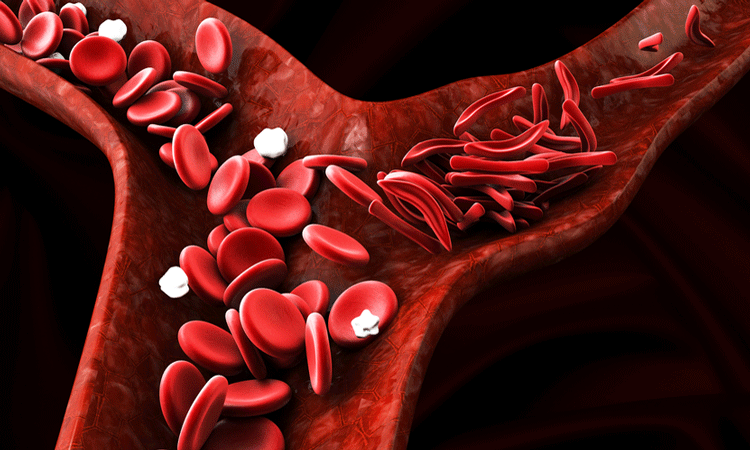
NewsNew CRISPR breakthrough could transform sickle cell treatment
Researchers at UNSW Sydney have unveiled a next-generation CRISPR tool that could lead to safer treatments for genetic disorders, including Sickle Cell.
-
 Article
How to select the optimal bispecific antibody format for therapeutic success
Choosing the right bispecific antibody format can make or break your therapy’s success. This article explores how format impacts function, manufacturability and development strategy - helping you make the best choice from the start.
-
 News
NewsHow to select the optimal bispecific antibody format for therapeutic success
Discover the key scientific, strategic and manufacturing factors that could decide whether your bsAb succeeds in the clinic or stalls in development.
-
 Article
Challenges in developing robust potency assays for ADCs
Developing robust potency assays for Antibody-Drug Conjugates (ADCs) is crucial for ensuring their clinical success, but designing assays that meet both technical and regulatory standards is challenging. Here, Abzena’s CSO Campbell Bunce explores the complexities of assay development and the importance of ensuring accuracy, consistency and regulatory alignment for ADCs ...
-
 News
NewsFDA-approved asthma drug may protect against food allergy reactions
An existing asthma drug has been shown to almost completely prevent life-threatening allergic reactions to food in mice, after researchers found a previously unknown genetic pathway linked to anaphylaxis.
-
 News
NewsEvenamide targets multiple symptoms in schizophrenia models
New preclinical research suggests that evenamide – a glutamate modulator – targets hippocampal hyperexcitability, potentially addressing positive, negative and cognitive symptoms of schizophrenia.
-
 Article
Beyond the hype: a veteran’s honest assessment of AI in drug discovery - Part 1
An interview with Thibault Géoui reveals why this technology wave might finally break through pharma’s productivity crisis – and why it will take longer than the optimists claim.
-
 Article
Lupus reimagined: targeting the cause, not just the symptoms
Engineered cell therapies are offering a potential new way to treat lupus – not by suppressing symptoms, but by reprogramming the immune system itself. For the first time, lasting remission looks like a real possibility.
-
 News
NewsNew PCAI compound targets aromatase inhibitor-resistant breast cancer
Researchers at Florida A&M University have identified a new compound – NSL-YHJ-2-27 – that disrupts key survival pathways in aromatase inhibitor-resistant breast cancer cells – offering a potential new treatment for hard-to-treat cases.
-
 News
NewsKidney tumour organoids offer new drug testing platform
Scientists in China have used 3D bioprinting to grow kidney tumours from patients’ own cells, creating realistic models that could speed up development of personalised treatments.
-
 News
NewsLithium deficiency identified as key Alzheimer’s trigger
New research from Harvard Medical School shows that natural lithium deficiency in the brain may be a key early factor driving Alzheimer’s disease – which allow for the development of new approaches to preventing and reversing cognitive decline.