



Drug Target Review spoke with discovery leaders at AACR 2026 about modern drug discovery and how it is no longer defined by single innovations but by integrated systems connecting AI, biology and translational execution.
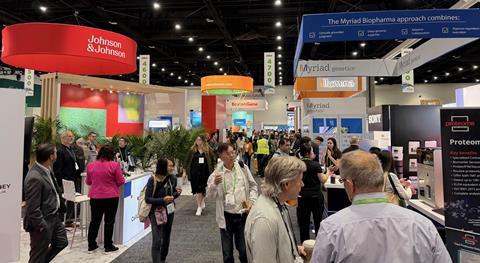
At the American Association for Cancer Research (AACR) Annual Meeting 2026, Drug Target Review spoke with drug discovery leaders, platform developers and translational scientists about how oncology R&D is shifting from isolated technological breakthroughs towards more integrated discovery systems.
Across these discussions, it became clear that modern oncology is no longer defined by single innovations in isolation, but by how effectively organisations connect biology, computation and translational execution. From AI-designed molecules and molecular glues to spatial biology and cell therapies, companies are focusing on building systems that shorten the distance between hypothesis and clinical results.
AI is improving both speed and quality of drug design
One of the most prominent themes at AACR was the growing maturity of AI-driven drug discovery – not just as a tool for faster design cycles but as a mechanism for improving molecular quality and clinical probability of success.
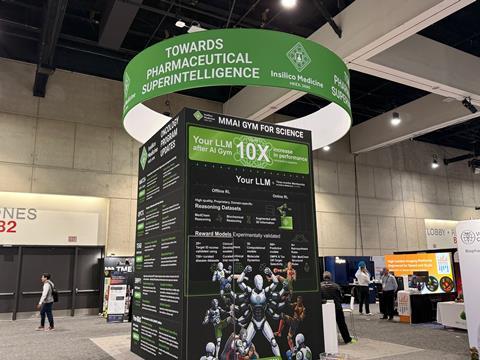
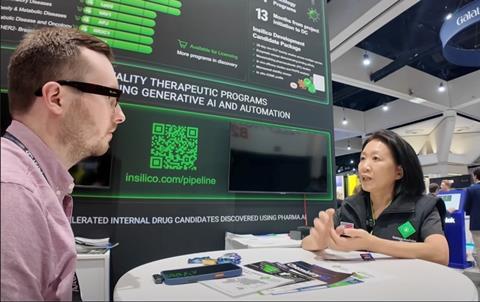
At Insilico Medicine, Dr Halle Zhang, VP of Global Clinical Development (Oncology Portfolio), highlighted how AI is now embedded across target selection and molecule optimisation, particularly for challenging oncology targets.
“AI is not just about speed; it is also about improving the quality of the drug candidates,” she explained.
Insilico’s pan-KRAS inhibitor programme, ISM-6166, illustrates this approach. By targeting both active and inactive KRAS conformations the molecule is designed to overcome one of oncology’s most persistent challenges: adaptive resistance driven by dynamic protein switching.
AI is not just about speed; it is also about improving the quality of the drug candidates
“KRAS is a very dynamic protein and tumours often develop resistance by shifting KRAS conformational states that are not effectively targeted, thereby evading treatment,” Zhang said.
Beyond KRAS, Insilico is also applying its platform to historically difficult targets such as Casitas B-lineage lymphoma-b (CBLB), an E3 ligase with complex structural dynamics and limited druggable pockets. Here, AI was used to identify previously ‘invisible’ transient binding sites and engineer optimal potency, selectivity and ADME properties in parallel, rather than in sequence. Zhang emphasised that this integrated optimisation is already translating into biological activity, including T-cell activation and tumour growth inhibition in preclinical models.
“The AI platform allows us to tackle historically very difficult targets and optimise molecules in parallel,” she said.
She also pointed to early clinical translation momentum, with multiple programmes advancing into Phase I and plans to move towards Phase II development by 2027.
From discovery speed to clinical differentiation
While AI platforms are accelerating early discovery, companies stressed that clinical value depends on more than rapid repetition.
“To achieve impact, we need robust biomarkers and well-designed clinical studies that demonstrate clear benefit,” Zhang said.
This reflects how the industry is moving in a broader sense, with AI increasingly being used not just to generate candidates, but to define where those candidates will succeed in heterogeneous patient populations.
AI-enabled biology meets translational urgency
Alongside in silico design approaches, companies such as LabGenius Therapeutics are applying AI within closed-loop experimental systems, combining machine learning with automated lab testing to optimise multispecific and multivalent therapeutic molecules directly in biologically relevant assays. This approach allows thousands of antibody designs to be generated and tested in parallel using human cell-based systems, helping ensure that computational predictions are continuously validated against real biological responses.
As Chief Scientific Officer Angus Sinclair explained, incorporating human-relevant systems early is critical for translation.
“We use primary human cell-based assays, as close as possible to what would be produced for the clinical situation,” he explained.
By integrating design, build, test and learn cycles into a single workflow, LabGenius is also improving iteration across large molecular design spaces of up to 2 million unique antibody architectures.
We use primary human cell-based assays, as close as possible to what would be produced for the clinical situation
“This is the fastest that I’ve ever seen molecules being developed,” Sinclair said.
One example is LGTX-101, LabGenius’ selectivity enhanced Nectin-4 × CD3 T-cell engager for solid tumours, designed to kill Nectin-4–expressing tumour cells while reducing the risk of damage to healthy tissue that also expresses the target. As a product of LabGenius’ closed-loop AI-guided discovery platform, it illustrates how these systems aim to uncover non-intuitive yet clinically viable candidates that would likely remain inaccessible through conventional, hypothesis-driven or rational design approaches.
Molecular glues expand the boundaries of druggable biology
Another major theme at AACR was the continued expansion of targeted protein degradation and molecular glue technologies into previously inaccessible biology.
At Neomorph, President and CEO Dr Philip Chamberlain described the disclosure of the company’s lead programme, NEO-811, which targets the transcription factor HIF-1β (also referred to as ARNT) – a protein that was considered undruggable using conventional modalities.
“This is the first time this has even been described as a druggable protein,” Chamberlain said.
For Neomorph, molecular glue discovery is not simply about identifying new degraders but expanding the boundaries of what the druggable proteome can include.
However, Chamberlain acknowledged that translating early glue discoveries into clinically viable molecules is still a major challenge across the field.
“Finding targets is one thing but optimising them into useful clinical molecules is still a cutting-edge endeavour,” he noted.
This dual focus – platform innovation alongside pipeline execution – is Neomorph’s strategy. The company is now advancing NEO-811 into clinical trials in clear cell renal cell carcinoma, a genetically defined disease where pathway inhibition is strongly validated but still underexploited therapeutically.
Balancing platform innovation with clinical execution
Chamberlain went on to highlight that molecular glue development requires simultaneous investment in both discovery infrastructure and translational discipline.
“We see the platform and pipeline as going hand in hand,” he said.
While platform expansion enables the identification of previously inaccessible targets, clinical success depends on selecting well-defined disease contexts and maintaining rigorous execution standards once molecules enter the clinic.
We see the platform and pipeline as going hand in hand
Neomorph is also continuing to expand its pipeline, with additional programmes expected to be disclosed, all based on the same principle of expanding the druggable genome through targeted protein degradation.
AI-enabled biology meets translational urgency
A commonality across both Insilico Medicine and Neomorph was the convergence of computational design and biology-driven validation. While AI and molecular design platforms are accelerating discovery, both companies stressed that biological context and clinical relevance remain decisive factors.
The ultimate ambition is not only to identify new targets, but to ensure these targets translate into meaningful clinical outcomes for patients with limited treatment options.
“The key takeaway is AI makes us go faster, leaner, but more importantly, it helps us design better molecules,” said Zhang.
Connecting discovery innovation to clinical reality
Across these discussions at AACR 2026, it was clear that oncology innovation is being defined by integration: AI with biology, platform with pipeline and discovery with clinical design.
Whether through AI-generated KRAS inhibitors, transcription factor degraders or biomarker-guided development strategies, companies are trying to reduce the gap between molecular insight and patient benefit.
In part two, we explore how this same shift is playing out in spatial biology, cell therapy manufacturing, ADC design and translational infrastructure, where the challenge is no longer only discovering new biology but also making it usable at scale.



No comments yet