



All Molecular Biology articles – Page 15
-
News
Scientists chart ovarian reserve to help advance new infertility treatments
UCLA scientists have created the first detailed map of how the ovarian reserve forms in primates, offering new insights – and potential new treatments – for infertility, polycystic ovary syndrome (PCOS) and hormone-related conditions.
-
 Article
Gene therapies that listen and respond: the power of RNA regulation
Most gene therapies rely on static DNA promoters to control gene activity, but nature uses far more sophisticated tools. Dr Matthew Dale explores how harnessing RNA-level control could enable treatments that sense and respond in real time, offering unprecedented precision and safety.
-
 News
NewsHijacking Leydig cells: how COVID-19 lowers testosterone
Brazilian researchers have discovered that SARS-CoV-2 targets testosterone-producing cells in the testicles, hijacking cholesterol and lipid metabolism in order to replicate. The findings could lead to new therapies for treating the disease based on drugs that disrupt lipid metabolism.
-
 News
NewsDNA organiser STAG3 could advance infertility and cancer research
Kyoto University researchers have discovered a new DNA-organising protein complex called STAG3-cohesin – a protein that appears in human B cells and blood cancers. This discovery could potentially lead to new approaches for treating infertility and certain cancers.
-
 News
NewsNew M13 virus method could change future genetic treatments
Researchers at the University of Waterloo have developed a modified bacterial virus that can deliver gene therapies cheaper and more efficiently – moving us closer toward personalised, affordable genetic medicine.
-
 News
NewsNew Zika vaccine prevents infection and organ damage
Brazilian researchers have developed a new Zika virus vaccine that is safe and effective in mice – protecting against both brain inflammation and testicular damage while avoiding cross-reactions with dengue.
-
 News
NewsCholesterol drug restores brain barrier function in 22q11.2 syndrome models
Researchers have found that mitochondrial dysfunction in the blood-brain barrier may drive neuropsychiatric disease in 22q11.2 deletion syndrome – and that a cholesterol drug could restore barrier function and ease symptoms.
-
 News
NewsChikungunya’s 2025 surge sparks urgent research response
The 2025 chikungunya outbreak has surged from the Indian Ocean to Europe, prompting an urgent global research response. With no antivirals and limited vaccine access, laboratories and biotech firms are under pressure to deliver solutions fast.
-
 News
NewsFrom graphene to grey matter: tech that supercharges brain organoids
Researchers at UC San Diego have discovered a graphene-based technology that accelerates the maturation of human brain organoids, offering a safer, non-invasive way to model diseases like Alzheimer’s.
-
 News
NewsStriosomes may hold the key to better treatments for mental disorders
Scientists have developed a new computational model that reveals how the striosomal compartment of the brain’s striatum influences decision-making – which could lead to improved therapies for psychiatric disorders.
-
 News
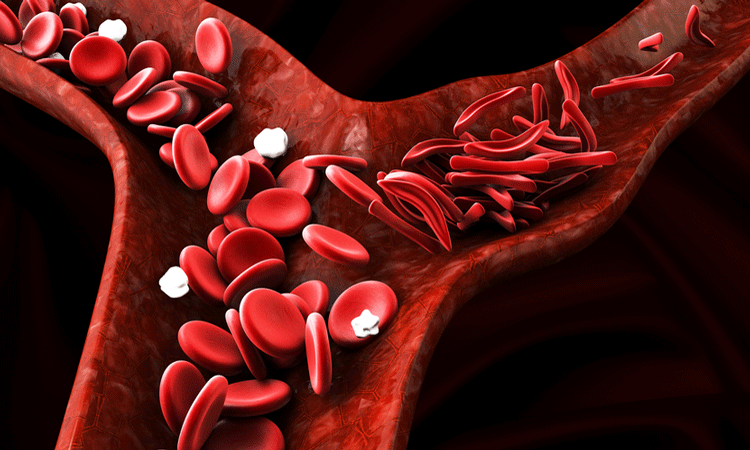
NewsNew CRISPR breakthrough could transform sickle cell treatment
Researchers at UNSW Sydney have unveiled a next-generation CRISPR tool that could lead to safer treatments for genetic disorders, including Sickle Cell.
-
 Article
Challenges in developing robust potency assays for ADCs
Developing robust potency assays for Antibody-Drug Conjugates (ADCs) is crucial for ensuring their clinical success, but designing assays that meet both technical and regulatory standards is challenging. Here, Abzena’s CSO Campbell Bunce explores the complexities of assay development and the importance of ensuring accuracy, consistency and regulatory alignment for ADCs ...
-
 News
NewsFDA-approved asthma drug may protect against food allergy reactions
An existing asthma drug has been shown to almost completely prevent life-threatening allergic reactions to food in mice, after researchers found a previously unknown genetic pathway linked to anaphylaxis.
-
 News
NewsScientists develop 3D-printed dermis for faster burn recovery
Researchers have developed a 3D-printed ‘skin in a syringe’, using a patient’s own cells to create functional dermis that could change the way we treat severe burns.
-
 News
NewsEvenamide targets multiple symptoms in schizophrenia models
New preclinical research suggests that evenamide – a glutamate modulator – targets hippocampal hyperexcitability, potentially addressing positive, negative and cognitive symptoms of schizophrenia.
-
 News
NewsecDNA discovery targets 'zombie' cells in childhood cancers
Researchers have discovered how circular extra-chromosomal DNA drives relapse in childhood cancers and found a way to target dormant “zombie” tumour cells – which could allow for the development of more durable treatments.
-
 Article
Lupus reimagined: targeting the cause, not just the symptoms
Engineered cell therapies are offering a potential new way to treat lupus – not by suppressing symptoms, but by reprogramming the immune system itself. For the first time, lasting remission looks like a real possibility.
-
 News
NewsNew PCAI compound targets aromatase inhibitor-resistant breast cancer
Researchers at Florida A&M University have identified a new compound – NSL-YHJ-2-27 – that disrupts key survival pathways in aromatase inhibitor-resistant breast cancer cells – offering a potential new treatment for hard-to-treat cases.
-
 News
NewsKidney tumour organoids offer new drug testing platform
Scientists in China have used 3D bioprinting to grow kidney tumours from patients’ own cells, creating realistic models that could speed up development of personalised treatments.
-
 News
NewsLithium deficiency identified as key Alzheimer’s trigger
New research from Harvard Medical School shows that natural lithium deficiency in the brain may be a key early factor driving Alzheimer’s disease – which allow for the development of new approaches to preventing and reversing cognitive decline.