


A new peer-reviewed review explores whether psychedelic compounds could influence cancer biology through neurological and immune mechanisms, whilst identifying psychological wellbeing as the most credible near-term clinical opportunity.
Cancer does not develop in isolation from the rest of the body. Tumours can interact with the nervous system, using neuronal signalling to support their growth and progression. Now, researchers are exploring whether drugs that profoundly alter brain activity could also influence these interactions, raising new questions about the relationship between psychological wellbeing, immune function and cancer biology.
A new peer-reviewed review published in Psychedelics examines the potential role of psychedelic compounds in this relationship, bringing together existing clinical research and experimental findings to identify opportunities for future investigation.
The review, written by Feilong Cheng, Dr Cong Lin and Professor Xiaohui Wang of the Changchun Institute of Applied Chemistry, Chinese Academy of Sciences, alongside Professor Shanwen Chen of Peking University First Hospital, considers whether psychedelic-induced changes in brain activity could have wider effects on tumour-associated biological processes.
Importantly, the authors do not suggest that psychedelics are established cancer treatments. Instead, they highlight an emerging area of research where several biological mechanisms are underdeveloped.
Three biological connections worth understanding
1. Malignant synaptic plasticity
The ability of cancer cells, particularly glioma cells, to form functional connections with neurons and use neuronal signals to support tumour growth.
2. Neuroimmune signalling
The communication between the nervous system and immune cells, which can influence inflammation and potentially affect the tumour microenvironment.
3. Psychoplastogens
Compounds that promote neuroplasticity, potentially without producing the subjective psychedelic effects associated with traditional psychedelics.
Why does the nervous system matter in cancer research?
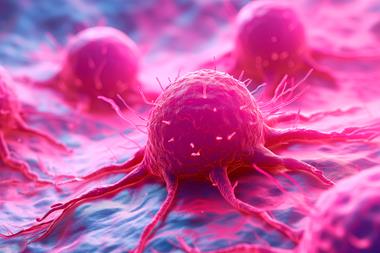
One of the starting points for the review is the growing recognition that cancer cells can interact directly with neuronal networks.
In experimental glioma models, tumour cells have been shown to form functional, synapse-like connections with surrounding neurons. These interactions allow cancer cells to respond to neuronal activity through glutamate signalling and molecules such as neuroligin-3 and brain-derived neurotrophic factor (BDNF).
This occurance has been described as malignant synaptic plasticity, with similar relationships having been observed in other cancers.
Prostate, breast and pancreatic tumours can become infiltrated by autonomic and sensory nerves. In prostate cancer, for example, sympathetic nerve infiltration has been linked to tumour proliferation through norepinephrine and beta-adrenergic signalling.
These findings suggest that the nervous system is not simply responding to cancer but can actively participate in the tumour microenvironment.
For drug discovery researchers, this asks the question, could targeting neurological pathways influence the biological signals that help tumours grow?
What does existing psychedelic research tell us?
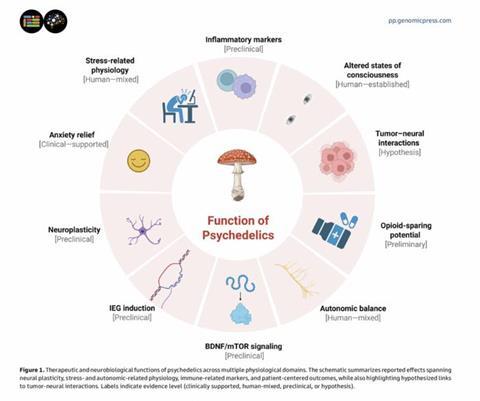
The strongest clinical evidence discussed in the review relates to psychological wellbeing rather than tumour biology.
Advanced cancer can bring significant anxiety, depression, loss of meaning and existential distress. These experiences are not always adequately addressed by conventional medication or psychotherapy.
Randomised controlled trials published in 2016 found that one or two supervised high-dose psilocybin sessions, delivered alongside structured preparation and integration, could produce rapid and sustained reductions in cancer-related anxiety, depression and existential distress.
Patients also reported improvements in their sense of meaning, acceptance and connectedness.
The researchers suggest that these effects could be associated with changes in brain network organisation. Neuroimaging studies have shown that psychedelics can temporarily reduce the internal connectivity of the default mode network, which is associated with self-referential thinking and rumination, while increasing communication between different brain networks.
However, these neurological findings come largely from studies involving healthy volunteers and psychiatric populations. They do not establish the precise mechanisms behind psychological improvements in people with cancer.
Pain management is another potential application, although the evidence is considerably less developed. Early studies suggest that low doses of lysergic acid diethylamide (LSD) may increase pain tolerance and reduce the unpleasantness of experimentally induced pain. Whether this translates into meaningful relief for people with advanced cancer remains to be seen.
Could psychedelics influence tumour biology?
The more speculative aspect of the review concerns the potential relationship between psychedelic compounds, immune signalling and tumour growth.
Some clinical reports have identified reductions in inflammatory markers such as interleukin-6 (IL-6) and tumour necrosis factor-alpha (TNF-alpha) following psilocybin administration. Meanwhile, laboratory studies suggest that activating the serotonin 5-HT2A receptor, the principal target of classic psychedelics, can influence inflammatory signalling in certain immune cell populations.
However, reducing inflammation does not necessarily benefit people with cancer. Some immune responses are essential for recognising and eliminating tumour cells, meaning that suppressing particular inflammatory pathways could potentially weaken anti-tumour immunity.
Animal research also offers some more clues. In tumour-bearing mice, experimentally activating reward-related dopaminergic brain circuitry reduced sympathetic signalling, altered the movement of immunoregulatory cells from the bone marrow and slowed tumour growth.
Whether psychedelic-induced changes in human brain activity could produce comparable effects has not been established.
Some studies have reported accelerated tumour growth following psychedelic administration alone under particular experimental conditions. Others have suggested that combining psychedelics with immune checkpoint inhibitors could improve anti-tumour responses, although these findings require independent replication.
This conflicting evidence highlights why understanding the relationship between neurological and immune pathways will be important before therapeutic conclusions can be drawn.
What happens next?
The authors propose a staged research approach, beginning with clinical trials that prioritise psychological wellbeing and quality-of-life outcomes while also investigating exploratory biological markers.
Further work could examine psychedelic use alongside immunotherapy, investigate their potential role in cancer-related neuropathic pain and fatigue, and use animal models to distinguish direct neuroimmune effects from changes associated with stress.
Ultimately, the researchers argue that the immediate objective should not be ’mystical cures’ but scientifically testable interventions that improve quality of life.
Although the possibility that psychedelic compounds could influence tumour growth remains unproven, the review highlights an increasingly important consideration for cancer research: understanding how the brain, nervous system and immune system interact could reveal new biological pathways worth investigating.
For now, the most credible clinical opportunity remains the treatment of cancer-related psychological distress, while the potential implications for tumour biology represent an emerging area for experimental research.







No comments yet