



A new study published in Nature Microbiology describes two complementary tools – the PAC-MAN screening assay and the MycoPermeNet neural network – that together predict compound permeability across the mycobacterial outer membrane.
Researchers have developed two new techniques that could significantly speed up the search for more effective treatments for tuberculosis (TB), one of the world’s deadliest infectious diseases.
The study was led by the University of Massachusetts Amherst and combines laboratory testing with artificial intelligence to identify chemical compounds capable of penetrating the protective outer membrane of the bacterium responsible for TB, called Mycobacterium tuberculosis (Mtb),
According to the World Health Organization, tuberculosis caused 1.23 million deaths in 2024, making it the world’s deadliest infection caused by a single infectious agent. One of the biggest challenges in treating the disease is the bacterium’s highly protective outer cell membrane, which prevents many antibiotics and other drugs from entering the cell.
Breaking through the bacterium’s defences
The research team’s new approach first measures which chemical compounds can cross the bacterium’s outer membrane before using those results to predict other compounds likely to do the same.
“Mtb is unique,” says Sloan Siegrist, Associate Professor of Microbiology at UMass Amherst and, along with Anna Green, Assistant Professor in UMass Amherst’s Manning College of Information and Computer Sciences, one of the paper’s senior authors. “Not only does it have two membranes that protect the cell from antimicrobial chemical compounds that we might use to kill it, its outer membrane is unlike any other biological barrier out there.”
The research team’s new approach first measures which chemical compounds can cross the bacterium’s outer membrane before using those results to predict other compounds likely to do the same
The outer membrane, known as the mycomembrane, is a major reason why the bacterium is so resistant to both the body’s immune system and existing antibiotics. Siegrist’s laboratory focuses on identifying weaknesses in this barrier to support the development of faster and more effective TB treatments.
Until recently, however, researchers had to test chemical compounds individually to determine whether they could enter Mtb cells, making the process extremely slow.
Combining laboratory science with AI
In 2023, Siegrist co-authored research with Marcos Pires, Professor of Chemistry at the University of Virginia, introducing a technique called Peptidoglycan Accessibility Click-Mediated AssessmeNt (PAC-MAN). The method enabled scientists to screen many compounds simultaneously rather than one by one.
Despite this improvement, the researchers wanted to go further.
“Marcos and I wanted to harness measurements of known chemicals to predict compound uptake for unknown chemicals, so we brought in computational biologists and chemists, including my colleague Anna Green from UMass Amherst’s Manning College of Information and Computer Sciences.”
Green specialises in using computational techniques to identify patterns in biological compounds.
“Small molecules can be particularly difficult to analyse computationally,” she says. “Because they come in all different sizes with a wide range of molecular connections, you can’t describe them with a single measurement – by weight, say, or size.”
Small molecules can be particularly difficult to analyse computationally
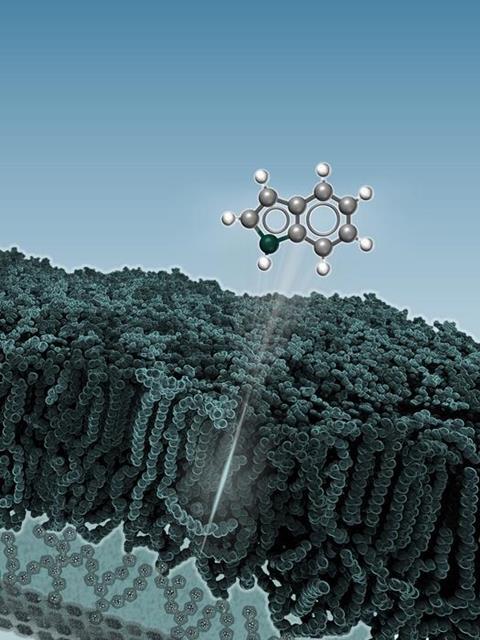
To address this challenge, Green’s team developed an artificial intelligence model called the Mycobacterial Permeability neural Network (MycoPermeNet). Trained using data generated through PAC-MAN, the model can predict how easily a chemical compound will pass through the mycomembrane using its chemical structure alone.
Using both PAC-MAN and MycoPermeNet, the researchers identified characteristics that help compounds penetrate the bacterium’s protective barrier. They also found that these same features are linked to a compound’s ability to kill Mtb, offering a promising route for identifying potential new TB drugs more quickly.
“The mycomembrane lets some molecules through and keeps others out,” says Green. “There must be something about this membrane, and about the chemistry of each molecule, that decides which ones get in—and our combined tools help us figure out which ones can get through, and why.
Potential to speed up drug discovery
While further research will be needed before the findings translate into new treatments, the researchers believe the combined approach could significantly reduce the time needed to identify promising drug candidates.
The researchers believe the combined approach could significantly reduce the time needed to identify promising drug candidates
By enabling them to rapidly predict which compounds are most likely to penetrate the bacterium’s protective outer membrane, the techniques could allow researchers to focus their efforts on the most promising molecules instead of testing vast numbers individually.
The team also suggests that the approach could provide new insights into how the bacterium’s unique outer membrane functions, helping researchers design medicines that are better able to overcome one of the biggest barriers to successful tuberculosis treatment.

No comments yet