




Researchers at Nagoya University have identified elevated blood levels of N-acyl taurines as a marker of rapidly progressing ALS and demonstrated that a compound targeting their breakdown slowed motor decline and extended survival in preclinical models.
A metabolic signal found in the blood of people with amyotrophic lateral sclerosis (ALS) could help researchers track how quickly the disease is progressing and identify new treatment strategies, according to a study led by Nagoya University researchers in Japan.
The team found that blood levels of molecules called N-acyl taurines (NATs) were higher in people with rapidly progressing ALS and that patients with the highest levels had shorter survival times. In experiments using patient-derived cells and ALS mouse models, the researchers also found that increasing NAT levels with the compound PF-04457845 slowed motor decline and extended survival.
The findings point to a new route into ALS drug discovery by starting with metabolic changes observed directly in patients rather than relying primarily on laboratory models.
“We therefore began by analysing patient blood samples to map metabolic changes and identify treatments suggested by the results,” said Professor Masahisa Katsuno.
What are NATs?
N-acyl taurines are lipid-related signalling molecules that form part of the extended endocannabinoid system, a network involved in regulating processes including inflammation, metabolism and nervous system function.
In this study, higher NAT levels were associated with faster ALS progression. The researchers propose that this may represent a protective response by the body which is ultimately unable to compensate for the damage caused by the disease.
That raises an important therapeutic question: rather than suppressing NATs, could increasing their levels help protect vulnerable nerve cells?
Why does this matter for early drug discovery?
ALS causes progressive loss of upper and lower motor neurons, leading to worsening muscle weakness and ultimately respiratory failure. Around 90-95 percent of ALS cases are sporadic rather than familial, meaning there is no known family history of the disease.
That distinction matters for drug discovery. SOD1-based mouse models are widely used in ALS research and can reproduce important features of motor neuron degeneration and changes in glial cells. However, they do not necessarily reflect the full pathogenesis of sporadic ALS. The researchers acknowledge this as a limitation of their study.
ALS also involves systemic metabolic changes, including altered glucose metabolism and a hypermetabolic state. Rather than treating these changes simply as consequences of the disease, the Nagoya team asked whether they could contain clues to the mechanisms driving different rates of progression.
The researchers analysed blood from a discovery cohort of 26 people with ALS and 10 healthy controls, followed by a replication cohort involving 55 people with ALS and 25 healthy controls. All participants were Japanese and were recruited at Nagoya University Hospital.
An untargeted metabolomics screen identified several metabolites associated with disease progression. NATs were particularly notable because their levels correlated with changes in the revised ALS Functional Rating Scale and with survival.
From patient blood to potential treatment
The researchers next tested compounds against metabolic pathways identified through their patient analysis. PF-04457845 emerged as a promising candidate because it inhibits FAAH, an enzyme involved in breaking down several lipid mediators.
Rather than simply increasing NATs, FAAH inhibition upregulated the expanded endocannabinoid system, including NATs and N-acyl ethanolamines (NAEs), in the researchers’ models. This means the study does not establish NATs as the sole mediator of the compound’s effects.
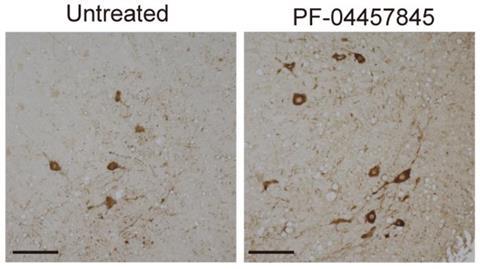
PF-04457845 reduced signs of motor neuron degeneration in ALS cellular models and in motor neurons generated from patient-derived induced pluripotent stem cells. The researchers also observed effects on neurite preservation, showing that the compound could protect vulnerable neuronal structures.
The team then tested the compound in SOD1^G93A ALS mice. Treated animals lived for 138 days compared with 129.5 days in untreated animals and showed improved motor performance. The treatment also produced changes in the spinal cord’s cellular environment.
How does this fit with what’s already happening in the field?
The study combines three levels of evidence that are often investigated separately: human metabolic data, patient-derived cells and an established ALS animal model.
Gene expression and single-nucleus RNA sequencing suggested that PF-04457845 may work partly by changing the behaviour of microglia, immune cells in the nervous system. The researchers observed a more neuroprotective microglial phenotype alongside changes in lipid metabolic support. They also found evidence of effects on neurons involving pathways linked to neuronal development, survival and synaptic plasticity.
This broader mechanism is significant because ALS is increasingly understood as a disease involving interactions between motor neurons and their surrounding cellular environment rather than simply the death of motor neurons in isolation.
What happens next?
The researchers say larger patient studies will be needed to determine whether NATs can become a practical biomarker of disease progression or treatment response. Further work will also be required to establish which components of the expanded endocannabinoid system are responsible for the observed effects.
“Through our reverse translational approach, beginning with patient blood analysis, we identified metabolic changes throughout the body,” Katsuno said. “Based on these findings, we explored new treatments and demonstrated that the potential drug is effective in both patient-derived iPS cells and animal models.”
For ALS drug discovery, the wider significance may ultimately lie in the strategy as much as the compound itself: using patient-derived metabolic signals to identify biological pathways before testing them in increasingly complex models could help researchers find therapeutic opportunities that conventional model-first approaches miss.
Key takeaways
- Higher blood NAT levels were associated with faster ALS progression and shorter survival.
- PF-04457845 increased NAT availability by blocking its breakdown.
- The compound protected ALS patient-derived motor neurons in laboratory experiments.
- In ALS mice, treatment extended lifespan and improved motor function.
- The findings indicate that metabolism and the endocannabinoid system could be potential areas for further ALS research.









No comments yet