



An integrated discovery platform combining desorption electrospray ionisation mass spectrometry with automated synthesis and screening could transform early-stage drug development by enabling researchers to generate, evaluate and refine therapeutic candidates within a unified system.
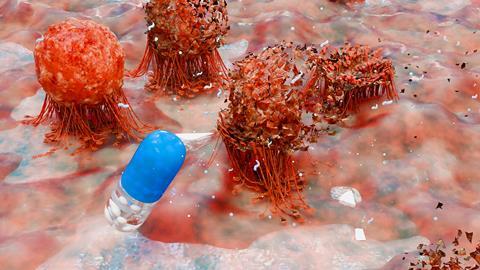
Researchers at Purdue University have developed a next-generation technology platform that could improve one of the most difficult stages of cancer drug discovery by rapidly identifying compounds with the potential to become new treatments.
The automated ultrahigh-throughput platform, created by scientists at the Purdue Institute for Cancer Research (PICR), combines chemical synthesis, biological testing and mass spectrometry into a single workflow. The technology allows researchers to generate and refine drug candidates within the same system, potentially reducing the time needed to develop therapies for challenging cancer targets.
The findings were recently published in the Proceedings of the National Academy of Sciences and represent more than a decade of research and development.
Tackling a major bottleneck
According to Nicolás Morato, research assistant professor at the PICR and lead author of the study, drug discovery remains a numbers game.
“Drug discovery is a fight against probability,” Morato said. “You’re searching through enormous biological space and even larger chemical space trying to find the right molecule for the right target. If you can’t make compounds fast enough and test them fast enough, it becomes a battle you’re going to lose.”
The platform is built around desorption electrospray ionisation mass spectrometry (DESI-MS). It enables scientists to analyse and test compounds quickly using very small sample volumes and highly automated processes.
The platform is built around desorption electrospray ionisation mass spectrometry (DESI-MS)
Traditionally, chemists synthesise compounds before biologists test them against disease targets. Researchers then spend considerable time purifying and analysing results before repeating the process.
“If you walk through a chemistry building late at night, the lights that are still on are probably organic synthesis labs,” Morato said. “You still see flasks on heating plates waiting overnight for reactions. Meanwhile, biology has evolved into highly automated, instrumentation-driven science. There’s been a disconnect between those worlds.”
Faster route to new treatments
The Purdue system aims to unite these separate stages into a single process, helping researchers identify promising drug candidates more quickly.
Andrew Mesecar, director of the Purdue Institute for Cancer Research, said the platform could help address the growing number of cancer targets identified through genomics, artificial intelligence and computational research.
“The new DESI-MS platform enables researchers to rapidly screen tens of thousands of molecules against newly identified cancer targets to identify promising therapeutic candidates,” Mesecar said. “Every year we eliminate from the drug development process means we will get new drugs to patients faster and extend their lives.”
The Purdue system aims to unite these separate stages into a single process, helping researchers identify promising drug candidates more quickly
Researchers have already used the system to reassess a cancer-associated enzyme target, with the platform quickly demonstrating that a heavily studied compound was not interacting with the target as previously believed.
“It was difficult because people had invested years of work into it,” Morato said. “But the platform immediately showed us the compound wasn’t doing what we thought it was doing. That allowed the project to change direction much faster instead of continuing to lose time.”
Looking to the future
The platform can complete stages of early drug discovery in hours rather than days or weeks. In one proof-of-concept study, researchers completed an integrated discovery cycle in around four hours.
For Purdue chemist Graham Cooks, whose laboratory invented DESI nearly 20 years ago, increasing speed remains critical.
“The Achilles’ heel of drug discovery is its low speed,” Cooks said. “This platform increases the speed of several distinct aspects of drug discovery.”
Morato believes the technology will become increasingly valuable as artificial intelligence generates larger numbers of potential drug candidates.
The Achilles’ heel of drug discovery is its low speed
“AI is only as good as the data you feed it,” Morato said. “What this platform allows us to do is generate huge volumes of high-quality experimental data very quickly. That creates the possibility for faster cycles of prediction, testing and optimisation.”
Researchers hope the technology will soon be adopted more widely across cancer research and drug discovery programmes.
“It really took a village to build this,” Morato said. “This was academic researchers, federal researchers, industry collaborators, engineers, biologists and chemists all working together toward the same goal.”










No comments yet