Japanese researchers have developed a nasal HPV vaccine that could offer a non-invasive, fertility-preserving alternative to surgery for cervical cancer.
Cervical cancer, one of the most common cancers affecting women worldwide, is primarily caused by the human papillomavirus (HPV), a virus transmitted through sexual contact. While preventive HPV vaccines and regular screening tests can reduce the risk of developing the disease, there are currently no approved therapeutic medicines to treat current infections or HPV-associated cancers. As a result, surgery remains the main treatment option, along with radiotherapy and chemotherapy.
Now, a new study from Chiba University researchers has developed a therapeutic HPV vaccine that can be administered through the nose, offering a potential non-invasive treatment for individuals already infected with the virus.
A novel approach through nasal administration
Unlike injectable vaccines, nasal vaccines trigger an immune response at the mucosal surface lining the upper airway. This response not only helps protect the airway itself but also extends to distant mucosal sites, including the reproductive tract, providing a protective barrier against pathogens.
Unlike injectable vaccines, nasal vaccines trigger an immune response at the mucosal surface lining the upper airway.
Building on previous research showing that nasal immunisation produced strong immune responses in the reproductive tract against herpes simplex virus type 2 (HSV-2), the team focused on HPV.
“We have developed an intranasal therapeutic vaccine as a non-surgical alternative to conventional treatments that can compromise women’s quality of life,” said Associate Professor Rika Nakahashi-Ouchida. “This novel nasal vaccine activates the mucosal homing pathways of lymphocytes, allowing it to trigger an immune response in the cervical mucosa, a site from the nasal administration.”
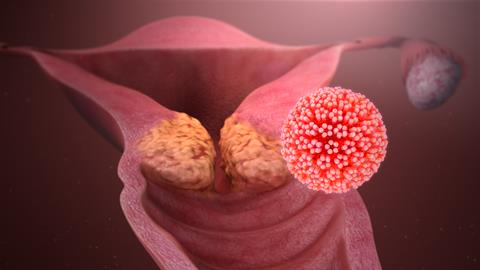
 The experimental nasal vaccine developed at Chiba University stimulated strong and long-lasting immune responses in animal models, activating tumour-fighting cells in the cervix and slowing cervical tumour growth. This approach offers a promising new direction for cervical cancer treatment, moving beyond conventional therapies. Credit: “HPV causing cervical cancer” by www.scientificanimations.com.[/caption]
 How the vaccine works
The vaccine targets the E7 oncoprotein, produced by HPV16, a high-risk strain linked to cervical cancer. E7 inactivates the tumour suppressor pRb, which normally prevents cancer occurring. To enhance the immune response, the team added cyclic-di-AMP (c-di-AMP), an immune-boosting adjuvant that encourages T cells to attack infected or cancerous cells.
The vaccine targets the E7 oncoprotein, produced by HPV16, a high-risk strain linked to cervical cancer.
To deliver the HPV antigens, the researchers employed cationic nano-sized hydrogel particles called cCHP nanogels. Composed of positively charged cholesteryl groups forming small spherical structures, the nanogels attach to the negatively charged nasal mucosa and gradually release the antigens to trigger the body’s immune response.
Promising results in animal studies
The resulting vaccine, cCHP-E7 + c-di-AMP, demonstrated strong antitumour activity in both mice and macaques. In mouse models, the nasal vaccine significantly slowed tumour growth compared with control groups. In macaques, nasal administration using a device suitable for human use induced high levels of E7-specific helper and killer T cells after four doses. Immune activity was also detected in cervical tissue, suggesting protection at the critical site of infection. Even four months after the final dose, E7-specific killer T cells remained active, indicating a lasting immune defence.
A potential game-changer in cervical cancer treatment
According to the World Health Organization, cervical cancer caused an estimated 660,000 new cases and 350,000 deaths in 2022. If proven safe and effective in humans, this nasal vaccine could revolutionise treatment by offering a non-invasive, fertility-preserving alternative to surgery.
Researchers also suggest that the cCHP nanogel delivery system could serve as a platform for nasal vaccines against other pathogens, expanding its clinical applications beyond cervical cancer.