



An international research team has deployed a two-stage machine learning system to overcome data limitations in targeting glycoprotein 130, achieving 56 percent tumour growth inhibition in xenograft models with structurally optimised indolopyridine derivatives.

Researchers have developed an artificial intelligence-assisted drug discovery platform that has identified a promising new compound targeting colorectal cancer.
The international study, led by Professor Wenying Yu and Professor Yixian Liao from China Pharmaceutical University alongside global collaborators, focused on glycoprotein 130 (gp130), a key signalling receptor involved in inflammatory and cancer-promoting pathways.
Gp130 plays a key role in activating the JAK2/STAT3 signalling pathway, which is linked to tumour growth and survival in several cancers, including colorectal cancer. Despite its therapeutic potential, drug development targeting gp130 has progressed slowly because of the limited number of known active compounds available for machine learning analysis.
AI pipeline overcomes major research obstacle
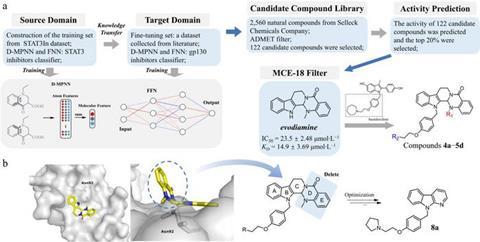
To address this challenge, researchers designed a two-stage AI-assisted drug discovery system using transfer learning, a machine learning approach that allows models trained on one dataset to be adapted for related tasks.
The team first trained a predictive model using data from known STAT3 inhibitors, a pathway closely linked to gp130 signalling. Researchers then fine-tuned the model using a smaller curated dataset of gp130 inhibitors. Using this strategy, scientists screened a library of 2,560 natural products while applying strict filters for drug safety, metabolic properties and structural novelty.
The team first trained a predictive model using data from known STAT3 inhibitors, a pathway closely linked to gp130 signalling
This process identified evodiamine, a naturally occurring compound, as a promising starting point for further development.
Researchers subsequently used structural hybridisation and chemical optimisation techniques to develop a series of indolopyridine derivatives. Among them, Compound 8a emerged as the leading candidate.
Strong anti-cancer activity demonstrated
Laboratory testing showed that Compound 8a binds directly to the gp130 D1 domain with significantly higher affinity than several existing compounds, including evodiamine, rutaecarpine and bazedoxifene.
Further biochemical analysis demonstrated that 8a selectively blocks gp130-mediated JAK2/STAT3 phosphorylation, preventing activation of cancer-promoting signalling pathways. The compound also inhibited STAT3 DNA binding and reduced levels of oncogenic proteins Bcl-2 and Cyclin D1, both associated with tumour growth and survival.
Functional studies using HT-29 colorectal cancer cells demonstrated that 8a strongly inhibited cancer cell proliferation and triggered mitochondrial apoptosis, a form of programmed cell death. Researchers found that the activity of the compound depended on gp130 expression, supporting its targeted mechanism of action.
Promising results in animal studies
The compound was also tested in HT-29 xenograft mouse models of colorectal cancer.
At a dose of 20mg/kg, Compound 8a achieved tumour growth inhibition of 56.20 percent without noticeable systemic toxicity. The treatment also outperformed bazedoxifene under the same experimental conditions.
At a dose of 20mg/kg, Compound 8a achieved tumour growth inhibition of 56.20 percent without noticeable systemic toxicity
Preliminary metabolic stability studies in rat liver microsomes also suggested that 8a has improved pharmacokinetic properties compared with evodiamine, potentially increasing its suitability for future therapeutic development.
Potential blueprint for future cancer therapies
This study demonstrates how transfer learning can accelerate drug discovery in areas where biological data remains limited.
The researchers believe the approach could provide a framework for identifying inhibitors targeting other understudied cytokine receptors and signalling pathways linked to cancer and inflammatory disease.
Compound 8a is now considered a structurally novel and mechanistically distinct gp130-targeted anti-tumour candidate with potential applications not only in colorectal cancer but also in other malignancies driven by IL-6/gp130 signalling.
While further preclinical and clinical testing will be required, the findings highlight the growing role of AI-driven methods in accelerating the discovery of next-generation cancer therapies.







No comments yet