
Researchers in Japan have identified a promising blood-based marker that could enable faster, simpler and more accurate detection of liver fibrosis.
Researchers at the Osaka Metropolitan University have identified a potential new blood-based marker that could help diagnose liver fibrosis earlier and more accurately than current methods. The discovery could help people at risk of cirrhosis and liver cancer, particularly those with a history of chronic hepatitis C.
A growing need for earlier diagnosis
Liver fibrosis occurs when long-term damage – often caused by alcohol abuse or viral infections – triggers the replacement of healthy liver tissue with collagen fibres. Over time, this scarring can progress into cirrhosis, leading to declining liver function.
Patients with chronic hepatitis C are particularly vulnerable. Even after successful antiviral treatment, fibrosis can continue to develop, creating an ongoing risk of liver failure and liver cancer. Because fibrosis is the strongest known risk factor for hepatocellular carcinoma, the most common form of liver cancer, researchers worldwide have been seeking reliable, non-invasive methods for early detection.
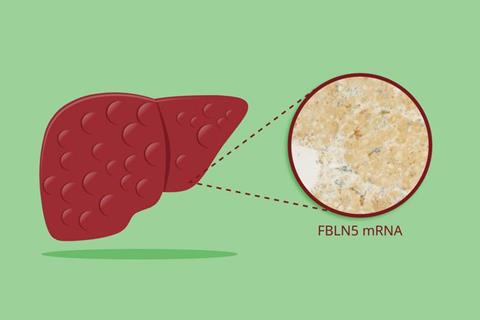
 FBLN5 detection in human hepatic stellate cells could act as an early warning sign of liver damage. Credit: Osaka Metropolitan University.[/caption]
 Investigating a new biomarker
A research team led by Associate Professor Misako Sato-Matsubara at Osaka Metropolitan University’s Graduate School of Veterinary Science has been looking into the potential of fibulin-5 (FBLN5) – a component of elastic fibres in the body – to use as a diagnostic marker.
Their findings demonstrated that activated HSCs generate FBLN5, indicating a direct connection between the protein and the fibrotic process.
Using human hepatic stellate cells (HSCs), the liver cells responsible for driving fibrotic scarring, the team conducted in vitro experiments to assess how FBLN5 is produced. Their findings demonstrated that activated HSCs generate FBLN5, indicating a direct connection between the protein and the fibrotic process.
To understand how this translates to clinical cases, the researchers analysed plasma and tissue samples from 90 chronic hepatitis C patients who had undergone liver biopsies. Of these patients, 72 showed expression of FBLN5 in liver tissue using immunohistochemistry, and 67 displayed detectable levels of the protein in their blood.
Higher accuracy than existing tests
One of the key outcomes of the study was the clear association between FBLN5 levels and the severity of liver fibrosis. According to the researchers, the amount of FBLN5 in the blood rose consistently as fibrosis advanced. This suggests that FBLN5 may outperform the commonly used type IV collagen test, which has long been a standard tool for clinicians monitoring liver health.
If validated in larger clinical studies, FBLN5 could help doctors identify patients at an earlier stage – before irreversible liver damage or cancer has set in.
Expert insights and future directions
The researchers are now hoping to refine the detection method and progress to broader clinical testing.
Advancements in this research could enable earlier and simpler detection of liver fibrosis.
“Moving forward, we plan to develop a method capable of detecting FBLN5 more accurately and proceed with testing using actual patient samples,” said Professor Sato-Matsubara. “Advancements in this research could enable earlier and simpler detection of liver fibrosis, potentially leading to earlier diagnosis and treatment of liver disease.”
Topics
- Analytical Techniques
- Assays
- Associate Professor Misako Sato-Matsubara (Osaka Metropolitan University’s Graduate School of Veterinary Science)
- Biomarkers
- Cancer
- Digestive disorders
- Disease Research
- High-Throughput Screening (HTS)
- In Vitro Testing
- Molecular Biology
- Osaka Metropolitan University
- Research and development
- Translational Science