At World ADC London 2026, experts highlighted how advances in payload design, targeting strategies and AI-driven discovery are changing antibody–drug conjugate development.
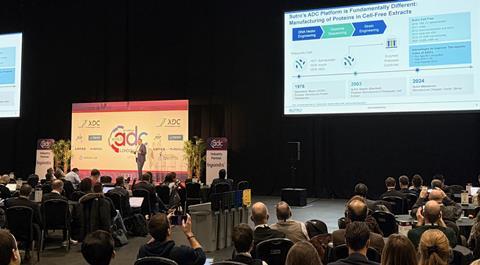
When Drug Target Review attended World ADC 2026 it quickly became clear that this was not just a showcase of the latest ADCs and platform technologies, but a vivid demonstration of how the field is evolving towards smarter payloads, more precise targeting, integrated discovery platforms and ultimately patient-centric outcomes.
Rather than focusing on bold claims, the conference emphasised practical progress: how innovative approaches, robust preclinical validation and AI-driven insights are aiding the discovery and development of ADCs. Through speaking to experts in the field, five recurring themes emerged.
1. ADC design is moving towards holistic integration
A major focus of the conference was the growing recognition that ADCs must be designed as fully integrated therapeutics, where antibody, linker, conjugation strategy and payload all work together. Joshua Greally, ADC lead at Sygnature Discovery, explained:
“The DMTA cycle [design, make, test, analyse] needs to be expanded to include each ADC component. Only then can we produce a therapy truly fit-for-purpose, designed around the target disease.”
It’s about understanding every interaction in the ADC – not just the individual components but how they influence each other.
Sarka Stehlikova, Director of Biologics Core Technologies at Sotio Biotech, reinforced this idea, highlighting the importance of balancing design with mechanistic insight:
“It’s about understanding every interaction in the ADC – not just the individual components but how they influence each other. A holistic approach ensures the final molecule works as intended in the patient.”
Allan Jordan, VP of Oncology Drug Discovery at Sygnature Discovery, also echoed this, emphasising that payloads are no longer secondary considerations and noting the following trend:
“We’re definitely seeing a move from generic and highly toxic payloads to those crafted to have the right properties for an ADC, and to be much more specific for the diseased cell versus normal tissues.”
The consensus was clear. Taking a holistic approach increases efficacy, reduces off-target effects and supports ADCs to succeed in increasingly complex oncology settings.
2. Expanding the therapeutic window through smarter payloads
Payload innovation was a recurring narrative. Traditional ADC payloads often drive systemic toxicity, which limits the therapeutic window and patient tolerability.
Tony Eglezos, Head of Business Development at Starpharma, described how their flexible dendrimer-based platform addresses this problem:
“The dendrimer allows us to control payload release rates, manage biodistribution and pharmacokinetics eliminate the high Cmax effects that often drive toxicities.”
Traditional ADC payloads often drive systemic toxicity, which limits the therapeutic window and patient tolerability.
Stehlikova also highlighted how her team at Sotio is leveraging payload innovation to balance potency and tolerability:
“The goal is to expand the therapeutic window without sacrificing efficacy. By refining payload selectivity and linker design, we can reduce systemic toxicity and improve patient outcomes.”
By integrating chemistry, biology and computational insight, companies are expanding the therapeutic window, keeping potency high while minimising side effects.
3. Bispecific targeting and proteomics are unlocking new opportunities
Target biology remains a bottleneck for many ADCs. Bispecific ADCs, which engage two antigens simultaneously, were highlighted as a way to improve tumour selectivity and efficacy. Dr Michael Hunter, CEO of Promatix Biosciences, shared insights from his team’s work:
“By applying our proprietary proteomics database, TX Pro, we’ve identified over 2,000 potential cis-bispecific target pairings with strong differential expression across tumour numerous types. Coupled with an AND gating approach, this has significantly opened up previously untapped target space in oncology.”
Bispecific ADCs, which engage two antigens simultaneously, were highlighted as a way to improve tumour selectivity and efficacy.
Hunter emphasised the importance of patient-derived data too:
“We need to start at the patient and focus on protein not mRNA. Comparing tumour cell surface protein expression with healthy tissue enables targeting that minimises toxicity.”
Across the field, advanced proteomics and computational screening are enabling researchers to explore targets previously thought inaccessible, providing a foundation for the next generation of ADCs.
4. Preclinical validation and biomarkers are more important than ever
Experts highlighted that ADC development increasingly mirrors small-molecule discovery, emphasising mechanistic understanding and early biomarker integration. Sygnature’s Greally explained:
“We need to understand every mechanism: antigen engagement, internalisation, payload release and endosomal escape. Each should inform early biomarker strategy.”
We need to understand every mechanism: antigen engagement, internalisation, payload release and endosomal escape.
Jason Holsapple, Principal Scientist at Outer Biosciences, described how his team’s physiologically relevant skin models complement these approaches:
“Our platform lets us detect potential toxicity that traditional cell-based or animal models may miss, particularly for ADC payloads. Early insight means safer therapies later.”
Robust preclinical validation, from histochemistry to cell-based assays, is now seen as essential to guide ADC design before clinical testing begins.
5. AI and computational platforms are driving precision and efficiency
Finally, artificial intelligence and machine learning were discussed repeatedly as tools to streamline ADC discovery.
Our machine learning platform allows us to integrate data from multiple donors and experiments, screen compounds early and focus on the most promising candidates.
“Our machine learning platform allows us to integrate data from multiple donors and experiments, screen compounds early and focus on the most promising candidates,” said Holsapple of Outer Bioscience’s AI platform.
Similarly, Michael Hunter highlighted how predictive algorithms can help optimise binding affinities for bispecific ADCs:
“Our models ensure hybrid avidity for tumour binding while minimising monovalent off-target effects – we’re not flying blind.”
Conclusion
World ADC 2026 highlighted a field in transformation. Experts agreed that the future of ADCs lies in integration between chemistry, biology, payloads, targets and AI-driven insight. Bispecific designs, selective payloads, robust biomarker strategies and predictive computational tools are all converging to create safer and stronger therapies.
As Joshua Greally put it:
“The next generation of ADCs will be safer, more effective and truly designed around the patient.”
From preclinical discovery to clinical translation, ADC development is moving beyond incremental improvements towards a fully integrated, patient-centric approach – a shift that promises not just new drugs but better outcomes for patients worldwide.