A study from the Institut Pasteur reveals how cellular senescence during mammary gland involution after pregnancy may both aid tissue repair and promote postpartum breast cancer.
Postpartum breast cancer, diagnosed five to ten years after giving birth, carries a higher risk of metastasis and lower survival rates compared with women who have not been pregnant or those diagnosed during pregnancy. To investigate this, a team from the Institut Pasteur looked into the mechanisms within the mammary gland that may contribute to tumour formation during the major tissue remodelling process that occurs after pregnancy, called involution.
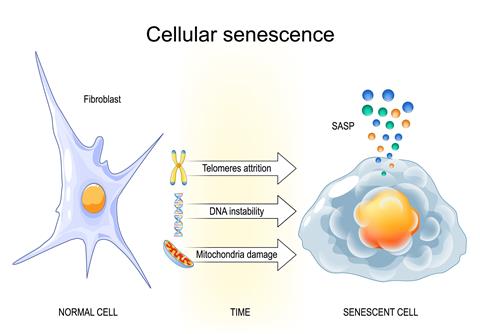
Their study reveals that cellular senescence, a response that induces stable cell cycle arrest, plays an ambivalent role during mammary gland involution. While senescence is essential for normal tissue remodelling, it can also be exploited by tumour cells to help them spread. The research suggests that targeting senescent cells during involution could reduce the risk of postpartum breast cancer.
Mammary gland involution: a complex repair process
After pregnancy and breastfeeding, the mammary gland undergoes extensive transformation to return to its pre-pregnancy state. This process, known as postpartum involution, resembles wound healing. It involves the elimination of millions of milk-producing alveolar epithelial cells, infiltration of immune cells, remodelling of the extracellular matrix and repopulation with adipocytes.
Involution is also a critical period, as the inflammatory environment created during this process temporarily increases the risk of breast cancer. Women diagnosed with postpartum breast cancer face a higher likelihood of metastasis and lower survival rates compared with other patients, regardless of hormone receptor status. Additionally, the risk further rises with maternal age.
 Left: Morphology of a mouse mammary gland after labelling to detect senescent cells (in blue). Center: Close-up of the distal part of the mammary gland. Right: Histological section of a mouse mammary gland after labelling. Senescent alveolar structures are labelled in blue. The milk ducts are labelled in pink. © Institut Pasteur / Cellular Plasticity in Age-Related Pathologies Unit[/caption]
 How senescence orchestrates tissue remodelling
By studying mammary gland physiology in mice, the Cellular Plasticity in Age-Related Pathologies Unit at the Institut Pasteur, led by Han Li, identified senescent cells specifically appearing during involution, the majority of which were milk-producing alveolar cells.
Using pharmacological treatment to selectively remove senescent cells, the researchers confirmed that senescence is essential for normal involution.
Using pharmacological treatment to selectively remove senescent cells, the researchers confirmed that senescence is essential for normal involution. Without it, tissue remodelling is delayed. The study also showed that senescent cells actively recruit immune cells such as macrophages by secreting signalling molecules, guiding the restructuring of the microenvironment.
"These results show that senescence is not simply an epiphenomenon; it is a key player in the complete tissue remodelling of the mammary gland during involution – a remarkable process of reconstruction that leaves no scars or lasting damage," said Aurélie Chiche, first author of the study.
Senescence hijacked by cancer cells
The research also discovered the paradoxical role of senescence, while beneficial for tissue repair, it can also be hijacked by tumour cells. Factors secreted by senescent cells enhance the plasticity of cancer cells, allowing them to adapt to environmental changes and spread more effectively. In mouse models of breast cancer, eliminating senescent cells during involution significantly delayed tumour growth and reduced metastasis formation.
The researchers hope that their work could eventually lead to preventive treatments for this aggressive and currently under-addressed form of breast cancer.
"Our results suggest that targeted intervention to eliminate senescent cells during mammary gland involution could reduce the risk of postpartum breast cancer," said Han Li, last author of the study.
The researchers hope that their work could eventually lead to preventive treatments for this aggressive and currently under-addressed form of breast cancer. The study also provides a foundation for future drug discovery efforts aimed at developing new interventions for postpartum breast cancer.