



Researchers have engineered single-component protein nanocages that spontaneously form complex spherical structures up to 220 nanometres in diameter, offering new possibilities for targeted drug delivery.

An international team of researchers has successfully designed large-scale protein structures that mimic the sophisticated self-assembly mechanisms used by naturally occurring viruses.
The breakthrough was led by Professor Sangmin Lee of the Department of Chemical Engineering at Pohang University of Science and Technology (POSTECH) in collaboration with Professor David Baker of the University of Washington. Together, they developed a new design principle that enables a single protein component to form both pentagonal and hexagonal arrangements simultaneously, allowing it to self-assemble into complex virus-like structures.
Protein nanocages seen as future of drug delivery
Protein nanocages have been growing as a research focus in recent years due to their potential as a platform for next-generation drug delivery systems. These hollow structures, which measure only nanometres in size, are formed when multiple proteins spontaneously bind together.
Scientists believe they could provide an effective means of transporting drugs, genetic materials and enzymes within the body. Antigens can also be attached to their outer surface, making them potentially useful in vaccine development.
Protein nanocages have attracted growing interest in recent years as a potential platform for next-generation drug delivery systems
However, existing design approaches have generally relied on computationally generated structures with perfect symmetry. While effective for producing relatively simple forms, this method limits the size and complexity of structures that can be created from a single protein building block.
Researchers replicate nature’s quasisymmetry principle
To overcome this challenge, the research team turned to a strategy commonly found in nature.
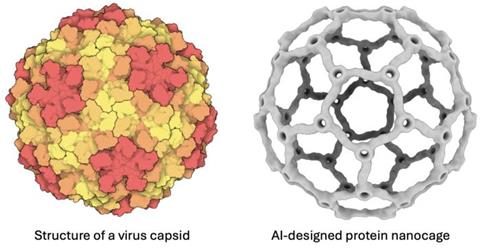
Many viruses are built from a single type of protein repeated hundreds or even thousands of times. Rather than arranging these proteins in identical positions, viruses subtly alter the local environment and orientation of each component to create large protective shells. This architectural principle is known as quasisymmetry.
The researchers identified the relationship between angles and curvature in protein assemblies as the key factor controlling shell size. Structures that are too flat fail to close, while excessive curvature results in smaller assemblies.
Many viruses are built from a single type of protein repeated hundreds or even thousands of times
By carefully balancing these forces, the team engineered a single protein capable of occupying both pentagonal and hexagonal positions depending on where it was located within the structure.
To achieve this, researchers used a trimeric unit, consisting of three proteins, as the basic building block. They then employed RFdiffusion, an AI-based protein structure generation tool, to design entirely new connecting structures.
The resulting approach allowed proteins to fit together at multiple angles, creating large dome-shaped shells rather than flat sheets.
Microscopy confirms successful assembly
The team produced the designed proteins using E. coli and examined them using advanced cryo-electron microscopy.
The analysis confirmed that the proteins spontaneously assembled into spherical shells ranging from approximately 70 nanometres to 220 nanometres in diameter. Researchers described the smallest structure as resembling a highly intricate nano-sized football, while the largest was more than three times larger.
Potential applications across medicine
The study has generated large amounts of interest because it did not rely on modifying existing viral proteins. Instead, researchers created large virus-like structures using a single protein designed entirely through artificial intelligence.
If successfully commercialised, the technology could support a range of biomedical applications, including targeted drug delivery systems, genetic material transport and vaccine antigen presentation platforms.
The study has generated large amounts of interest because it did not rely on modifying existing viral proteins
The team is now planning follow-up research aimed at improving size consistency by using internal scaffold proteins or nucleic acids as templates, with the aim to expand the technology’s medical potential.







No comments yet