



A new study has revealed the molecular mechanism by which amino acid abundance triggers release of LARS1 from the multi-tRNA synthetase complex, activating mTORC1-dependent growth signalling – which could support the development of upstream-targeted cancer therapies that spare healthy cells.

Researchers from KAIST and Yonsei University have discovered the molecular mechanism that enables cells to detect amino acids and activate their internal growth switch.
The study identified how amino acid signals trigger mTORC1-dependent growth signalling, providing a new look into one of the body’s most important cellular control systems. The research was led by Professors Hee-Sung Park and Jin Young Kang from the Department of Chemistry, working alongside Professor Sunghoon Kim’s team at Yonsei University.
Understanding the cell’s growth switch
Cells are always monitoring their environment to determine whether sufficient nutrients are available, particularly amino acids. This information influences cell growth, protein production and energy use.
At the core of this process is mTORC1 (mammalian Target of Rapamycin Complex 1), a protein complex that acts as the cell’s growth switch. When nutrients and energy are plentiful, mTORC1 stimulates cell growth, metabolism and protein synthesis.
However, excessive activation of mTORC1 can drive uncontrolled cell growth, a hallmark of many cancers. Although mTORC1 has been recognised as a promising target for cancer drugs, the precise mechanism by which nutrient signals activate the complex has remained unclear.
Key role for LARS1
The research focused on the multi-tRNA synthetase complex (MSC), a large protein assembly involved in protein production. While aminoacyl-tRNA synthetases are known for attaching specific amino acids to transfer RNA during protein synthesis, the team discovered that the MSC also plays an important role in nutrient sensing.
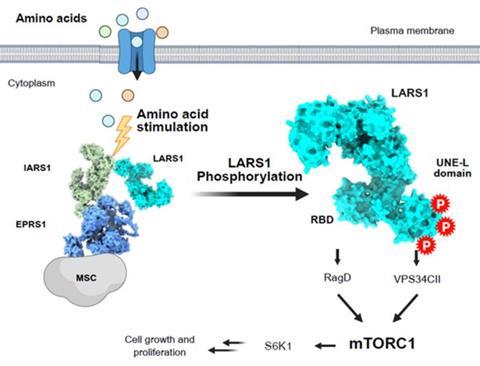
Central to the process is LARS1 (leucyl-tRNA synthetase 1), an enzyme that both attaches leucine to its corresponding tRNA and acts as an intracellular leucine sensor.
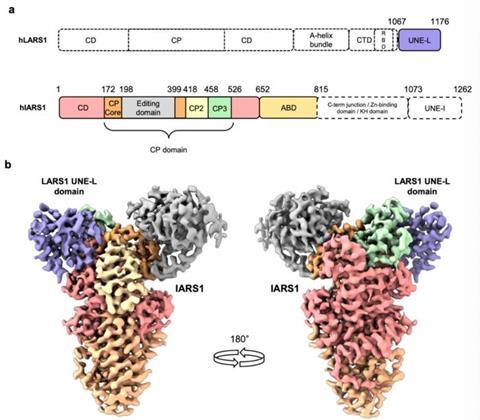
The researchers found that when amino acids become abundant, LARS1 undergoes phosphorylation, a chemical modification that changes how the protein behaves. This weakens its interaction with IARS1, the protein that anchors LARS1 within the MSC, allowing LARS1 to break free and activate mTORC1.
When nutrients are scarce, LARS1 remains bound within the MSC, preventing activation of the growth pathway. Once nutrient levels rise, LARS1 is released, effectively switching on the cell’s growth signalling.
Structural insights
To understand how this process works at a molecular level, the team used cryo-electron microscopy, a technique capable of producing near-atomic resolution images of protein complexes by rapidly freezing samples.
The images revealed that phosphorylation weakens the bond between LARS1 and IARS1, enabling LARS1 to dissociate from the MSC. The researchers also created phosphomimetic versions of LARS1, engineered to mimic the phosphorylated form, and found these variants significantly increased mTORC1 activity, confirming phosphorylation acts as the critical molecular switch.
Potential for future therapies
The discovery provides one of the clearest explanations to date of how cells translate nutrient availability into growth signals.
Current anticancer drugs often target mTORC1 directly, but because the protein is also essential for normal cell growth and metabolism, these treatments can affect healthy cells as well as tumours.
The researchers believe future work to identify the kinase responsible for phosphorylating LARS1 and understand how it is regulated could support the development of more precise cancer therapies. Rather than blocking mTORC1 itself, these treatments could interrupt the signalling pathway further upstream, preventing abnormal growth signals before they reach the cell’s central growth switch.










No comments yet