Designing gene control from scratch is becoming possible. SynGenSys is using computational design to create synthetic promoters for advanced therapies.
Precise control of gene expression is essential for modern biotechnology. Whether producing complex biologics at scale or engineering cells for therapeutic use, the ability to regulate when, where and how strongly genes are expressed determines both performance and safety. Yet for decades, much of biotechnology has relied on naturally occurring promoter sequences that were not designed for the specific therapeutic or manufacturing contexts in which they are now used.
Synthetic promoter engineering aims to address this limitation. Rather than adapting existing biological components, researchers are increasingly designing gene control elements from first principles. SynGenSys applies computational design strategies that integrate genomic data with experimental validation to create promoters with defined and more predictable behaviour.
This work is led in part by Professor David James, co-founder of SynGenSys and professor of bioprocess engineering at the University of Sheffield. He explains that the company’s focus is on developing systems that enable precise regulation of gene expression across both therapeutic and manufacturing settings.
“My current role is to guide scientific strategy and technology development, focusing on computational and experimental systems for designing synthetic promoters and related synthetic genetic elements,” says David.
The challenge of context in promoter design
Designing promoters is not simply a technical exercise in controlling expression levels. The biological and clinical context in which a promoter operates fundamentally changes what is required of it.
In biomanufacturing, promoters are used to drive productivity. They support stable, high-level expression of therapeutic proteins or biologics over extended production runs, where consistency and output are key.
In biomanufacturing, promoters are enabling technologies for productivity and stability, whereas in in vivo gene therapy they are part of the medicine, influencing safety and dosing. These applications require very different design considerations.
In contrast, promoters used in gene therapy operate inside patients and therefore become part of the medicine itself. This difference creates a major design challenge.
“The biggest challenge is context,” David explains. “In biomanufacturing, promoters are enabling technologies for productivity and stability, whereas in in vivo gene therapy they are part of the medicine, influencing safety and dosing. These applications require very different design considerations.”
Historically, developers have relied heavily on screening naturally occurring sequences to identify suitable promoters. While effective in some cases, this approach can be slow and unpredictable. Promoter activity often varies depending on cell type, genomic environment or regulatory interactions that were not apparent during initial screening.
SynGenSys takes a different approach: the Company is designing promoters using computational analysis of gene activity across target and off-target tissues. By identifying functional regulatory motifs and assembling them in silico, promoters can be designed to meet defined performance requirements before experimental testing begins. Developers can specify the therapeutic context, target expression level and acceptable off-target activity at the design stage.
Computational promoter construction
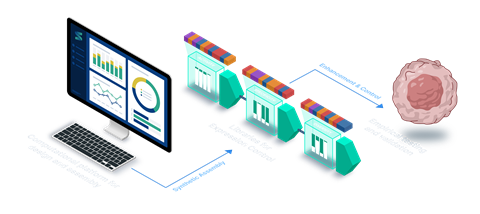
The company’s computational design platform turns large-scale genomic data into modular components that can be assembled into synthetic promoters.
“By comparative mining of transcriptional landscapes, we identify motifs that drive context-specific expression and assemble them into synthetic promoters with predictable functionality,” explains David.
Our combined approach of computationally guided, rational design and testing capabilities aims to bridge the genotype–phenotype divide, which is one of biology’s central challenges.
Designed promoters are then tested experimentally, with results feeding back into computational models in a continuous design–test–learn cycle.
“Our combined approach of computationally guided, rational design and testing capabilities aims to bridge the genotype–phenotype divide, which is one of biology’s central challenges,” David notes.
This approach reduces reliance on brute-force screening and accelerates development of promoters tailored to specific therapeutic or manufacturing requirements.
Embedding performance requirements at the design stage
The SynGenSys platform builds performance criteria directly into promoter design rather than assessing them only after construction. Its informatics workflows analyse genome-wide transcriptional data across multiple tissues to identify regulatory elements linked to specific expression patterns. Public and proprietary datasets are combined to support tissue-specific promoter design.
Our informatics workflows, developed over years of R&D, deconvolute transcriptional landscapes to identify cis-regulatory elements with desired specificity and activity.
“Our informatics workflows, developed over years of R&D, deconvolute transcriptional landscapes to identify cis-regulatory elements with desired specificity and activity,” David says.
Promoters can therefore be designed for specific tissue activity while limiting expression in non-target cells. Sequence features associated with long-term stability can also be incorporated during design. For example, elements such as CpG islands, regions of DNA rich in cytosine and guanine bases that influence gene regulation and epigenetic silencing, may be included or excluded depending on their effect on expression durability.
The functional properties of sequence components are predicted computationally before synthesis, allowing promoter candidates to be evaluated against defined performance criteria prior to experimental testing.
Designing for immune cell specificity
These principles of tissue-specific design and off-target control are illustrated by the development of the NK.SET™ synthetic promoter library for natural killer cell immunotherapies.
The challenge for this project was clear from the start: promoters needed to be highly active in NK cells while silent in B cell lymphoma.
The aim was to achieve strong expression in natural killer (NK) cells while avoiding activity in B cell lymphoma and HEK cells (a human embryonic kidney cell line commonly used for AAV production). This required comparing gene expression and regulatory activity across cell types to identify sequence motifs that are active in NK cells but inactive in non-target cells.
“The challenge for this project was clear from the start: promoters needed to be highly active in NK cells while silent in B cell lymphoma,” David explains.
By comparing gene expression patterns across different cell types, the team identified regulatory motifs that are active in NK cells but inactive elsewhere. Synthetic promoters built from these elements produced targeted NK cell expression with minimal off-target activity.
The resulting library supports both in vivo and ex vivo NK-based immunotherapies and demonstrates how the design framework can be extended to other cell types, including emerging work on synthetic promoter libraries for T cell therapies.
Synthetic promoters as engineered genetic components
Synthetic promoters provide a way to control gene expression more predictably than naturally occurring regulatory sequences.
Synthetic promoters allow us to engineer expression with precision, representing a shift from opportunistic use of natural sequences to rational design of genetic components.
For many years, developers have relied on viral or endogenous promoters such as CMV and EF1α, commonly used regulatory sequences that drive strong gene expression in many cell types. While widely used, these promoters often show variable performance depending on the cellular environment or regulatory context.
Synthetic promoters offer an alternative based on design rather than adaptation.
“Synthetic promoters allow us to engineer expression with precision, representing a shift from opportunistic use of natural sequences to rational design of genetic components,” David adds.
In manufacturing, this level of control can improve productivity, stability and consistency in biologic production. In therapeutic settings, it enables gene expression to be more precisely regulated, supporting both efficacy and safety.
Empirical screening to in silico engineering
Promoter design is increasingly guided by computational approaches.
The future lies in engineering design systems to create genetic components with predictable functionality.
“The future lies in engineering design systems to create genetic components with predictable functionality,” David says. “We have to move from screening in vitro to designing in silico.”
Advances in informatics and modelling now allow promoter behaviour to be modelled and functional performance predicted before experimental testing begins. As predictive accuracy improves, development timelines may shorten, enabling genetic components to be engineered for specific therapeutic applications with greater efficiency.
Toward predictable control of gene expression
As cell and gene therapies expand and biologic manufacturing becomes more complex, the need for reliable gene control systems continues to increase. Integrating genomic data, computational modelling and experimental validation allows genetic regulatory elements to be designed with defined and testable performance characteristics for therapeutic and manufacturing applications.
About the expert
 Professor David James, co-founder, SynGenSys
Professor David James is professor of bioprocess engineering in the Department of Chemical and Biological Engineering at the University of Sheffield. His research focuses on recombinant protein biopharmaceutical production, systems biotechnology and gene vector engineering, work that contributed to the founding of SynGenSys.
In 2006, he was appointed Chair of Bioprocess Engineering at the University of Sheffield and received a Royal Society Wolfson Research Merit Award. His work has also supported training and development in biopharmaceutical bioprocessing for the UK bioindustry.
He has previously held academic positions at the University of Kent, the University of Queensland and the Australian Institute of Bioengineering and Nanotechnology.