




A new spatial transcriptomics method can identify full-length RNA isoforms at single-cell resolution, potentially giving drug discovery researchers a more detailed view of disease biology than ever before.
Spatial biology has transformed our ability to map gene expression within intact tissues, revealing not only which genes are active but also precisely where they are expressed. However, one important layer of biology has remained largely inaccessible: transcript isoforms, the distinct versions of messenger RNA (mRNA) produced from a single gene.
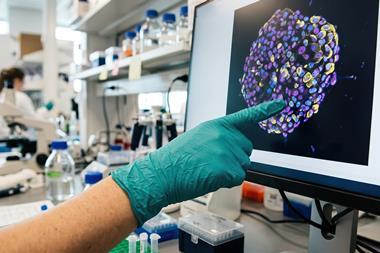
Researchers have now developed Fullscope-seq, a spatial transcriptomics approach that combines Stereo-seq – a high-resolution technology that maps gene expression across large tissue sections – with long-read sequencing. This enables the capture of full-length RNA transcripts while preserving their precise spatial location within the tissue. Demonstrated in macaque brain tissue, Fullscope-seq achieved single-cell spatial resolution across large tissue sections while distinguishing alternative transcript isoforms.
The study, published in Nature Methods, moves the field beyond measuring where genes are expressed towards understanding how different transcript variants contribute to tissue function and disease.
How Fullscope-seq works
By combining Stereo-seq, which provides high-resolution spatial transcriptomic mapping, with long-read sequencing, which can read complete RNA molecules, the method captures the spatial location of full-length RNA transcripts within intact tissue at single-cell resolution while also revealing alternative splicing patterns. When applied to macaque brain tissue, the technique identified thousands of transcript isoforms that differed between cortical layers, brain regions and individual cell types, uncovering a previously unrecognised level of spatial complexity in gene regulation.
Studies such as this highlight how understanding disease often requires more than studying cells in isolation. Our latest report explores how spatial biology is revealing aspects of disease biology that cannot be captured through individual cells alone, and what that could mean for biomarker discovery, immunotherapy and drug development.
Why does this matter for drug discovery?
For many years, transcriptomics has largely treated each gene as a single entity.
In reality, a single gene can generate multiple RNA isoforms through alternative splicing, producing proteins with different – or even opposing – functions. Some isoforms may promote disease, while others are protective. Yet conventional spatial transcriptomics methods often collapse these variants into a single measurement.
This matters because drug developers now need to identify precise molecular targets, rather than broadly targeting an entire gene.
By finding which transcript isoforms are present in specific cell types and anatomical regions, Fullscope-seq could help researchers:
- Identify disease-associated isoforms that were previously hidden
- Improve target validation by distinguishing functional transcript variants
- Discover spatial biomarkers linked to disease progression
- Better understand why therapies succeed in some cell populations but fail in others
Rather than asking ’where is a gene expressed?’, researchers can begin asking ’which version of that gene is active, and where?’
How does this fit into the wider field?
Spatial biology has progressed very quickly over the past five years, with technologies such as Stereo-seq, MERFISH and Visium enabling researchers to map gene expression within intact tissues.
However, most current platforms generate gene-level information rather than isoform-level data.
Fullscope-seq reflects a broader trend in spatial omics towards increasing molecular resolution. Recent innovations have expanded beyond RNA to include proteins, chromatin accessibility and multiomic datasets, while computational developments are making it possible to integrate these complex layers of information.
Together, these developments suggest that spatial biology is now focussing less on generating maps and more on uncovering mechanisms of disease.
Why do transcript isoforms matter?
Genes are often described as blueprints for proteins, but most human genes produce multiple RNA transcripts, or isoforms, through a process called alternative splicing.
Each isoform can produce a protein with different properties, including altered activity, localisation or interactions with other molecules.
For drug discovery, this distinction is critical because:
- Some disease-associated mutations affect only specific isoforms
- Individual isoforms may have distinct biological functions
- Biomarkers based on total gene expression may overlook clinically relevant variants
- Therapeutics targeting one isoform could avoid disrupting beneficial versions of the same gene
As precision medicine advances, understanding which transcript variant is present – and where – is becoming much more important for identifying safer and more selective therapeutic targets.
What does this mean for researchers?
For researchers working in target discovery, the technology opens several new possibilities.
Spatial isoform mapping could improve confidence in candidate targets by revealing whether disease-associated transcript variants are restricted to specific tissues or cell populations. This could help prioritise targets with greater therapeutic specificity while reducing the likelihood of off-target effects.
The approach may also support biomarker discovery, particularly in diseases where alternative splicing plays a known role, including cancer, neurodegeneration and rare genetic disorders.
Although demonstrated in the primate brain, the underlying principles are applicable to a wide range of disease areas where tissue architecture influences disease progression.
What happens next?
Like many new omics technologies, Fullscope-seq will need to demonstrate scalability before widespread adoption.
Future work will now focus on:
- Applying the method to human disease tissues
- Integrating isoform information with spatial proteomics and epigenomics
- Improving throughput and reducing sequencing costs
- Incorporating AI-based analytical tools capable of interpreting increasingly complex spatial datasets
The longer-term challenge will be determining how spatial isoform information translates into clinically actionable targets and biomarkers.








No comments yet