



A preclinical study has shown that restoring fragile X messenger ribonucleoprotein via adeno-associated viral gene delivery reduces seizure susceptibility, sensory hyperactivity and aberrant EEG activity in Fmr1-knockout mice.
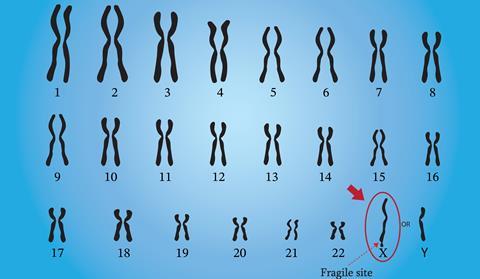
A gene therapy designed to replace the missing protein responsible for fragile X syndrome has restored several key disease-related features in a mouse model, meaning it could be used to inform future treatments targeting the underlying cause of the condition.
The therapy was designed by researchers at Cincinnati Children’s and collaborators at Forge Biologics, who say the work provides an important foundation for translating gene therapy into human clinical trials.
Fragile X syndrome is the most common inherited cause of intellectual disability and the leading single-gene condition associated with autism. There is currently no cure, with treatment focused on managing symptoms including anxiety, sensory sensitivity, hyperactivity, developmental seizures and learning difficulties.
Therapy targets the root cause
The research team tested adeno-associated viral vectors carrying the human FMR1 gene, which is silenced in people with fragile X syndrome. After evaluating several approaches, the scientists identified a strategy that restored production of the fragile X messenger ribonucleoprotein (FMRP) in key areas of the brain.
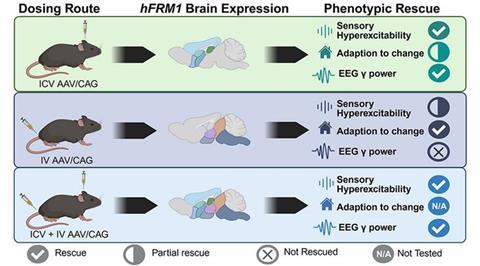
In mice lacking the Fmr1 gene, the therapy reduced susceptibility to audiogenic seizures, improved sensory hyperactivity and repetitive digging behaviour, and normalised elevated low-gamma electroencephalogram (EEG) activity, a brain activity pattern also observed in people with fragile X syndrome.
The research team tested adeno-associated viral vectors carrying the human FMR1 gene, which is silenced in people with fragile X syndrome
“These findings are important because they show that restoring FMRP can improve several fragile X-related traits in a model designed with clinical translation in mind,” says Dr Christina Gross, co-corresponding author and a researcher in the Division of Neurology at Cincinnati Children’s. “By pairing gene replacement with outcomes that can help bridge mouse studies and future human trials, this work gives the field a stronger foundation for developing therapies that address the root biology of fragile X syndrome.”
Building a path towards clinical trials
The study goes beyond demonstrating that FMRP can be restored. Researchers also investigated delivery routes, dosing strategies, gene promoters and other factors needed to establish a robust preclinical framework for future gene therapy development.
The findings also reinforce the potential value of EEG measurements as biomarkers that could help bridge laboratory studies with future clinical trials in people.
The researchers say the work highlights the importance of continued investment in gene therapy vector design, safety testing, biomarker development and scalable manufacturing before human studies can begin.
Hope for future treatments
Although the findings do not alter current clinical care, the study suggests that restoring FMRP could eventually improve symptoms that have proved difficult to treat through existing approaches.
Importantly, benefits were observed even when the therapy was delivered at different stages of development, with researchers also identifying two delivery methods that together could improve access to key regions of the brain.
Although the findings do not alter current clinical care, the study suggests that restoring FMRP could eventually improve symptoms that have proved difficult to treat through existing approaches
“Our studies show that re-expression of FMRP in mice at ages equivalent to 4-6 and 15-30 years in humans has the potential to rescue sensory hypersensitivity, stereotypic behavior and excessive EEG gamma power,” Pedapati says. “This suggests that certain FXS-related deficits are reversible or can be improved by re-expression of FMRP after large parts of brain development have already occurred.”
While the findings are encouraging for people living with fragile X syndrome and their families, the researchers stress that the therapy has not yet been tested in humans. Further studies will be needed to evaluate its safety, long-term effectiveness, optimal dosing, immune responses and the best timing for treatment before clinical trials can begin.








No comments yet