A team of researchers has developed a faster, simpler method for creating non-natural amino acids and assemble them into peptides, a breakthrough that could accelerate peptide research and provide new tools for designing drugs.
A team at the University of California, Santa Barbara has developed a new method for synthesising non-natural amino acids and assembling them into peptides, which could improve peptide research and inform future preclinical drug studies.
The technique allows scientists to access amino acids beyond the 22 found in nature with far greater efficiency. By producing amino acids in a form ready for peptide synthesis, the method removes several difficult steps required in traditional approaches.
“The key advantage is that these amino acids come out of the process already in a form that can be used directly to make peptides, without extra modification steps,” said first author Phil Kohnke, a doctoral student in senior author Liming Zhang’s lab in the Department of Chemistry & Biochemistry. “Compared to existing approaches, this is one of the most straightforward and broadly useful methods reported so far.”
The building blocks of life
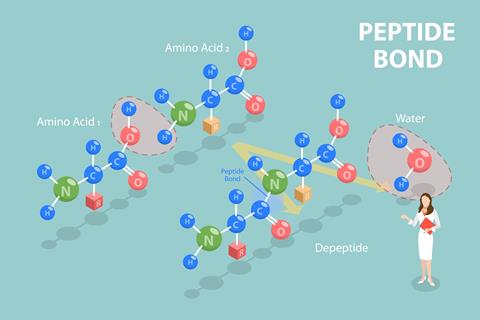
Peptides are short chains of amino acids that make up proteins. While proteins are larger and more complex, made of multiple peptides, the order of amino acids in both peptides and proteins defines their structure and function. Nature typically relies on 22 amino acids to construct proteins, including 20 standard amino acids encoded in DNA and two produced by other mechanisms.
Peptides are short chains of amino acids that make up proteins.
While natural amino acids are cheap and readily available, non-natural amino acids have been much harder to produce and integrate. Zhang’s team has created a process that overcomes these challenges with a straightforward chemical route that can produce amino acids ready to be used immediately in peptide synthesis.
A two-step synthetic approach
The method employs gold catalysis to transform inexpensive chemical ingredients into amino acids with precise handedness, a key property for their biological activity. The amino acids are then linked into peptides using a resin scaffold, which allows the chain to grow in a controlled sequence.
Traditional peptide synthesis methods require both removing the protective group on the amino end and activating the acid end of each amino acid. In contrast, this new approach produces amino acids with the acid group already ready to react, so only the amino group needs to be unmasked. The use of a resin scaffold also simplifies purification. Once the peptide is complete, it can be detached from the scaffold and washed clean, avoiding laborious extraction from solution.
Expanding possibilities in research and medicine
“Many existing methods either involve many time-consuming steps, only work for a narrow set of molecules or require further manipulations before ready for peptide synthesis,” Kohnke said. “The new technique mostly solves these problems, easily and cheaply producing amino acids that are immediately useful for peptide synthesis.”
Having access to a wider variety of amino acids could be crucial for biochemists, materials scientists and medical researchers.
Zhang highlighted the potential applications in peptide therapeutics, pointing out that over 80 peptide-based drugs have been approved worldwide since insulin was first synthesised. Peptides containing non-natural amino acids can be made more resistant to enzymes or shaped to fit target receptors more effectively.
While the current work is primarily a chemistry breakthrough, it could inform preclinical drug studies in the future by providing medicinal chemists with a richer toolkit for designing and testing peptide therapeutics.
The team is now seeking collaborations to make the methodology accessible to researchers working on drug development and materials science.