
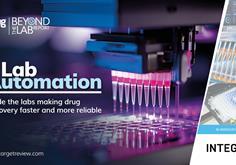
Laboratory automation in drug discovery can increase the number of compounds teams screen. But how do researchers decide which results are worth following up? In Lab Automation 2026, six researchers and industry specialists share practical lessons on validating screening hits, improving reproducibility in complex cell assays and deciding where automation can make the greatest difference.
Hit validation: What makes a high-throughput screening hit worth pursuing?
An automated screening workflow can flag promising compounds quickly. Before committing time to follow-up work, researchers need to establish whether the signal reflects genuine compound activity or an artefact, such as interference with the assay readout. Assay design, quality controls and hit validation all help teams decide which compounds warrant further investigation.
Assay quality control helps researchers judge whether a high-throughput screening run performed consistently. The Z′-factor measures how well the positive and negative controls separate relative to their variability. Follow-up testing then helps establish whether the apparent activity of an individual compound holds up.
The report follows an example from targeted protein degradation research. Virtual screening helps prioritise compounds for automated synthesis, and biological testing then evaluates their activity. Together, these steps help researchers decide which candidates to investigate further.
Where can automation improve iPSC assay reproducibility?
Automation can make liquid transfers and timing more consistent. In assays using cells derived from human induced pluripotent stem cells (iPSCs), differences between differentiation batches can still affect how cells respond. A consistent dispensing step helps teams narrow down whether variation comes from the workflow or the cell model.
In iPSC assay automation, automated liquid handling can help teams keep dispensing consistent across wells and runs. The report explores how flexible systems support assay reproducibility while accommodating changes to protocols.
Inside the full report
- Virtual screening and biological testing in targeted protein degradation research. See how researchers connect compound selection, automated synthesis and biological testing to assess which candidates to take forward.
- Automated liquid handling in screening workflows. Explore how flexible systems help laboratories standardise liquid transfers across assays while accommodating changes to protocols.
- Self-driving laboratories for reaction and formulation optimisation. See how a self-driving laboratory uses AI and robotics to select the next experiment based on the results of the last. The report explores applications in chemical reaction and drug formulation research.
Report contributors
- Professor Milad Abolhasani, Professor of Chemical and Biomolecular Engineering, NC State University
- Professor Christine Allen, Professor, University of Toronto, and Co-founder and CEO, Intrepid Labs
- Dr Sara Blick-Nitko, Technical Director, High-Throughput Screening Shared Resource, University of Rochester Medical Center
- Dr Fiona Jeganathan, Head of Screening and Pharmacology, Alzheimer’s Research UK Drug Discovery Institute at UCL
- Dr Sean McKenna, Postdoctoral Fellow, Leiden University
- Carl Bauert, Product Manager, INTEGRA Biosciences
Download the Lab Automation 2026 report
This report is published in association with INTEGRA Biosciences.
Download Now


No comments yet