



A new study from Thomas Jefferson University provides evidence that senolytic therapies – particularly the dasatinib-quercetin combination – may delay early intervertebral disc degeneration by targeting cellular senescence.

Researchers at Thomas Jefferson University have found evidence that senolytic therapies may help delay early intervertebral disc degeneration, a leading cause of chronic back and neck pain.
The study investigated how cellular senescence contributes to disc degeneration and whether therapies targeting senescent cells could slow disease progression in genetically susceptible individuals.
Intervertebral disc degeneration affects millions of people worldwide and is a major contributor to chronic musculoskeletal pain. Current treatments mainly focus on managing symptoms rather than preventing structural deterioration of spinal discs.
Scientists believe that cellular senescence, a process in which cells stop dividing and begin releasing inflammatory molecules, is key in tissue degeneration and ageing.
To investigate this further, a research team led by Professor Makarand Risbud from the Department of Orthopaedic Surgery at Sidney Kimmel Medical College used SM/J mice, a model of spontaneous early-onset disc disease.
The researchers tested two senolytic treatment approaches: navitoclax, which targets BCL-2 family survival proteins and a combination of dasatinib and quercetin, commonly referred to as DQ.
Early senescence identified before visible damage
Using histological, molecular, imaging and transcriptomic analyses, the team tracked changes in spinal disc tissue over time.
The study found that SM/J mice showed elevated markers of cellular senescence as early as four weeks of age, before visible structural degeneration had developed.
Researchers also observed increased inflammatory activity and gene expression changes associated with cellular stress and extracellular matrix remodelling.
The study found that SM/J mice showed elevated markers of cellular senescence as early as four weeks of age
“Importantly, early molecular changes preceded visible tissue damage, suggesting that senescence is not just a consequence of degeneration but a driving force in genetically susceptible discs,” explained Professor Risbud.
The findings suggest that senescence may actively contribute to the earliest stages of disc degeneration rather than simply appearing after tissue breakdown has occurred.
Dasatinib-quercetin combination shows strongest effects
Among the treatments tested, the combination of dasatinib and quercetin produced the most significant benefits.
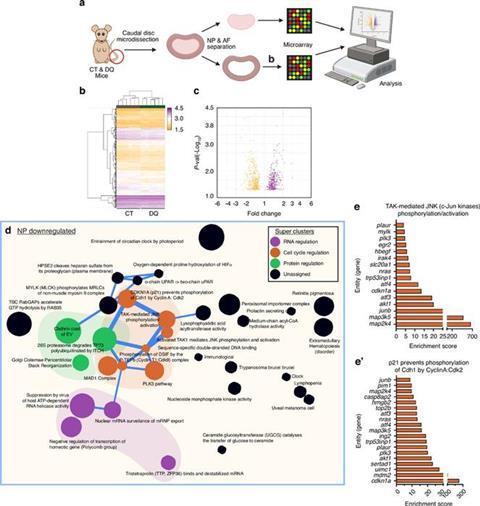
Mice treated with DQ showed reduced disc degeneration severity compared with untreated animals. Researchers observed improved preservation of nucleus pulposus structure, lower levels of degenerative remodelling and reduced expression of senescence markers including p19ARF and p21.
The treatment also lowered inflammatory signalling within disc tissue.
In contrast, navitoclax failed to significantly improve either structural or molecular outcomes.
Mice treated with DQ showed reduced disc degeneration severity compared with untreated animals
Transcriptomic analyses showed that DQ treatment altered gene expression programmes associated with inflammation, stress responses and cell cycle regulation, indicating reduced senescence activity and improved tissue stability.
Further computational and functional analyses identified JNK signalling, also known as c-Jun N-terminal kinase signalling, as a central pathway linked to both disease progression and therapeutic response.
“These data point to JUN signalling as a convergence hub linking senescence, inflammation and extracellular matrix breakdown, helping explain why pathway-specific modulation by dasatinib–quercetin is effective,” Professor Risbud said.
Potential implications for regenerative medicine
To support the findings, researchers also carried out experiments using human degenerated disc cells.
Inhibiting JUN signalling reproduced several effects observed with DQ treatment, including reduced senescence-associated β-galactosidase activity and lower inflammatory gene expression.
The researchers believe the results position JUN signalling as a possible regulatory link between cellular ageing, inflammation and tissue degeneration.
Beyond spinal disease, the study may have broader implications for regenerative medicine and musculoskeletal ageing research.
Scientists said the findings highlight the importance of developing pathway-specific senotherapeutic approaches rather than relying on broad elimination of senescent cells.
The study concludes that dasatinib-quercetin therapy may help delay early disc degeneration by reducing inflammation, suppressing senescence-associated pathways and preserving tissue structure, while identifying JUN signalling as a promising therapeutic target for future research.









No comments yet