



Researchers at UC Berkeley have developed a low-dose triple combination of dichloroacetate, metformin and navitoclax that selectively eliminates senescent and cancer cells by exploiting impaired mitochondrial function and disrupted energy metabolism.
A new study has identified a promising experimental treatment that simultaneously targets cancer cells and senescent cells, improving physical performance and extending lifespan in aged mice while avoiding some of the side effects associated with current therapies.
The research was led by first author Zachery Robinson and corresponding author Irina Conboy, both of whom are based at the Department of Bioengineering and QB3 Institute at the University of California, Berkeley.
Addressing ageing and cancer together
Cancer and ageing are closely connected, with senescent cells accumulating throughout the body as people grow older. Although these cells no longer divide, they remain metabolically active and release inflammatory molecules known as the senescence-associated secretory phenotype (SASP). This contributes to chronic inflammation, tissue dysfunction and tumour progression.
Current treatments, including the BCL-2/BCL-xL inhibitor navitoclax (ABT-263), have been able to eliminate both cancer cells and senescent cells. However, the doses required often lead to thrombocytopenia, which causes serious reduction in platelet numbers, limiting the drug’s clinical use.
Low-dose combination therapy
To overcome these challenges, the research team developed a three-drug combination known as DMA, which combines dichloroacetate (DCA), metformin and a ten-fold lower dose of navitoclax than is typically administered.
The therapy was tested using multiple human senescent cell models, several human cancer cell lines, healthy primary human cells and aged mice.
According to the findings, DMA selectively eliminated senescent cells generated through different biological mechanisms while largely sparing healthy cells, including fibroblasts, neural precursor cells and hepatocytes. Human myoblast viability was also largely preserved. The treatment also reduced the viability of cervical, breast and colorectal cancer cells, including breast cancer cells that had shown relative resistance to navitoclax when used alone.
Exploiting shared metabolic weaknesses
The researchers found that both senescent cells and many cancer cells share impaired mitochondrial function and altered energy metabolism, making them less able to cope with additional reductions in cellular energy.
The study demonstrated that DMA dramatically depleted ATP levels in senescent and cancer cells while allowing healthy cells to maintain energy production. Further metabolic analysis suggested that senescent cells lacked the flexibility needed to compensate for this stress, resulting in selective apoptosis and reduced cancer cell proliferation.
Improved health and survival
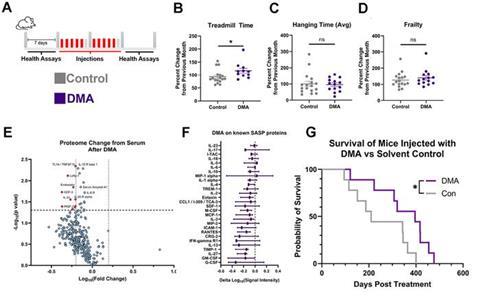
The treatment also delivered encouraging results in aged mice. Short-term administration significantly improved treadmill endurance without increasing frailty or reducing strength.
Longer-term intermittent treatment, beginning at around 18 months of age, extended average post-treatment survival by approximately 102.6 days, representing a 41.7 percent increase compared with control animals following treatment initiation.
Importantly, the lower-dose combination avoided the marked thrombocytopenia associated with conventional high-dose navitoclax while shifting circulating inflammatory proteins towards a more youthful profile.
Despite these promising findings, further evaluation in animal models of spontaneous cancer and age-related diseases will be needed before progressing to clinical studies. However, because metformin and dichloroacetate are already widely used medicines and navitoclax has previously undergone clinical testing, the researchers think the strategy could provide a practical foundation for future therapies that target both cancer and cellular senescence while reducing treatment-related toxicity.






No comments yet