For International Women’s Day, Dr Amanda Hemmerich, Global Director of Digital Pathology & Innovation at IQVIA Laboratories, describes how digital pathology is being applied in early drug development and what it takes to build credibility in a multidisciplinary technical field.
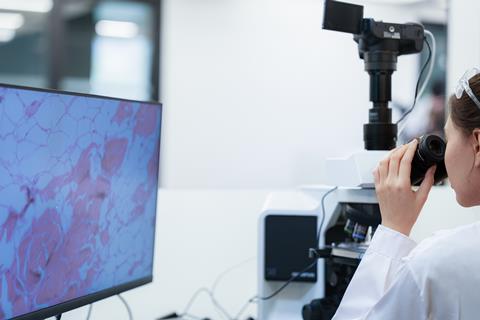
Digital pathology is becoming an important part of early drug discovery. Tissue samples that once existed only as glass slides can now be converted into high-resolution digital images that can be shared between laboratories and analysed remotely, making specialist expertise easier to access. Image analysis and artificial intelligence (AI) tools can then be applied to these images to quantify biomarker and tumour marker expression, generating quantitative pathology data that support biomarker discovery and translational research.
To mark International Women’s Day, Dr Amanda Hemmerich, Global Director of Digital Pathology Innovation at IQVIA Laboratories, discusses how digital pathology workflows are being developed to support biomarker research and clinical trials, while reflecting on building technical expertise in a multidisciplinary scientific field.
Leading digital pathology
Dr Amanda Hemmerich oversees IQVIA Laboratories’ global digital pathology strategy across five anatomic pathology laboratories. Her role spans exploratory biomarker development through to clinical trials, with a focus on ensuring digital pathology workflows are harmonised across sites.
A key part of her work is aligning systems, education and training across laboratories so that clinical trial sponsors receive consistent pathology support throughout the trial lifecycle.
Hemmerich is board certified in anatomic and clinical pathology as well as cytopathology, with additional surgical pathology training focusing on gastrointestinal and liver pathology. She has spent most of her career in industry, beginning in roles focused on molecular testing and immunohistochemistry biomarker assessment.
At IQVIA Laboratories, she initially helped guide services and capabilities for the genomics laboratory and the exploratory biomarker laboratory, including the Anatomic Pathology Translational Science and Innovation Laboratory (AP TSAIL). As her career progressed, she took on responsibility for digital pathology and now leads the global strategy while continuing to work as a pathologist in AP TSAIL.
This dual role allows her to support exploratory digital pathology work, including projects that apply AI and machine learning to develop algorithms for scoring unique biomarkers, helping translate exploratory findings into methods that can be used in clinical trials.
Moving into digital pathology
Hemmerich’s interest in digital pathology developed from a combination of visual learning and an early interest in computing.
"I am a visual person and this has influenced everything from my personal hobbies like drawing and painting to my educational preferences of being a visual learner," she explains.
She also grew up alongside developments in computing and took an early interest in user interfaces, systems and connectivity. During residency, she encountered early digital slide scanners and learned about the practical realities of implementing digital pathology, including validation, return on investment and storage capacity.
When she later took on responsibility for digital pathology at IQVIA Laboratories, she saw an opportunity to bring these areas of experience together. Her work has included developing approaches that use AI and machine learning to define analyses that improve understanding of disease processes and treatment effects, including in xenograft samples.
Practical uses of digital pathology
Hemmerich emphasises that digital pathology needs to provide practical benefits, particularly when introduced earlier in the development pipeline.
"There are three key ways I see digital pathology benefitting drug development," Hemmerich says.
One is efficiency. Digital tools allow expert pathologists to review different specimen types within a single environment, including brightfield and darkfield samples, rather than requiring separate locations or workstations.
Another is access to expertise. Digital pathology allows specialists to review samples regardless of location, reducing turnaround time and making consultation more practical. This is particularly important for disease-area specialisms such as metabolic dysfunction-associated steatohepatitis, where sharing images rather than physically shipping slides makes specialist input easier to obtain.
This work began as an exploratory study that identified a computational, AI-driven mathematical model showing benefits in specific patient populations.
A further advantage is quantification and computational analysis. Digital images allow tumour marker expression to be analysed using computational tools in ways that cannot be calculated reliably by eye alone. AI and machine learning approaches are increasingly used in translational research to support quantitative image analysis and comparison across samples.
Hemmerich highlights the TROP2 normalised membrane ratio algorithm, developed for non-small cell lung cancer, as an example of how digital pathology and AI can be used to quantify tumour markers such as TROP2, a protein found on the surface of some cancer cells.
"This work began as an exploratory study that identified a computational, AI-driven mathematical model showing benefits in specific patient populations," Hemmerich says.
Larger trials have since replicated these findings and, pending final FDA review, the algorithm may become one of the first AI-based approaches to progress from exploratory research to regulatory approval.
Credibility in multidisciplinary teams
Digital pathology programmes bring together expertise from medicine, technology and operations. Hemmerich works closely with pathologists, data scientists, information technology teams and business development colleagues to develop and implement digital workflows.
Two simple, yet key, factors have helped establish my credibility as an expert clinical digital pathologist: appreciation of our team’s experience and collaborative ability alongside our confidence in making informed decisions.
Hemmerich emphasises that building credibility is an important part of working in multidisciplinary environments.
"Two simple, yet key, factors have helped establish my credibility as an expert clinical digital pathologist: appreciation of our team’s experience and collaborative ability alongside our confidence in making informed decisions that are guided by extensive R&D know-how, scientific expertise, data-driven insights and strategic operational processes," she explains.
The first is recognising the experience of colleagues and partners and understanding what motivates a team. The second is decision-making grounded in scientific knowledge, data and operational processes, combined with accountability when changes are needed.
Credibility is also supported by continuous education and learning from colleagues. In a fast-moving field, this includes keeping up to date with developments in both pathology and digital pathology technology.
Advice for women entering technical fields
For women early in their careers who are interested in building technical expertise in digital pathology or related technologies, Hemmerich keeps her advice direct.
I say pursue what you are interested in.
"I say pursue what you are interested in," Hemmerich advises.
She emphasises that strong interest makes it easier to overcome challenges that arise in any work environment. She suggests finding leaders whose careers provide useful examples and learning from their experiences.
She also notes that different approaches work for different people and that it is important to develop individual ways of working. Experiences that appear only loosely connected at the time may prove valuable later in a career.
Building leadership on purpose
Hemmerich attributes her move into leadership roles to a sustained interest in business and management alongside scientific training.
"My continued interest in business and leadership roles has helped my professional growth and progress," she says
My continued interest in business and leadership roles has helped my professional growth and progress.
At each stage of her education and career, she sought opportunities to develop leadership skills. In college, she studied business management and economics. During residency, she attended a health policy lecture series in the evenings and requested regular meetings with the chair of the pathology department to learn about managing teams and working with senior leadership.
She continued this development through workplace leadership training, including business techniques, management styles and communication approaches. In parallel, she has held a range of professional roles supporting the clinical pathology community, including positions with the North Carolina Society of Pathologists and the College of American Pathologists.
What comes next for digital pathology
Digital pathology is changing how pathology data can be generated and used during drug development. Quantitative image analysis allows biomarker expression to be measured more consistently, while digital workflows make specialist expertise more accessible.
For International Women’s Day, Hemmerich’s experience illustrates the technical and collaborative skills required to work in a multidisciplinary scientific field. Her work reflects the growing role of digital pathology in early drug discovery and translational research.
About the expert
 Dr Amanda Hemmerich, Global Director of Digital Pathology Innovation, IQVIA Laboratories
Board certified in anatomic and clinical pathology and cytopathology, Dr Amanda Hemmerich leads the global digital pathology strategy, including implementation of end-to-end workflows that meet regulatory standards and partnerships with image analysis vendors. She also assists with testing at the Genomics Center of Excellence and the Anatomic Pathology Translational Science and Innovation Laboratory in the Raleigh-Durham area of North Carolina.
Dr Hemmerich has expertise in developing digital pathology techniques, managing large-scale pathology services, test validation and operationalisation. Her current areas of focus include validating image analysis workflows such as TROP2.