

Scientists at Jeonbuk National University have engineered a Salmonella strain to simultaneously deliver apoptin and carcinoembryonic antigen epitopes directly to tumours.
Researchers have engineered a strain of Salmonella to deliver two anticancer components, reducing tumour growth and the detection of metastatic cancer cells in mouse models of aggressive breast cancer.
The approach combines apoptin, a protein that promotes cancer-cell death, with carcinoembryonic antigen (CEA) epitopes designed to stimulate antitumour immune responses. The results of the study suggest that engineered bacteria could offer a platform for delivering multiple therapeutic agents directly to tumours.
Engineering bacteria to target tumours
Tumours that evade immune responses, recur and spread remain a significant challenge for cancer treatment. Some bacteria naturally accumulate within tumour environments, making them potential vehicles for delivering anticancer therapies.
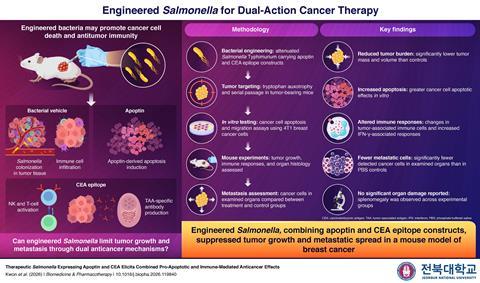
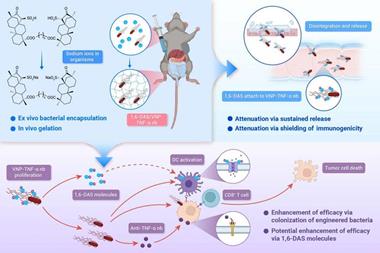
To explore this approach, a research team led by Professor John Hwa Lee from Jeonbuk National University in the Republic of Korea developed an engineered strain of Salmonella Typhimurium, designated JOL3136.
The researchers deleted four bacterial genes – trpA, trpE, asd and pagL – to attenuate the strain and make it dependent on tryptophan. They also passaged the bacteria in tumour-bearing mice to improve their ability to localise within tumours.
The resulting strain carried a dual-expression plasmid designed to produce apoptin inside cancer cells and a CEA epitope protein within the bacterial compartment. The team then confirmed expression of both components, detecting apoptin at 18 kDa and the CEA epitope protein at 27 kDa.
Reduced tumour growth and metastatic spread
The researchers first tested JOL3136 in 4T1 cells, a highly metastatic mouse breast cancer cell line. Compared with untreated cells and those exposed to bacterial-vector controls, cells treated with the engineered strain showed increased early and late apoptosis, indicating greater levels of programmed cell death.
The team then evaluated the treatment in mice bearing 4T1 tumours, with the mice recieving four weekly doses of either a control solution, the bacterial vector or JOL3136.
Mice treated with JOL3136 had significantly lower tumour mass and volume than those in either control group. The reduction in tumour volume was reported to exceed that observed in the vector-control group by more than 200 percent.
The researchers also investigated whether the treatment influenced immune activity. JOL3136 administration was associated with increased CD49b-positive lymphocytes and interferon-gamma (IFN-γ), alongside changes in immune-cell populations within the tumour.
In a separate experiment examining metastatic spread, the team detected significantly fewer labelled cancer cells in the lungs, liver and spleen of treated mice compared with controls.
Further safety testing needed
The findings suggest that combining direct cancer-cell killing with immune stimulation could offer an alternative strategy for targeting aggressive tumours.
“Cancer treatment needs ways to reach tumours while also addressing the immune environment that can help them persist,” said Professor Lee. “Our approach combines a bacterial delivery vehicle with apoptin to promote cancer-cell death and CEA epitopes to stimulate antitumour immunity.”
However, the study did not establish the individual contributions of apoptin and the CEA epitopes to the observed therapeutic effects.
“An important feature of this platform is that the bacterial carrier can be modified to deliver other therapeutic candidates,” added Professor Lee. “Before clinical use can be considered, we need stronger safety safeguards and further evaluation in models that better represent human disease.”
As the approach uses live Salmonella, further work will need to address infection risks and establish how the bacterial carrier and its individual payloads contribute to treatment outcomes.

No comments yet