




Researchers have demonstrated that chemically engineered suppressor tRNAs, packaged in lung-targeted lipid nanoparticles, can restore CFTR protein production in preclinical models of nonsense mutation cystic fibrosis.

Researchers have developed a potential new approach for treating a form of cystic fibrosis caused by so-called nonsense mutations, combining chemically modified transfer RNAs with lipid nanoparticles designed to deliver the therapy directly to the lungs.
The study, led by Jingan Chen and colleagues, found that the treatment restored production of functional cystic fibrosis transmembrane conductance regulator (CFTR) protein in bronchial epithelial cells, mouse models and patient-derived cystic fibrosis organoids.
The results of the study point to a possible way of correcting the consequences of certain genetic mutations at the protein-production stage rather than attempting to replace or permanently edit the underlying DNA.
However, the work remains at the preclinical stage. A related Perspective by Jacob Myerson and Drew Weissman highlights an important hurdle before the approach could move towards patients: establishing how safe repeated delivery will be, particularly because inflammation was observed at higher doses.
“Translating these effects to the amelioration of respiratory function in cystic fibrosis patients will require further work, including characterisation of side effects, especially given dose-dependent inflammation noted both by [the current study] in mice and in prior animal studies of inhaled [lipid nanoparticle] delivery,” write Myerson and Weissman in the Perspective.
What is a suppressor tRNA?
Transfer RNAs, or tRNAs, normally help translate mRNA into proteins. Each tRNA carries a particular amino acid and recognises the corresponding three-letter sequence, or codon, in mRNA.
Suppressor tRNAs (sup-tRNAs) are engineered to recognise premature stop codons instead. By changing their anticodons, researchers can make them insert an amino acid at the premature stop signal and allow translation to continue.
The concept is attractive because it could potentially address multiple genetic diseases caused by nonsense mutations using a common therapeutic strategy.
But getting from that concept to an effective medicine is difficult. Sup-tRNAs need to reach the right cells, remain functional for long enough and avoid triggering unwanted immune responses. They also need to read through the premature stop signal efficiently without disrupting normal protein production.
The problem with nonsense mutations
To understand why the approach matters, it helps to look at what a nonsense mutation actually does.
Genes contain the instructions cells use to make proteins. Those instructions are copied into messenger RNA (mRNA), which is then read by cellular machinery to assemble a protein from individual amino acids.
A nonsense mutation introduces a premature stop signal into the mRNA. Instead of continuing to build the protein, the cell stops translation too early. The resulting protein is often shortened and unable to perform its normal function.
Nonsense mutations are estimated to account for around 11 percent of human genetic disorders, making them an important target for drug discovery.
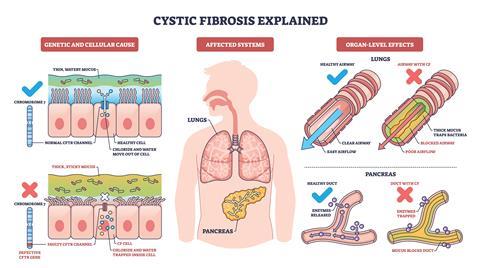
In cystic fibrosis, nonsense mutations can occur in the CFTR gene. The CFTR protein helps regulate the movement of salt and water across cell membranes. When functional CFTR is absent or severely reduced, thick mucus can accumulate in the lungs and contribute to chronic respiratory disease.
The challenge is therefore not necessarily to replace the entire gene. In principle, if researchers can persuade the cell to read through the premature stop signal, it may be possible to restore production of the full-length protein.
Why chemically modify the tRNA?
Chen and colleagues sought to address several of these problems by chemically modifying the sup-tRNAs.
Their experiments showed that the modifications increased readthrough of premature termination codons and improved aminoacylation, the process by which a tRNA is loaded with its amino acid.
The modified tRNAs also remained functionally active for longer and reduced activation of innate immune responses.
These properties are important from a drug-discovery perspective. An experimental therapy can demonstrate an impressive biological effect in a laboratory dish yet still fail as a potential medicine if the molecule is unstable, poorly delivered or recognised as foreign by the immune system.
The study suggests that chemical engineering of the tRNA itself could help address some of those limitations simultaneously.
Getting the therapy to the lungs
The second half of the strategy involves delivery.
Rather than administering the engineered tRNAs systemically, the researchers packaged them in lipid nanoparticles (LNPs) designed for inhaled delivery to the lungs.
LNPs have become an important technology for delivering nucleic acid medicines. They can protect fragile RNA molecules and help transport them into cells. The challenge is making them suitable for a particular tissue while limiting unwanted effects elsewhere in the body.
For cystic fibrosis, the lungs are an especially logical target because respiratory disease is a major driver of illness. Direct inhalation could potentially concentrate treatment where it is needed while reducing systemic exposure.
In the study, the researchers tested their approach across several increasingly relevant models. They used bronchial epithelial cells, mouse models and organoids derived from people with cystic fibrosis.
Across these systems, the treatment restored CFTR protein production and function.
How this fits into the wider field
RNA-based approaches have already demonstrated that genetic information can be therapeutically altered or exploited without making a permanent change to the genome. Sup-tRNAs offer a particularly interesting proposition because the same basic strategy could potentially be adapted to different nonsense mutations and different genetic diseases.
That does not mean the approach will automatically work across patients. The specific premature stop codon, surrounding genetic sequence, required amino acid and level of protein restoration could all influence the outcome.
For researchers, the significance of the study therefore extends beyond cystic fibrosis. It provides evidence that chemical modification and targeted delivery can be combined to improve several properties of suppressor tRNAs at once.
What happens next?
The immediate priority is establishing whether the promising laboratory and animal results translate into meaningful benefits in living organisms and ultimately in people.
Safety will be particularly important. The dose-dependent inflammation highlighted by Myerson and Weissman will need to be investigated alongside the durability of treatment, distribution of the nanoparticles and the potential for repeated inhaled dosing.
Researchers will also need to determine how much restored CFTR function is required to produce a clinically meaningful improvement in lung health.
The study is therefore best viewed not as a treatment ready for patients but as a proof of concept for a potentially versatile class of genetic medicines.
Key takeaways
- The target: Nonsense mutations that cause cells to stop making proteins too early.
- The approach: Chemically enhanced suppressor tRNAs designed to bypass premature stop signals.
- The delivery: Inhaled lipid nanoparticles targeted towards the lungs.
- The result: CFTR production and function were restored in cell, mouse and patient-derived organoid models.
- The opportunity: The platform could potentially be adapted to other genetic diseases caused by nonsense mutations.
- The hurdle: Safety, particularly inflammation associated with higher doses, must be addressed before clinical development.








No comments yet