



Researchers at the University of Tokyo and international collaborators have developed a reusable, fish-inspired sensor capable of detecting real-time pressure changes in beating cardiac organoids.
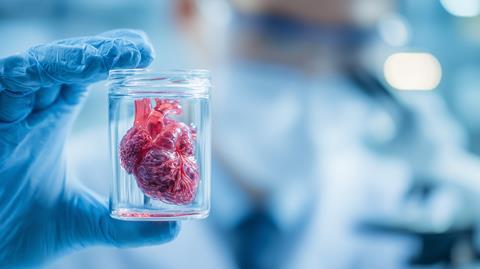
A fish’s natural ’sixth sense’ has inspired the development of a new device capable of measuring the heartbeat of lab-grown human heart tissue, making it faster and more efficient to test new medicines.
The international research team, which included scientists from the University of Tokyo alongside collaborators in Australia and the United States, has developed a reusable sensor that can monitor the pulse of multiple three-dimensional cardiac organoids simultaneously.
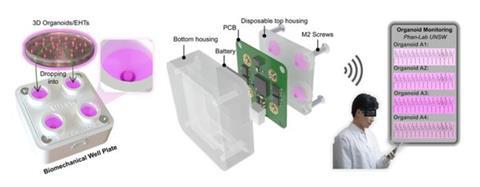
Known as a biomechanical well plate, the device consists of four liquid-filled wells that each hold a tiny cardiac organoid. Every time the tissue beats, it creates pressure changes that are detected by a sensitive cantilever sensor beneath the well. The data is then transmitted wirelessly to an app, allowing researchers to monitor heart activity in real time.
The team believes the technology could significantly improve drug screening and, in the future, support more personalised treatments.
Inspired by a fish’s ’sixth sense’
Although typically cardiac organoids measure less than three millimetres across, they have transformed cardiovascular research over the past decade by providing a more realistic model than traditional two-dimensional cell cultures or animal testing.
However, analysing the tiny structures is challenging and current techniques often require organoids to be grown directly onto sensors, preventing reuse, or examined individually under a microscope.
The newly developed device overcomes these barriers by enabling several organoids to be monitored at the same time while remaining suitable for reuse.
“Our device measures the pulse strength and rhythm of cardiac organoids using a biomechanical multi-well plate as the foundation,” said Associate Professor Timothée Mouterde from the Graduate School of Engineering at the University of Tokyo. ”The design means that you can parallelise many measurements, testing different types and concentrations of treatments, while wirelessly receiving the data to see how the organoids respond in real time.”
The design takes inspiration from the lateral line found in fish, a sensory organ that detects subtle changes in water pressure to help identify prey, predators and movement in the surrounding environment.
Delicate engineering challenge
Each well contains a small opening leading to an air cavity beneath the liquid. As the organoid contracts, the liquid briefly bulges into the air pocket, creating pressure fluctuations that bend a cantilever sensor below.
Developing this system required careful control of the interface between the liquid and trapped air.
“The challenge was that there is no direct contact between the liquid that holds the heart organoids and the sensor. Instead, we created a water interface which traps an air cavity below and the only reason it does not flood the cavity is because of carefully managed surface tension which we first worked out through analytical computer models,” explained Mouterde.
“It is a fine balance, as the liquid needs to be able to move into the air pocket without flooding it. The beating of the organoid deforms water into the cavity before bouncing back, causing pressure fluctuations which compress the air, activating the cantilever sensor below and enabling us to pick up the heartbeat.”
Potential for personalised medicine
Researchers say the sensor’s ability to detect subtle changes in heartbeat makes it particularly useful for assessing how cardiac tissue responds to different medicines.
“Because our device detects change in pressure, it is very good for measuring the fluctuations of a heartbeat and how it may change – becoming faster, slower or more irregular – in response to drug treatments,” said Mouterde. “It also has a key advantage over animal testing as we can directly test drug treatments on human tissue, opening the way for future more personalised drug therapies which consider a person’s individual genetics. As an engineer rather than a biologist or pharmacologist, our research demonstrates the advantages of cross-disciplinary collaboration and what we can build together.”
The researchers believe the scalable design could eventually allow hundreds of cardiac organoids to be monitored simultaneously, accelerating pharmaceutical research and bringing personalised medicine a step closer.


No comments yet