



Johns Hopkins researchers have developed all-metal microrobots capable of penetrating tissue, delivering targeted therapeutics and collecting biopsies from hard-to-reach areas of the gastrointestinal tract.
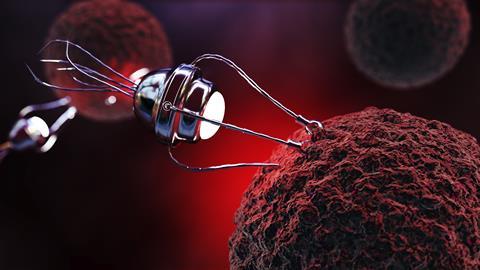
Tiny, shape-shifting robots made entirely of metal could one day change how doctors deliver drugs and collect tissue samples, potentially replacing invasive procedures with a simple swallowable capsule, according to research at Johns Hopkins University presented at Digestive Disease Week 2026.
The experimental microrobots, tested in mice, are designed to carry out medical tasks inside the body before safely dissolving, eliminating the need for removal.
A new generation of medical microrobots
Unlike earlier biodegradable microrobots made from polymers or hydrogels, the new devices are constructed entirely from metal, giving them both strength and precision.
“Existing biodegradable microrobots are made of materials such as polymers or hydrogels that biodegrade, but they lack the strength and rigidity that enable our all-metal microrobots to penetrate and cut tissue, while still leaving no trace behind when their work is done,” said Ling Li, MD, an instructor in gastroenterology and hepatology at Johns Hopkins University School of Medicine and co-lead author of the study.
This combination of durability and safety will be important in the future development of medical microrobotics.
From capsule to microscopic tools
The technology could eventually reduce the need for conventional endoscopy procedures, which many patients find uncomfortable and invasive. Instead, patients might swallow a capsule containing thousands of these microscopic devices.
Once inside the body, the microrobots are programmed to transform into different shapes depending on their task. At their destination, they can form tiny grippers capable of collecting biopsy samples from hard-to-reach areas of the gastrointestinal tract.
The technology could eventually reduce the need for conventional endoscopy procedures
They can also shift into microinjectors, delivering drugs directly into targeted tissues. This works as an alternative to injections or intravenous infusions, particularly for biologic treatments such as anti-tumour necrosis factor agents and glucagon-like peptide-1 medications.
By delivering drugs beneath the mucosal lining and targeting specific locations, the approach may improve how medications are absorbed while reducing the need for repeated clinic visits.
Controlled design and safe breakdown
The researchers can precisely control how the microrobots behave by adjusting the thickness of their metal layers. This determines how the devices fold into two-dimensional or three-dimensional structures and how long they remain active before breaking down.
“The variability of the layers’ thickness and use of other materials determines how long the metals last before they begin to biodegrade,” said Wangqu Liu, a PhD candidate at Johns Hopkins University Whiting School of Engineering who designed and fabricated the microrobots. “We can control the degradation rate from minutes to months depending on the application.”
We can control the degradation rate from minutes to months depending on the application
The devices are made using a novel liquid-free manufacturing process that produces strong but biodegradable structures from water-soluble metals and metal oxides. Only a tiny amount of material is required.
“It’s typically only a few micrograms and it’s engineered to stay within established safety limits,” Liu said.
Promising early results
In laboratory tests, the microrobots successfully penetrated the inner lining of the intestine in mice. They were also able to change shape as programmed and insert their tips beneath the tissue surface without causing damage.
Researchers believe this precision could make future treatments less invasive and more effective for conditions such as inflammatory bowel disease, bleeding and cancer.
“We see these all-metal, biodegradable devices as an important advancement in the effort to realise the full potential of medical microrobots,” Dr Li said. “We don’t have to choose between strength and safety, we can have both.”
While still in early stages, this technology could mean that complex internal procedures can be carried out by microscopic machines, eliminating the need for many traditional interventions.






No comments yet