Researchers at The University of Osaka have developed a new system to study human norovirus, with the hope of being able to develop vaccines and antiviral treatments faster.
Norovirus is the leading cause of gastroenteritis worldwide and is responsible for hundreds of thousands of deaths every year. Despite its global impact, research into antiviral treatments and vaccines has been hampered by the lack of a robust ‘reverse genetics’ system. This has made it difficult for scientists to fully understand how the virus replicates and causes disease.
Now, a team at The University of Osaka has overcome this barrier, developing a simple and efficient system to study human norovirus. Their work promises to accelerate research into new therapies and vaccines to fight Norovirus.
Understanding reverse genetics
Reverse genetics systems allow scientists to study the function of individual genes by making targeted changes and observing the effects. These genetically engineered or ‘recombinant’ viruses provide crucial insights into viral replication and pathogenesis. Tools like these are essential for the development of antiviral drugs and vaccines.
The study applied virological techniques to a zebrafish model to create a novel reverse genetics system capable of producing infectious human noroviruses. This approach allows for direct manipulation of the virus in ways that were previously impossible.
A simple and efficient method
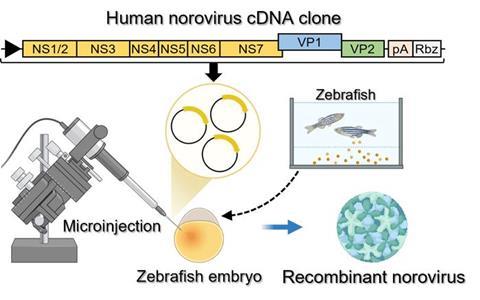
The system developed by the researchers involves the direct injection of norovirus cDNA clones into zebrafish embryos. This method is both straightforward and highly efficient, enabling the production of infectious human noroviruses in the laboratory.
To demonstrate the system’s utility, the team generated genetically modified noroviruses, either incorporating specific mutations or tagged with ‘reporter genes’. Reporter genes, such as chemiluminescent molecules, can label the virus and reveal its activity and location within host cells. This allows scientists to visualise viral behaviour in real time and study the mechanisms of replication and disease progression.
 Outline of Recombinant Human Norovirus Generation Using Zebrafish Embryos. Credit: Takeshi Kobayashi[/caption]
 Implications for vaccine and drug development
“This will also allow the development of novel vaccines with controlled antigenicity and pathogenicity,” said senior author Takeshi Kobayashi. By enabling precise genetic manipulation, the system provides a platform for designing vaccines that are both safer and more effective.
Beyond vaccine development, the reverse genetics system opens up new possibilities for antiviral screening. Researchers can now systematically test potential therapies in a controlled laboratory setting, accelerating the identification of promising candidates.
A transformative tool for public health
The introduction of this reverse genetics system fills a crucial gap in human norovirus research, supporting both vaccine development and antiviral testing. As this approach becomes more widely adopted, it could eventually lead to more effective public health strategies to help reduce the global impact of norovirus infection.
Looking ahead
By enabling precise genetic studies and providing a platform for rapid therapeutic development, this new research promises to accelerate progress towards effective treatments and vaccines, offering hope for millions affected by this pervasive pathogen.




Topics
- Assays
- Cell & Gene Therapy
- Disease Research
- Drug Development
- Drug Discovery Processes
- Drug Targets
- Drugs and therapies
- High-Throughput Screening (HTS)
- Imaging & Diagnostics
- In Vivo Testing
- Infectious disease
- Molecular Biology
- Neurological disorders
- norovirus
- Takeshi Kobayashi (The University of Osaka)
- The University of Osaka
- Translational Science
- Vaccine Development