

Polysaccharide-based microneedles are emerging as a dual-action platform for cancer immunotherapy, delivering anti-cancer drugs directly to the skin while actively modulating the immune system.
Cancer immunotherapy aims to harness the body’s own immune system to recognise and destroy tumours, but delivering these treatments accurately remains a significant hurdle. A recent review has outlined how transdermal drug delivery using microneedles could help overcome this challenge, particularly using natural polysaccharides as a new generation of microneedle materials.
Microneedles are tiny, minimally invasive structures designed to painlessly penetrate the outer layers of the skin. This route of delivery is especially useful for immunotherapy because the skin contains dense networks of immune cells. The review focuses on polysaccharide-based microneedles (PMNs), which are made from naturally derived sugars such as hyaluronic acid and chitosan sourced from plants, animals and microbes.
Natural materials with active biological roles
Unlike conventional synthetic materials, natural polysaccharides offer high biocompatibility and biodegradability, making them well suited for medical applications. Importantly, the review highlights that these materials are not biologically inert. Many polysaccharides can actively interact with immune cells, influencing immune responses in ways that are beneficial for cancer therapy.
Many polysaccharides can actively interact with immune cells.
The researchers distinguish their analysis by framing PMNs as an integrated 'active therapeutic platform’ rather than passive drug carriers. Rather than simply transporting drugs into the body, PMNs can themselves contribute to immunomodulation while delivering treatment.
Dual action delivery to immune-rich skin
PMNs can deliver a wide range of anti-cancer agents, including small-molecule drugs, antibodies and nanoparticles, directly into the skin. This targeted delivery places therapies near key immune cells, enhancing their potential effectiveness.
PMNs can deliver a wide range of anti-cancer agents.
Beyond delivery alone, the polysaccharide matrix of the microneedles can directly engage with immune cells such as dendritic cells. This dual functionality creates a synergistic effect, where both the delivered drug and the carrier material contribute to stimulating anti-tumour immune responses.
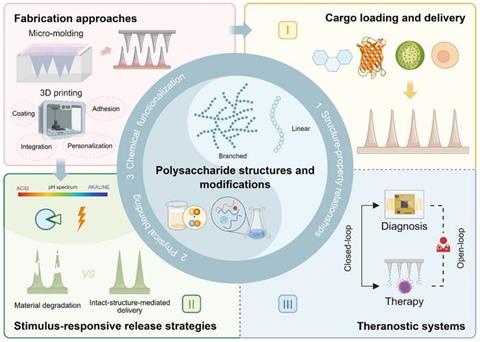
 A graphical representation of the paper‘s structure and key insights. Credit: Xin Luan et al.[/caption]
 Advances in materials science and design
The review also provides an overview of recent progress in polysaccharide materials science. It summarises how the structure–activity relationships of these natural polymers, along with their tuneable physicochemical properties, can be exploited to improve microneedle performance. These advances allow researchers to enhance mechanical strength, control biodegradation rates and design microneedles that respond selectively to tumour environments.
Three interconnected innovations at the materials–device interface are underlined. These include the dual-function design enabled by the intrinsic bioactivity of polysaccharides, advances in precision manufacturing such as 3D printing, and the engineering of microneedles that respond to tumour-associated cues like pH changes or enzymatic activity.
Towards intelligent cancer therapies
Advanced fabrication techniques, particularly 3D printing, are a key frontier in overcoming the limitations of traditional microneedle manufacturing. Such methods allow for precise control over microneedle geometry, improving tissue interaction and drug-loading capacity.
PMNs could lay the groundwork for intelligent drug–device combination systems.
Polysaccharide-based microneedles are a versatile and scalable platform for next-generation cancer immunotherapy. By integrating smart materials with advanced device design, PMNs could lay the groundwork for intelligent drug–device combination systems that deliver more precise, effective and responsive cancer treatments in the future.