



What if the vast amounts of data generated by molecular dynamics simulations could be routinely shared and reused? A new €10 million European initiative aims to do just that, helping researchers gain a deeper understanding of protein behaviour and drug-target interactions.

A major European research initiative aims to bring molecular dynamics into mainstream drug discovery by making simulation data easier to access, share and reuse.
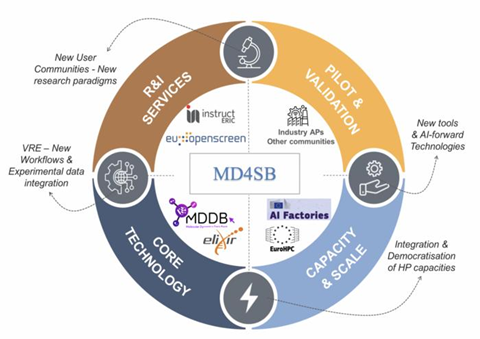
Coordinated by the Institute for Research in Biomedicine (IRB Barcelona), the Molecular Dynamics for Structure-based Biology (MD4SB) project has secured €10 million in Horizon Europe funding. The initiative will integrate molecular dynamics data and tools into major European research infrastructures, supporting structural biology, artificial intelligence applications and drug discovery research across Europe.
The value of molecular dynamics data
Molecular dynamics simulations allow researchers to study how proteins and other biological molecules move, change shape and interact with potential therapeutic compounds. While structural biology techniques such as cryo-electron microscopy and X-ray crystallography provide detailed snapshots of biomolecular structures, molecular dynamics reveals how those structures behave over time.
This information is becoming increasingly important for early-stage drug discovery, where understanding protein flexibility and transient binding sites can support the identification and optimisation of new therapeutic candidates.
However, molecular dynamics simulations generate enormous volumes of data and require substantial computational resources. According to the project team, these challenges have limited broader adoption and prevented many datasets from being reused after their initial analysis.
MD4SB seeks to overcome these barriers by integrating molecular dynamics tools and data into existing European research infrastructures, enabling researchers to access, share and exploit simulation data more effectively.
The initiative builds on previous work undertaken through the Molecular Dynamics Data Bank (MDDB), which developed a distributed platform for storing and sharing molecular dynamics datasets according to FAIR principles, ensuring that data is Findable, Accessible, Interoperable and Reusable.
Supporting structure-based drug discovery
A key objective of the project is to strengthen the role of molecular dynamics in structure-based drug discovery.
Unlike structural biology techniques that capture proteins in a single state, molecular dynamics simulations can reveal conformations and interactions that may not be visible in static structures. This information can support target identification, ligand binding studies and compound design.
To support these efforts, MD4SB will integrate its capabilities into three complementary European infrastructures: Instruct-ERIC for structural biology, ELIXIR for life sciences data and EU-OPENSCREEN ERIC for chemical biology and compound screening.
The project will also work with major supercomputing centres and AI Factories to provide the computing power, storage capacity and analytical tools needed to manage large-scale simulation datasets.
Making simulation data reusable
The project could also support the growing use of artificial intelligence in structural biology and drug discovery. Integrating molecular dynamics data into shared research infrastructures could allow researchers to apply AI tools to larger and more diverse simulation datasets.
According to the consortium, integrating molecular dynamics into major European infrastructures will help ensure that valuable simulation data can be reused across multiple scientific disciplines rather than remaining confined to local servers and individual research groups.
“Now, for the first time on a European scale, MD4SB will integrate this technology into major infrastructures and put it at the service of structural biology, artificial intelligence and drug discovery,” explained Dr Modesto Orozco, head of the Molecular Modelling and Bioinformatics laboratory at IRB Barcelona.
Industry engagement
The pharmaceutical industry is expected to play an active role in the programme.
Several companies, including Almirall and Sanofi, will participate as associate partners, providing feedback on the platform’s practical utility within industrial research settings. The project team says industry involvement will help ensure the platform addresses real-world drug discovery needs.
Nostrum Biodiscovery will also help facilitate adoption of the platform among biotechnology and pharmaceutical companies.
Dr Orozco said: “We want molecular dynamics to become a shared capability for the European scientific community because it can accelerate and expand the scope of many research projects.”
Broadening access to molecular dynamics
By combining expertise in structural biology, data science and high-performance computing, the project aims to make molecular dynamics capabilities more widely available to researchers across academia and industry.
If successful, MD4SB could help make molecular dynamics a more routine part of structural biology and early-stage drug discovery rather than a tool confined to specialist research groups.






No comments yet