


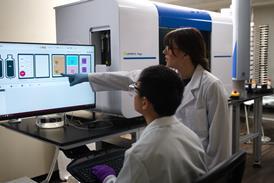
Researchers at Florida State University, in collaboration with Pennsylvania State University and GSK, have developed a photochemical technique capable of converting sulfonamides into anilines.
A light-powered chemical reaction developed by researchers at Florida State University (FSU) could help repurpose otherwise unusable compounds into new building blocks for drug discovery.
The technique transforms sulfonamides, a widely used molecular structure found in several medicines, into anilines, a different class of compounds used in the development of cancer treatments. The approach could give compounds previously considered difficult to repurpose a second chance as starting points for new medicines.
The research, involving Assistant Professor of Chemistry and Biochemistry Bryan Kudisch and collaborators at Pennsylvania State University and GSK, was published in the Journal of the American Chemical Society.
Repurposing difficult-to-modify compounds
During the sometimes decades it takes to develop a drug, thousands of chemical compounds are created that never become medicines. Finding ways to reuse these compounds could give researchers additional starting points for developing brand new treatments.
Sulfonamides are particularly interesting targets because they are among the most important molecular structures in medicinal chemistry. They are associated with sulfa drugs, some of the earliest widely used antibiotics, which were introduced almost 90 years ago.
Today, sulfonamides are present in medicines used to treat conditions including type 2 diabetes, high blood pressure, HIV and melanoma.
However, their chemical inertness makes them difficult to modify. While chemists have developed methods for converting many functional groups into others to alter a compound’s biological properties, options for modifying sulfonamides remain limited.
In particular, removing or replacing the central sulfur atom could allow researchers to create new versions of existing compounds while retaining other useful molecular features.
Kudisch and his collaborators addressed this challenge by developing a photochemical reaction that uses light to remove sulfur from sulfonamides, converting them into anilines.
“This outcome was achieved through a chemical ‘surgery’ that uses light to excise a sulfur atom from a sulfonamide,” Kudisch said. “We’re optimistic these types of photochemical surgical tools could underpin a range of powerful processes for reshaping molecules that could advance the development of new medicines.”
Observing molecular changes in real time
To understand how the transformation occurs, advanced laser spectroscopy techniques were used to evaluate the reaction on a picosecond timescale, equivalent to one trillionth of a second.
“We essentially spy on what the light is doing to sulfonamides,” Kudisch said. “Our research focuses on what photochemistry secrets are encoded in this transformation. We can track the molecules to understand how they transition into structures that eventually become the desired product or unwanted side product.”
The research brought together complementary experimental and computational expertise. Kudisch’s team investigated the reaction mechanism, while Elvira Sayfutyarova’s group at Pennsylvania State University conducted computational studies to explain the underlying chemistry.
Eric Nacsa’s group at Pennsylvania State University found and strengthened the reaction, showing its potential applications and carrying out other mechanistic studies. GSK also contributed by exploring its potential relevance to drug discovery.
“Experimental contributions from the Kudisch Lab at FSU combined with computational work by the Sayfutyarova group at Penn State were critical for understanding the reaction’s mechanism,” Nacsa said. “We anticipate these results and ongoing collaborations with the Kudisch group will provide new fundamental insight into how light can transform molecular structures.”
Expanding chemical tools for drug discovery
The researchers believe the technique could contribute to more efficient drug development by providing new ways to modify molecular structures and generate potential drug candidates.
Although further work will be needed to explore its wider applications, the findings demonstrate how photochemistry could help researchers access previously difficult-to-reach chemical structures.
“We’re just scratching the surface in learning new ways to make, break and remodel molecules to make them do what we want them to do,” Kudisch said. “There are so many fascinating opportunities in modern chemistry as long as you have the breadth of experience to understand how other chemists talk about their research and the depth of expertise to spot the beautiful new questions that come about with every discovery.”






No comments yet