

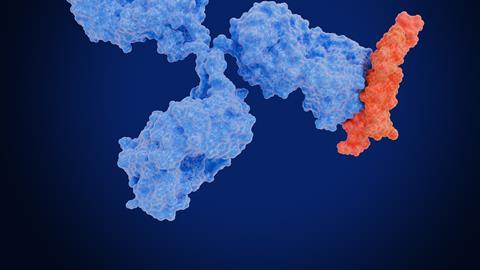

Stronger binding isn’t always better. Dr Teresa Barata of FairJourney Bio explains how researchers engineered a dual-specificity antibody switch designed to control IL-12 activity in tumours.
Affinity is usually the parameter a discovery team pushes hardest to improve, and in single-target programmes that instinct is often correct. Multi-target and switch-based molecules require a different approach to affinity.
However, a recent switch antibody campaign targeting interleukin-12, in which scientists at FairJourney Bio collaborated and performed the antibody discovery and engineering work, is a clean, quantifiable case where the opposite was true. The highest-performing molecule needed one of its two binding arms to bind its second target only weakly, and reaching that specific, deliberately low number was what made the whole therapeutic concept work.
Three decades of trying to widen a narrow window
Interleukin-12 (IL-12)’s clinical history is a long-running lesson in the gap between potency and tolerability. Early trials of recombinant human IL-12 were halted after severe, immune-related toxicity emerged despite genuine antitumour activity. Reported nearly thirty years ago, this result remains the reference point for why systemic IL-12 dosing is still largely off the table.1,2 The cytokine’s biology has not changed since.
What has changed is the range of engineering strategies available to work around the toxicity rather than around the biology itself. Intratumoural plasmid electroporation was an early attempt to keep IL-12 local by controlling where it was produced.3 Half-life extension through Fc fusion took the opposite approach, accepting systemic exposure but smoothing it into a tolerable range,4 while albumin-linked cytokine formats pursued a similar pharmacokinetic logic.5
More recent work has targeted activation itself, engineering IL-12 variants that only become active once they reach the tumour, either through tumour-triggered conformational change or through fusion to antibody fragments that localise the cytokine before it is unmasked.6,7 Each strategy treats a different variable, exposure, half-life, location or activation state as the lever to pull. None builds in a mechanism for the cytokine to switch back off in the event it drifts back into systemic circulation after activation.
Why reversibility is the harder design target
Building a two-way switch requires an antibody fragment that can occupy two different binding states depending on its environment, rather than one that undergoes a single, permanent change. Dual-specificity fragment antigen-binding (Fab) engineering has made this possible in recent years – most visibly in two-in-one antibody formats that bind two unrelated antigens through the same variable domain,8-10 and in dual-specificity T-cell engagers designed to improve tumour infiltration.11
Almost all published work to date describes cis-activation architectures, in which a first binding event on a target cell exposes a ligand for a second receptor on that same cell. A transactivation design, in which switching is controlled by an antigen entirely unrelated to the therapeutic cargo and located elsewhere in the tissue, is far less explored since it requires the two binding events to compete against each other rather than cooperate.
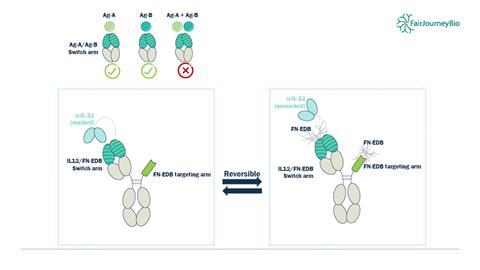
The study by Kahn, J.D. et al (2026) describes a novel IL-12 programme whereby a dual-specificity Fab – the switch arm that binds either IL-12 or the tumour matrix antigen fibronectin extra domain B (FN-EDB) in a competitive fashion – is paired with a separate targeting arm that binds FN-EDB alone with high affinity.12 In systemic circulation, the tethered IL-12 stays masked. In the tumour, the targeting arm draws the molecule onto FN-EDB, and the switch arm is drawn along with it creating an avidity binding opportunity for the FN-EDB binding conformation, thereby releasing IL-12 in trans.
The number that mattered, and where it came from
Before a single antibody in this programme was generated, the programme’s collaborators in quantitative systems pharmacology defined, computationally, the binding affinities a switch would need to achieve a meaningful improvement in therapeutic window. This work sat outside the antibody engineering team’s realm of responsibility, and it deserves acknowledgement as its own distinct discipline rather than folded into the engineering story. What it produced is worth any antibody engineer’s attention.
The model’s output ran against instinct. It specified that the switch arm should bind IL-12 tightly, at a dissociation constant of roughly 0.27 nanomolar, but bind FN-EDB only weakly, at 160 nanomolar, while the separate targeting arm carried high affinity for FN-EDB, at 0.5 nanomolar.12 A team optimising purely for function may have tended to push the switch arm towards tight binding on both fronts. That instinct would have undermined the mechanism.
If the switch arm bound FN-EDB tightly in its own right, it would compete with, rather than yield to, the avidity effect that the targeting arm was meant to provide, and the reversible handoff the design depends on would not occur within an effective therapeutic window. This is the part of the story that generalises beyond IL-12: the model did not simply say ‘tune the affinities’, it specified an asymmetry that only makes sense once the competitive mechanism is understood – one that would be easy to accidentally work against if affinity were treated as a single dial turned in one direction.
Closing the gap between a modelled target and a real molecule
Hitting a modelled affinity target and generating a molecule that actually reaches it are different problems – the second being where most of the engineering difficulty sat. Introducing a new specificity into an existing binder scaffold, while trying to hit a precise, non-maximal affinity value rather than the tightest binding achievable, is a harder search problem than conventional affinity maturation because the objective is a target window rather than a ceiling.
Hitting a modelled affinity target and generating a molecule that actually reaches it are different problems.
The earliest dual-specificity clones identified were nowhere near that window. Reaching it required a staged strategy: broadening the search across diversified antibody scaffolds to find a starting point with the right qualitative behaviour, two parallel rounds of targeted affinity maturation to bring both binding events into range independently, and a final, small set of rationally designed variants, guided by structural and sequence data, to close the remaining gap.12
The engineering did not stop once affinities were in range. Producing molecules that carried two distinct arms on the same antibody backbone brought its own recurring challenge. Heterodimeric switch molecules of this kind do not separate cleanly from unwanted homodimeric by-products through standard protein A capture and size-exclusion chromatography alone. An additional ion-exchange step was needed, with a gradient optimised for the specific molecule, to reach adequate purity, and identity had to be confirmed independently by intact mass spectrometry before any binding or functional data could be trusted.12
If the identity or purity of a switch molecule has not been confirmed, the resulting binding and functional data may be unreliable, regardless of how carefully the upstream affinity engineering was performed. It is also worth noting precisely what has and has not yet been shown. Human IL-12 does not cross-react with the murine receptor, and while humanised IL-12 receptor mouse models exist, they do not fully recapitulate human IL-12 biology, so quantitative systems pharmacology modelling was used in their place. Everything beyond the in vitro binding and functional data described here is therefore a model’s projection, not yet an observation in a living system.
Where this points next
The molecule that most closely matched the model’s target affinity was not the molecule that showed the cleanest unmasking behaviour in functional assays. An earlier, lower-affinity variant showed more complete release of IL-12 in the presence of FN-EDB than did the higher-affinity, model-matching candidate.12
The likely explanation is that higher IL-12 affinity raises the energetic threshold required for the switch arm to release its cargo, an effect compounded by a laboratory assay that could not fully replicate the antigen density found in real tumour tissue. Hitting the specification and achieving the best empirical behaviour are related but not identical goals, and that gap is itself the more durable lesson here.
The point worth carrying forward is how modelling and antibody engineering teams work together, not simply IL-12. A quantitative model can define the shape of a solution before a single binder exists, including asymmetries that would be difficult to reach through wet-lab intuition alone.
A quantitative model can define the shape of a solution before a single binder exists, including asymmetries that would be difficult to reach through wet-lab intuition alone.
But the model is only as useful as the engineering campaign’s ability to hit the number it specifies, and hitting it involves scaffold selection, library design, purification strategy and rigorous characterisation, each with failure modes for which no modelling accuracy can substitute.
The same modelling work enabled Kahn, J.D. et al (2026) to see, after the fact, which specific design features were actually doing the work,12 Isolating each element in turn showed that masking of IL-12 in circulation was necessary for any positive therapeutic index at all, while avid engagement of the tumour antigen by both arms was what preserved activity once the molecule reached the tumour. Neither finding was obvious in advance, and both are the kind of insight that only becomes available once a mechanism has been built and interrogated as a whole, rather than assumed.
There is genuine potential in extending this transactivation switch architecture to other potent immunostimulatory cytokines – and other proteins constrained by systemic toxicity rather than by a lack of biological activity – and in testing these designs in systems that better replicate the antigen density of real tumours than standard in vitro assays currently allow.
This marks one demonstration of a broader principle now available to antibody engineers: that a molecule’s binding behaviour can be specified, deliberately and asymmetrically, to fit a mechanism rather than to maximise every interaction it makes. Cytokines beyond IL-12 carry the same shape of problem: immense biological potency constrained by an inability to confine it. It can be expected that transactivation switches of this kind will be tested against several of them in the years ahead.










No comments yet